


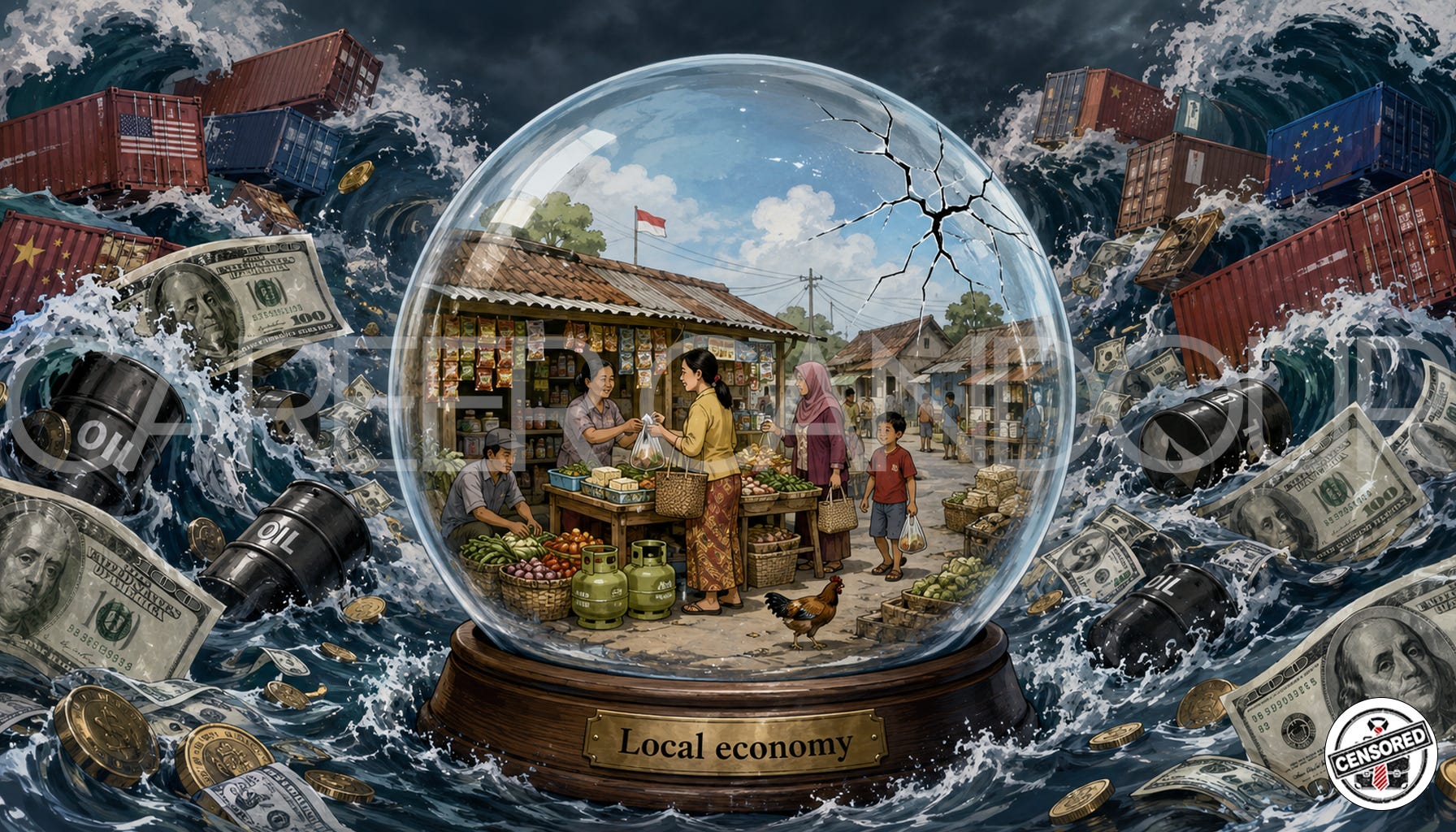
The rupiah has been weakening, Bank Indonesia has been trying to steady it, and the cost of import-dependent essentials has begun to remind everyone that global markets do not accept domestic political reassurance as payment. Into this came the soothing observation that ordinary Indonesians do not spend U.S. dollars. They spend rupiah. Therefore, apparently, the rupiah’s value against the dollar is not something people should worry about too much.
Well. Thank goodness.
Somewhere near a village market, an entire chain of people whose lives are shaped by imported costs must have wondered why nobody told them the problem could be solved by looking only at the currency printed on the receipt.
The argument is not completely false. Indonesians do spend rupiah. Nobody is suggesting that a grandmother buying tempeh checks the Federal Reserve’s mood before deciding what to cook for dinner. Nobody thinks an ojek driver fills his tank by refreshing a foreign-exchange chart.
But that is not the point.
The point is that the currency used at the end of a transaction is not the same thing as the currency pressures embedded at the beginning of it. A person may pay in rupiah, but the things they buy often carry costs shaped by the world outside Indonesia: import dependence, energy exposure, shipping costs, foreign debt, and the government’s own efforts to stop global prices from arriving too violently at the household level.
That does not mean every price moves instantly or that every citizen needs to become a currency analyst. It means only that Indonesia is not sealed off from the rest of the world by the fact that warungs do not accept dollars.
The rupiah matters because the world matters. The dollar matters because much of that world is still priced, financed, or benchmarked through it. And even when the final transaction happens in rupiah, the chain behind that transaction often began somewhere else, in a currency Indonesia does not control.
The Price Tag Hides the Exchange Rate
The easiest way to misunderstand an exchange rate is to begin and end with the consumer. A person walks into a market, buys tempeh, pays in rupiah, and leaves. No dollars were exchanged.
From that narrow angle, the argument almost works.
But the economy does not begin at the market stall. By the time the customer pays, the cost has already travelled through a chain of farmers, importers, processors, transporters, distributors, and sellers, each of whom has had to deal with costs that may be directly or indirectly linked to foreign currency. The customer sees the final price because the customer is at the end of the chain, but that does not mean the earlier links were imaginary.
Soybeans make the point well because they are ordinary. They are not a luxury import; they are the basis of tofu and tempeh, two foods central to daily life. If the imported input becomes more expensive because the rupiah buys fewer dollars, the pressure eventually has to go somewhere. It may be absorbed for a while by traders, reduced through margins, disguised through smaller portions, softened by government action, or passed along in the price. But it does not vanish because the final buyer pays in rupiah.
That is the basic flaw in the cash-register argument.
A shop may price everything in rupiah because it exists in Indonesia and would like customers to understand the label. But the price itself is still shaped by what it costs to produce, import, transport, store, and finance the goods being sold.
This is why exchange-rate depreciation often feels mysterious to ordinary households. There is not always a single moment when the public sees the currency fall and the price rise at the same time. The pressure moves slowly. It enters through wholesale contracts, fuel costs, imported inputs, and business expectations before it finally appears as a smaller serving, or a seller apologetically explaining that everything has gone up again.
The more import-dependent the economy is in essential areas, the more this matters. That does not mean every product is imported, or that Indonesia lacks domestic production. It means that a weaker rupiah raises the local-currency cost of the foreign parts of the economy, and those foreign parts are embedded deeply in everyday life.

Subsidies Hide the Pressure Until They Can’t
One reason this issue can be softened is that the government can stand between global prices and domestic households. It can subsidise fuel, cushion electricity, and slow the pass-through from a weaker currency to the prices people see. In a country where energy and transport costs shape the price of everything else, sudden exposure to global markets can be socially brutal.
When the rupiah weakens, imported energy and other globally priced necessities become more expensive in local currency. If the government chooses to keep household prices stable, the cost moves onto the state budget. Consumers may be protected at the pump or in the kitchen, but the pressure has not disappeared.
A government can spend heavily to prevent the public from feeling the full effect of currency depreciation, then point to the public not yet feeling the full effect as evidence that currency depreciation is not very important.
Subsidies can be justified. They can be necessary. But they are not magic. They require money, and money spent insulating consumers from exchange-rate pressure is money that cannot be used elsewhere, unless the government borrows more, cuts something else, or leans on state-owned companies to absorb the strain.
Governments are very good at making unsustainable things look manageable right up until the meeting where everyone suddenly starts using phrases like “reprioritisation” and “fiscal discipline.”
A surplus can cushion the early stage.
A budget can absorb some shocks.
A political system can postpone difficult choices.
But if the currency keeps weakening, and if global prices do not cooperate, the cost of pretending grows.
This is especially true when the government is already pursuing expensive programmes. A state can do many things, but it cannot permanently subsidise imported pressure, fund every flagship promise, defend purchasing power, preserve investor confidence, and maintain the appearance that none of this is connected to the exchange rate.
Sooner or later, the cost must be paid through higher prices, higher taxes, higher borrowing, lower spending elsewhere, weaker public balance sheets, or some combination of the above.

If Bank Indonesia Cares, So Should We
If the exchange rate were truly unimportant to daily life, Bank Indonesia would have an easy job. It could let the rupiah wander wherever it pleased, and reassure everyone that villagers use local currency.
Instead, the central bank behaves as though the exchange rate matters because, inconveniently, it does.
A weakening currency can force a central bank into a difficult position. If it does too little, depreciation can feed inflation, weaken confidence, and make investors wonder whether the currency has more falling left to do. If it does too much, it may need to tighten financial conditions, use reserves, or keep interest rates higher than the domestic economy would otherwise prefer.
If currency pressure contributes to higher interest rates, the effect spreads through the domestic economy. Business loans become more expensive, investment becomes more cautious, and consumers find that credit is less forgiving. A small business owner does not need to understand foreign-exchange intervention to be affected by the cost of working capital.
The “people spend rupiah” argument treats currency as a matter of what appears in someone’s wallet, when the more important question is how the value of that currency impacts the conditions around them. The rupiah is an indicator of confidence, purchasing power, and external pressure. When it weakens sharply, institutions need to respond.
There is also a psychological dimension, which economists prefer to call expectation.
If businesses expect the rupiah to keep weakening, they price more cautiously.
If importers expect costs to rise, they adjust earlier.
If investors expect instability, they demand higher returns or move money elsewhere.
If households begin to distrust future prices, they change behaviour too.
That is the problem with currency weakness. It can become self-reinforcing because everyone is trying to protect themselves at the same time. The central bank then has to act not only against current depreciation but against the possibility that depreciation becomes an expectation embedded in prices, contracts, and behaviour.

Indonesia Does Not Trade With Itself
Indonesia’s geography can tempt people into a narrative of self-containment. It is vast, with a large domestic market, and abundant natural resources.
A country can be resource-rich and still dependent on imported energy in key areas.
It can produce food and still rely on imported inputs.
It can manufacture domestically and still need foreign machinery, components, finance, or technology.
Modern economies are not judged by whether they can point to domestic activity somewhere in the chain; they are judged by how exposed they are when the foreign parts of that chain become more expensive.
This is where the dollar matters, but also where the dollar is only part of the story. The dollar remains central to global trade and finance, so a weaker rupiah against it raises the cost of many things Indonesia buys or owes. But Indonesia’s currency does not exist only in relation to Washington. Its value against regional and global currencies also affects competitiveness, travel, education, investment, and the cost of doing business with the countries around it.
If the rupiah is weak against a currency that has itself had uneven moments, the comparison with stronger currencies can be even less flattering. But the deeper issue is purchasing power. How much can the rupiah command outside Indonesia? How expensive does the rest of the world become when measured in local income?
That question matters for households more than they may realise. A family may never think about the Singapore dollar, the Malaysian ringgit, or the pound, but the economy around them does. Students, travellers, businesses, importers, investors, hospitals, manufacturers, and government agencies all interact with foreign prices in one way or another. A weaker rupiah narrows the country’s purchasing power beyond its borders.
There is a fair counterargument that currency depreciation can help exporters by making Indonesian goods more competitive abroad. This is true. A weaker currency can support certain sectors if they earn foreign revenue and have enough domestic cost advantages. But this is not a magic national offset. The benefit depends on what is being exported, how much imported input is used to produce it, and whether the gains are broad enough to outweigh the pressure on consumers and the budget.
A weaker currency is helpful only if the economy is structured to benefit from it more than it suffers from it.
This is the problem with treating depreciation as harmless. It assumes a version of Indonesia that is more self-sufficient, less import-exposed, less financially connected, and less vulnerable to global pricing than the real one.

What Happens If the Weakness Continues
The danger of currency depreciation is that it works slowly.
At first, the effects are manageable.
Businesses absorb some costs.
The government cushions key prices.
Consumers grumble but adjust.
Officials explain that the situation is under control.
But if weakness continues for twelve months or more, the pressure becomes harder to contain.
Import-dependent prices do not need to explode to hurt households; they only need to keep rising faster than incomes.
Subsidies do not need to collapse to strain the budget; they only need to keep consuming space that could have gone elsewhere.
Interest rates do not need to choke the economy completely to make businesses delay investment or households think twice before borrowing.
The cumulative effect is the point. A single price increase can be explained away. A year of them becomes a living standard issue.
For ordinary Indonesians, this will appear as the same amount of money doing less.
A meal costs a little more.
Transport feels less forgiving.
A household purchase gets delayed.
A business owner becomes cautious.
The government can continue to manage some of this, but management becomes more expensive the longer the pressure lasts. At some point, policy choices become more difficult.
Allow prices to rise and households suffer.
Spend more and the budget suffers.
Tighten policy and growth suffers.
Do nothing and confidence suffers.
The art of economic management is choosing which discomfort arrives first and what name to give it.
This is why the exchange rate matters even when there is no dramatic collapse. In fact, that is exactly why it matters. A slow decline in purchasing power can be politically easier to deny than a crisis, but it becomes embedded in expectations, business decisions, and wage demands.
The danger is not that every Indonesian wakes up one morning needing dollars. The danger is that the rupiah they already use becomes weaker in the world that supplies, finances, and prices too much of what their economy depends on.

Yes, Indonesians spend rupiah. That was never in dispute. The question is what forces shaped the price before goods get to the checkout counter. In a country connected to global supply chains, dependent on imported essentials in key areas, exposed to foreign finance, and reliant on subsidies to soften politically sensitive costs, the exchange rate is one of the prices that determines how pressure moves through the economy.
A weaker rupiah raises the cost of what Indonesia must buy from abroad, complicates the state’s effort to shield households, forces difficult choices on the central bank, and gradually erodes purchasing power in ways that ordinary people may feel long before they name the cause.
The dollar comparison matters because the dollar remains central to global trade and finance, but the broader point is even larger than USD/IDR. The rupiah’s value against the world matters because Indonesia is part of the world. It buys from it, sells to it, borrows from it, competes with it, and depends on it in ways that cannot be wished away by noting that local transactions are local.
At StratEx - Indonesia Business Advisory provides Indonesia-focused advisory and leadership intelligence for investors that need to understand what is really moving beneath the surface. Contact us for better visibility before making your next move in Indonesia.