


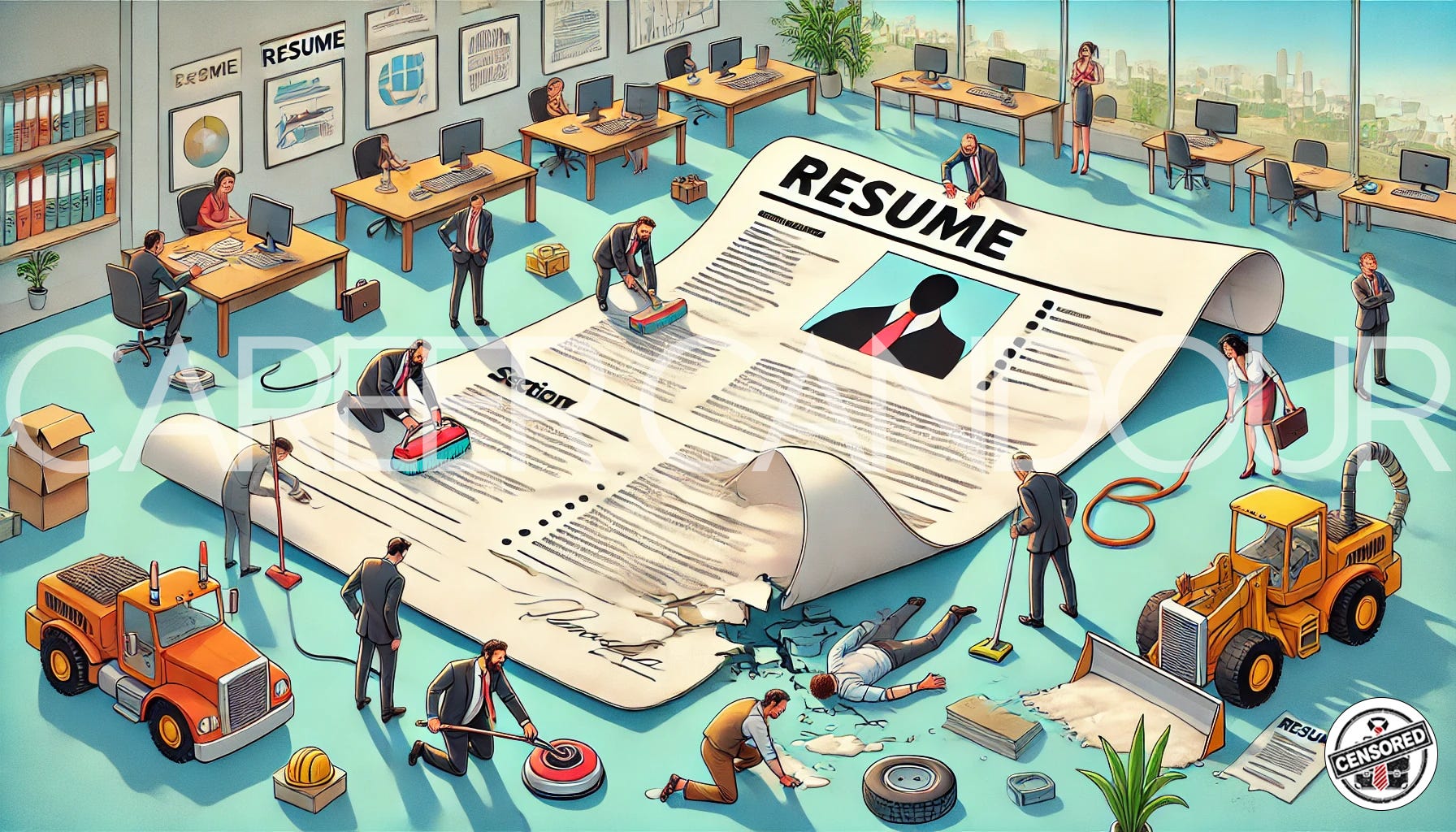
At any given moment, approximately 38% of the global workforce is Googling “CV template PDF.”
OK. Well, not really. I made that number up.
But many professionals are indeed hoping that a serif font, three tidy bullet points, and the phrase “cross-functional synergy facilitation” will convince a recruiter they are not simply improvising their career.
This is where the CV rewriting service industry enters the chat. A multi-million dollar ecosystem built around the virtuous mission of copying and pasting job descriptions into your experience section and hoping nobody notices.
These services promise transformation. They promise expertise. They promise to “elevate your professional narrative.”
What you usually receive is a document that sounds impressive while saying almost nothing. Think:
Generic achievements.
Responsibilities lifted from job descriptions.
Phrases like “strategic leadership” and “stakeholder alignment.”
Because here’s the dirty secret the industry doesn’t want you to know:
You can’t fix a CV by rewriting the CV.
You fix it by reconstructing the thinking behind it. Most people remember only fragments of what they actually accomplished. Projects blur together. Impact disappears. Achievements shrink in memory until they resemble routine tasks.
Recovering that detail requires something far more radical than Grammarly Premium or ChatGPT. It requires:
a deep, structured, professional conversation with someone who understands hiring, interviews, and senior roles well enough to pull the real story out of you.
In other words, someone who knows how to dig… and the difference between activity and impact.
The Modern CV Rewrite Industry
Walk into any budget CV service and the process goes something like this:
You submit your CV
A “professional writer” (who may or may not have been a barista three days ago) opens it.
They stare at it for 45 seconds.
If the CV says you managed something, it can be improved by saying you strategically managed it.
Responsibilities are lifted from job descriptions and repositioned as achievements.
Sentences are extended.
Words like “oversaw,” “led,” and “delivered” are applied liberally.
Voila! Your career is now, apparently, reimagined.
What has actually happened is linguistic inflation. The substance of the experience remains unchanged while the language surrounding it becomes increasingly elaborate. You now:
Oversaw operational optimisation.
Drove cross-functional synergies.
Leveraged stakeholder alignment processes.
Enabled enhanced enablement enabling.
These phrases sound impressive while communicating almost no information. Recruiters have developed a survival instinct around them. After reviewing thousands of resumes, their brains begin to filter this language automatically, much like background noise.
In fact, research on resume evaluation consistently shows that generic wording and buzzwords degrade recruiter attention, depress hireability, and lead directly to job seekers screaming into pillows across multiple continents.
But CV rewriting services press on, undeterred, because nothing says “I understand senior leadership roles" like a freshly pasted list of duties that 1,482 other applicants have also submitted this morning.

The Limits of “CV Rewriting”
Let’s address the blunt thesis directly.
A CV cannot be rewritten based solely on the CV.
Correct. Scientifically defensible.
The idea that a weak CV can be transformed purely through editing assumes the information already sitting on the page contains everything needed to build a compelling professional narrative. In reality, most CVs are closer to skeletal outlines than complete records of experience.
They contain fragments.
Job titles.
Responsibilities.
What they usually do not contain is the substance that hiring managers actually evaluate. The real material lives in the context behind the work.
The full story of the project.
The decisions made under pressure.
The business outcomes that followed.
The stakeholders who needed convincing.
The scale of responsibility and the ambiguity that came with it.
Most professionals never document these details. They were busy delivering the work rather than narrating it.
This is why rewriting alone fails. Polishing vague responsibilities does not magically produce evidence of leadership or impact.
Studies consistently show that structured, achievement oriented resumes improve hiring outcomes.
Candidates with clear evidence of results and measurable contributions receive stronger evaluations and better salary offers.
The key word here is evidence.
The real value lies in the process of knowledge construction. When candidates work with experts who help them:
reconstruct their experience
connect their achievements to business outcomes
identify implicit leadership behaviours
quantify impact
articulate complexity
…their employability skyrockets.
In other words:
The resume is the artifact.
The interview is the intervention.
CV rewriting services fix the artifact.
Professionals fix the human.
Guess which one produces long-term results?

Finding the Story Behind the Work
Let’s talk about the one thing many CV rewriting services avoid:
The professional, structured, deeply probing career interview.
This is where the magic happens. Not with templates. Not with formatting. With questions. Questions supported by meta-analyses, qualitative studies, and every competent career expert who has ever looked another human in the eye and asked:
“Okay, but what did you actually do?”
Suddenly, achievements that never made it into the original CV, tend to pour out like someone turned on a fire hose:
“Oh, well I did lead a £3M transformation programme, but it was just part of the job.”
“I suppose I negotiated that partnership across three regions, though the legal team handled the paperwork.”
“Yes, technically the project stopped us losing our largest client, but the whole team was involved.”
This pattern appears constantly. People understate their impact. They compress complex work into modest descriptions. Achievements fade in memory because the person experiencing them was focused on delivery.
The structured interview exists to rescue your accomplishments from the basement of your psyche.
Career counseling research says that talking about your work makes you better at getting work. Meta analyses show that guided career conversations improve:
job search self efficacy,
career clarity,
decision making ability.
confidence in pursuing senior opportunities.
When professionals narrate their work in detail, they begin to see patterns.
Leadership behaviours emerge.
Strategic thinking becomes visible.
Business outcomes connect to individual actions.
This matters even more at senior levels. because hiring managers evaluating leadership roles are not scanning for tasks completed. They want evidence of:
scope
ambiguity
influence
scale
leadership
problem-solving in political environments
strategic outcomes
None of which show up in most preexisting CVs because candidates tend to write resumes like they’re reporting a mild nuisance to an insurance company.
Not because the experience does not exist, but because no one has taken the time to draw it out.
You do not extract this information from a Word document.
You extract it from a person, through a skilled interviewer, using structured methods that pull out the “nooks and crannies” of real achievement.

What AI Can and Cannot Fix
Recruiters now receive waves of resumes that sound remarkably similar.
Page after page arrives declaring:
“an unparalleled passion for innovation”
“excellence in strategic execution”
“a proven track record of delivering world-class cross-functional results”
In aggregate, these phrases begin to resemble a script that thousands of candidates are reading from simultaneously.
AI itself is not the problem. The problem is how it is used. Many job seekers treat it like a magic wand instead of a power tool.
One well known study on AI assisted writing found that AI tools that correct grammar, tone, and clarity improved hiring outcomes by approx. 8%
Eight percent is nice. It suggests that cleaner writing helps candidates present themselves more effectively. But eight percent is not transformation.
AI cannot:
contextualise your achievements,
extract leadership behaviours,
articulate ambiguity,
model strategic reasoning,
explain why you actually mattered.
AI is a multiplier. If you give it garbage, it multiplies garbage. If you give it a rich, deeply explored narrative of your experience, it can polish it beautifully.
Unfortunately, most CV rewriting services and job seekers opt for the former.
Because AI generated resumes are now indistinguishable from each other, major employers are experimenting with filters that:
detect over-templated content
reject generic achievements
penalize resumes with overly polished “AI signature wording”
Ironically, some of these filters are powered by the same technology that produced the resumes in the first place.
In other words:
Candidates generate AI resumes.
Recruiters deploy AI to filter AI resumes.
Meanwhile, the applicants with unique, specific, clearly articulated achievements?
They’re sailing through.

Most CV rewriting services don't work because they start at the wrong end of the problem.
They believe the CV is a document.
But the CV is a diagnostic output of a deeper human process.
When that underlying process is weak, the document that emerges from it will also be weak.
You cannot create a high-impact CV by:
editing what already exists
inserting generic “achievements”
running the text through AI for spice
None of that changes the fundamental problem. The substance of the story has not improved.
You create a high-impact CV by:
deeply exploring your actual accomplishments
reconstructing the strategic value of your work
understanding the complexity of the roles you target
articulating your impact in language appropriate for senior hiring
using expert guidance to unearth the evidence hidden in your own head
This is the step many services skip because it requires time, expertise, and uncomfortable levels of curiosity. It means asking questions until vague memories become clear examples.
You do not simply rewrite a CV.
You reconstruct the understanding behind it.
And once that understanding changes, the document almost writes itself.
At Career Candour we work 1:1 with professionals to rebuild CVs from the ground up. Your real experience. Your impact. Your value. Built through a deep, no pressure interview. Doesn’t matter how good you are if no one can understand it in six seconds.. Want this done properly? DM us.
Exactly.
Interesting. And true. Something many miss is the need of CVs that AI ready. I often see beautiful documents built up to impress a human reader. The intention is correct, but misses the reality: humans reading CV are disappearing. Machine do it in first place and, often the last chance. I believe job seekers should focus on content and forget the layout altogether.
A simple text document with clear narrative, skills pattern and how they have been learned. Experience and achievements.
We at Noesis Hiring created a ARM software capable to comprehend context and categories ditching completely the keywords matching of ATS.
But also this top hedge solution can struggle with beautifully layouts risk missing elements that may be relevant.
The good point is that our model requires applicants to verify and validate the cv assessment.
My two cents: save money, don’t pay someone to improve your CV. Collect on a white document everything you achieved, what you went through, what hurt you and what made you who you are. Each experience with more details possible.
Then ask Claude to organise it. NOT TO INFLATE. Just reorganise and rewrite it with smoother narrative and clear skill and achievements
Be sure to avoid stuffing with keywords, descriptions exaggerated and unsupported skill claimed out of context.
10 pages? Fine. 20 pages? Ok don’t think a person will feel overwhelmed by it. It simply won’t happen if the machine doesn’t get the clear picture by the document informs against mandatory requirements.
For more information visit Noesishiring.ai
The job market should work from the people to people.