


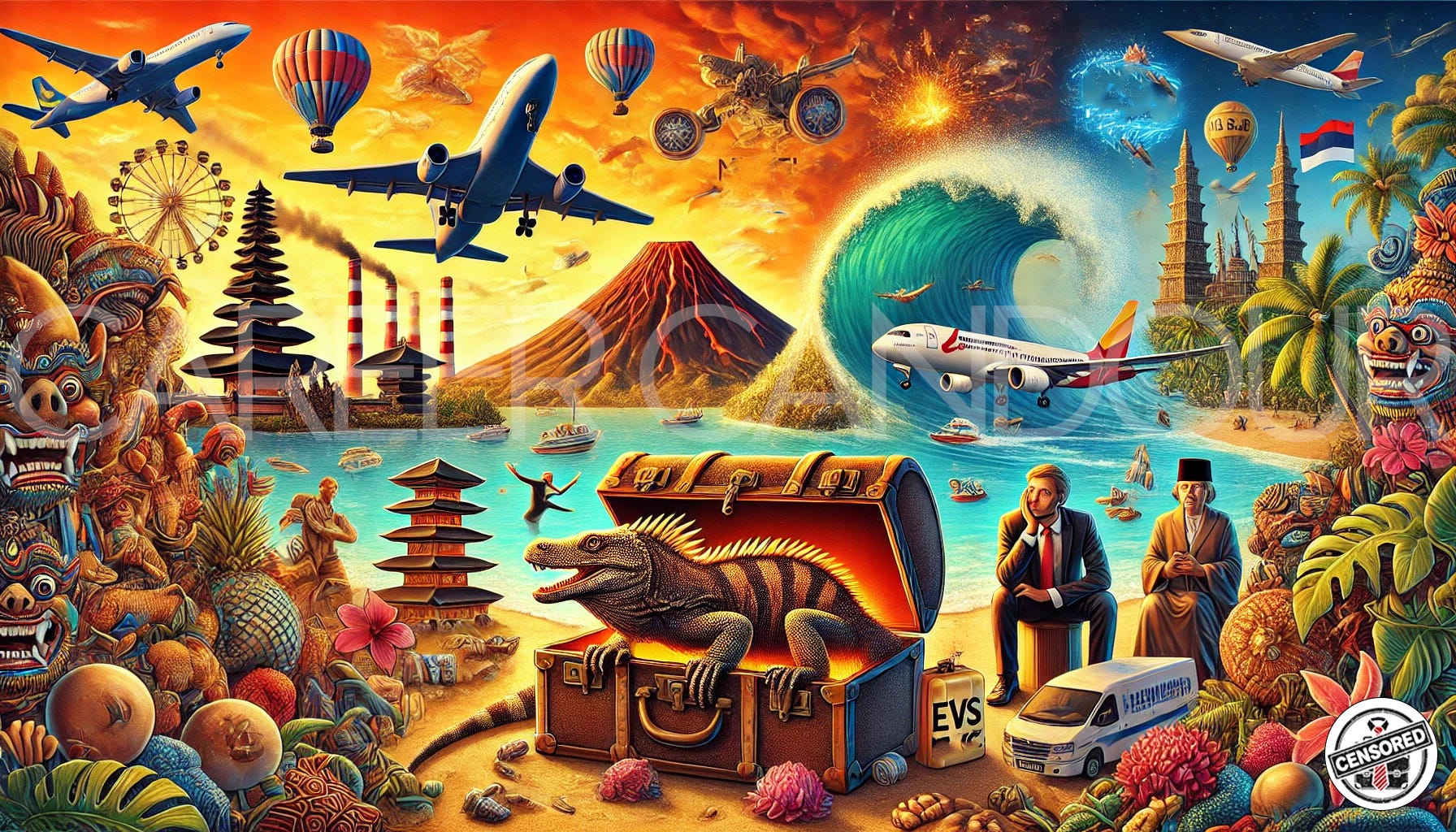
Southeast Asia is home to 11 countries, several thousand islands, and an uncountable number of tourism slogans promising turquoise water, smiling locals, and authenticity that has been carefully focus-grouped. In that context, one country appears almost unfairly endowed. Indonesia is not just scenic. It is obscenely scenic. The kind of place that makes geography feel rigged.
World-class diving? Indonesia.
Surf breaks that appear in surf mythology? Indonesia.
Active volcanoes you can hike before breakfast? Indonesia.
Bali, a brand so strong it sometimes forgets it is part of a country? Also Indonesia.
And yet, when the numbers are counted, Indonesia lands somewhere in the middle of the pack With roughly 13.9 million international visitors in 2024, it sits behind Vietnam, Malaysia, and far behind Thailand, which attracts more tourists in a year than Indonesia does excuses for why this is complicated.
This gap is not trivial. Indonesia is vast, famous, and visually unmatched, yet it performs like a country still warming up.
Is Indonesia quietly sitting on one of the world’s most underused economic advantages while focusing its attention elsewhere. And if so, is tourism the most obvious natural resource it has yet to seriously mine.
How a Country With Everything Ends Up With “Meh” Tourism Numbers
The initial reaction to Indonesia’s tourism data is disbelief. Indonesia is loudly, unambiguously beautiful. By almost any metric people use to justify travel, scenery, culture, food, biodiversity, Indonesia overdelivers. And yet, when the scoreboard comes up, it sits awkwardly in the middle of the table.
Thailand has turned tourism into a precision instrument. It is optimized, routinized, and scaled to a level that resembles industrial output. Thirty five million visitors is not an accident. It is the result of decades of intentional policy, infrastructure, and ruthless focus on friction reduction.
Malaysia benefits from geography and frequency. Millions of its visitors are regional, short stay, and repeat travelers. The numbers are inflated by land borders and convenience, but the system works. Malaysia welcomes them, counts them, and monetizes them.
Vietnam is the most uncomfortable comparison. It lacks Indonesia’s natural abundance but compensates with simplified visas, improved connectivity, and marketed itself relentlessly. It treated tourism like a growth sector. The result is a country that now outranks Indonesia on international arrivals with a fraction of the geographic complexity.
Indonesia, by contrast, has allowed Bali to become both its crown jewel and its crutch. Bali absorbs global demand while the rest of the country waits in a holding pattern. Lombok, Lake Toba, Yogyakarta, Labuan Bajo, Raja Ampat all exist in theory, in brochures, and in long term plans. In practice…
Indonesia behaves like a country unsure whether it wants mass tourism, premium tourism, or no tourism at all.

A Love Letter to Geography, Governance, and Chaotic Planning
Indonesia is not one place. It is many places separated by water, weather, logistics, and cost. Geography alone imposes a permanent tax on tourism scale. Vietnam and Thailand benefit from physical continuity. Once a visitor arrives, movement is cheap, and intuitive. Indonesia demands commitment. Each additional destination often requires another flight, another transfer, another decision point where travelers ask themselves if this is worth it.
What should be a two week multi stop holiday becomes a test of planning stamina. So instead, visitors concentrate in Bali, where the infrastructure, branding, and global familiarity reduce uncertainty.
Then there is bureaucracy. Indonesia’s entry process is not catastrophic, but it is layered. Multiple systems, overlapping requirements, shifting rules, and digital tools that sometimes feel as though they were stress tested exclusively on interns. Compared to Vietnam’s streamlined e visa or Thailand’s near philosophical embrace of visitor convenience, Indonesia feels hesitant.
Bali’s success adds another distortion. When one destination performs this well, it absorbs attention, investment, and urgency. Other regions wait their turn. Plans are announced, revised, renamed, and delayed.
Overlay this with a decade of national focus on extractive industries and industrial policy. Nickel, smelters, EV supply chains, and megaprojects dominate political bandwidth. Tourism becomes important, but never urgent.
Then Covid happened. Bali’s collapse was visceral. The lesson taken was caution. Avoid dependence. Diversify at all costs. Sensible logic, but it also froze ambition.
Indonesia is not behind because it cannot compete. It is behind because it has not fully decided that tourism deserves to be treated like a core economic engine rather than a useful side effect of having nice places.

The Case for Indonesia Becoming the Tourism Superpower It Was Born to Be
Indonesia should already be competing with Thailand for the top tourism slot in Southeast Asia. Not eventually. Not aspirationally. Already. The asset base is diverse, and globally distinctive in a way very few countries can replicate.
World-class diving (Raja Ampat alone is unfair to the rest of Earth)
World-class surfing (Mentawai, Lombok, Sumbawa)
Volcanoes (Bromo, Ijen, Rinjani)
Cultural heritage (Borobudur and Prambanan are literally UNESCO sites)
Nature (Komodo dragons are living dinosaurs! What more marketing do you want?)
Cities (Jakarta’s chaos is a niche product, but a product nonetheless)
Sheer scale (17,000 islands, 300 ethnic groups, 700 languages)
And yet… 13.9 million visitors.
When Malaysia outperforms Indonesia by more than ten million arrivals a year, the problem is structural, and ‘untapped opportunity’ starts looking like misallocation.
This matters because:
Indonesia’s historical strengths in natural resources face long term uncertainty.
Manufacturing, once the reliable escalator for developing economies, is increasingly automated.
Tourism stands apart as one of the few large scale service exports that is inherently local and resistant to automation.
You cannot outsource a sunrise on Bromo or replicate a Komodo encounter with software. These experiences cannot be streamed, cloned, or optimized away. They require presence, place, and people.
That is Indonesia’s real comparative advantage. Not nickel, not smelters, not industrial parks. Experience. And right now, that advantage is being used far less than it could be.

A Reasonable 5-Year Plan That Will Almost Certainly Be Ignored
Indonesia could fix much of this. Not instantly, but realistically. Five years is enough time to meaningfully change trajectory if the intent is serious and execution follows words.
1. Make Visas As Easy As Vietnam
Vietnam demonstrated that a simple, generous e-visa regime can move numbers quickly. Indonesia does not need innovation here. It needs imitation. A clean 60 to 90 day multi entry e-visa for priority markets would remove hesitation at the decision stage. Tourism grows when saying yes is easy.
2. Focus
Announcing ten new priorities guarantees none of them are actually prioritized. Indonesia needs three or four destinations that receive relentless attention. Pick the winners:
Lake Toba (North Sumatra)
Yogyakarta–Borobudur (Central Java)
Lombok–Mandalika (Nusa Tenggara)
Labuan Bajo–Komodo (Flores)
Then invest HARD:
Airports
Water & sanitation
Roads
Ports
Zoning (so they don’t turn into Bali 2.0 circus towns)
Tourist management systems
Waste management
The World Bank projects already show these interventions work. Tens of thousands trained, hundreds of thousands getting basic services improved. Now scale it.
3. Market the Whole Country, Not Just Bali
Indonesia sells Bali brilliantly and sells everything else intermittently. Create a handful of national brand “families“
Bali & Beyond
Java Heritage Circuit
Sumatra Highlands
Sail Nusa Tenggara
Destinations need to be grouped, branded, and marketed consistently so travelers can imagine coherent itineraries rather than isolated highlights.
4. Measure Success by Quality, Not Just Quantity
More tourists alone is not the goal. Better distribution, higher spend, longer stays, and genuine local benefit are.
If Bali stays stable while Lake Toba doubles arrivals? That’s a win.
If tourists spend 30% more per trip because experiences improve? That’s a win.
If tourism improves livelihoods without eroding landscapes? That’s a win.
If fewer influencers ride scooters shirtless on the sidewalk? Well, that’s a miracle.
The plan itself is reasonable. Whether it survives the committee process is the million dollar question.
Indonesia’s tourism story is one of restraint, hesitation, and unrealized scale. The country possesses a depth of natural and cultural capital that most nations will never approach, yet converts only a fraction of that into sustained global demand. The gap between potential and performance is what makes the story so frustrating, and so compelling.
Indonesia has already proven it can attract the world. Bali alone settles that argument. The question is whether the rest of the country will be given the same clarity of purpose, infrastructure, and institutional support. With five years of focused execution, Indonesia really could become:
A tourism superpower
A diversified economy less reliant on nickel and assembly work
A global destination beyond Bali
A job creator for millions
A regional heavyweight challenging Thailand for the tourism crown
That outcome, however, requires:
Choosing tourism as a strategic priority rather than a supporting character.
Discipline in planning, consistency in policy.
Political courage to enforce rules before problems metastasize.
None of this happens by default. It requires intention.
Until then, Indonesia remains a country admired more than utilized. A destination everyone agrees should be doing better. A place that feels like it is permanently on the verge of something larger. And observers will keep returning to the same question, asked with admiration and disbelief in equal measure…
How is a place with this much to offer still playing catch up?
At StratEx - Indonesia Business Advisory we help organisations build the teams and talent pipelines to support national ambition and regional expansion. Contact us to align workforce strategy with shifting economic realities.
Lot of corruption