


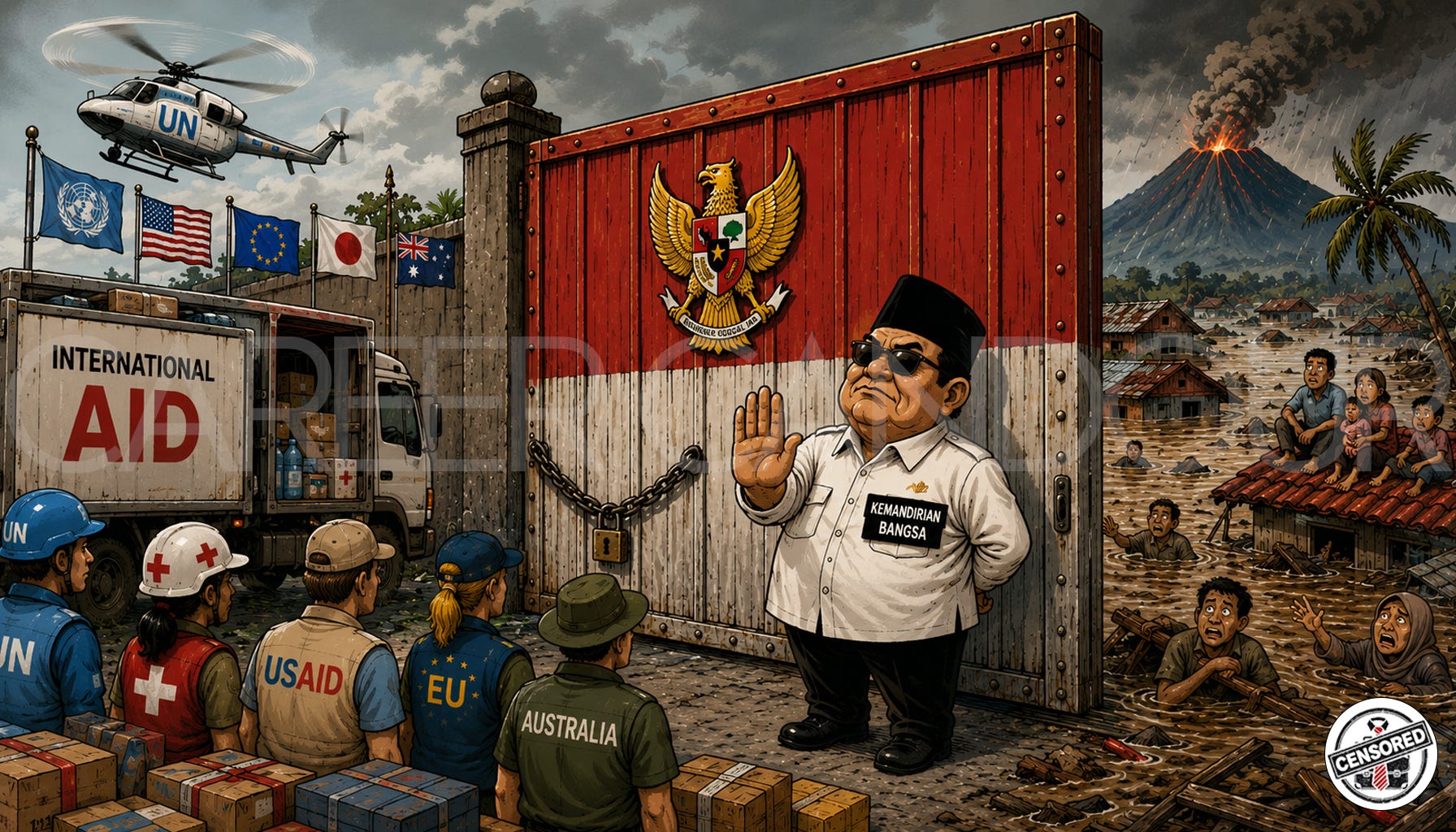
To observe the official response of the Indonesian state during a catastrophic natural disaster is to witness… geopolitical pantomime. As the earth buckles across the volcanic spine of Flores, and as the river basins of Sumatra periodically regurgitate millions of tons of freshly harvested, unmapped timber into provincial living rooms, the view from the air-conditioned redoubts of Jakarta remains almost heroically serene.
The ministerial consensus is invariably the same:
Indonesia is fully capable.
The situation is entirely under control.
Please take your unsolicited emergency field hospitals and shove them back into your cargo planes.
It is an inspiring display of sovereign swagger.
To the untrained eye, this posture might look like lethal, criminal stubbornness. But to the visionary strategists in Jakarta, refusing to declare a state of national emergency or to unlock the gates for international humanitarian assistance is statecraft. It is the gospel of Kemandirian Bangsa, a doctrine of national self-reliance designed to project the muscular silhouette of a rising G20 heavyweight that dispenses development aid to distant continents rather than receiving it from meddlesome neighbors.
Yet, when one scratches through the thin veneer of patriotic bravado, the rhetoric of pure national pride begins to look remarkably like a smoke screen. There is a distinct, pungent whiff of institutional conspiracy in the air.
The refusal to lean on international allies during moments of acute systemic collapse is a calculated convergence of fiscal panic, closed-door disaster capitalism, maritime intelligence paranoia, and the cold, eternal imperative of the Javanese core to keep its restive outer islands firmly on a short leash.
Why accept free help when pride can keep the domestic machinery humming entirely undisturbed?
Why Say No?
To understand how Indonesia arrived at its current posture of aggressive self-isolation in the face of calamity, one must travel back to the mid-2000s.
In the immediate wake of the apocalyptic 2004 Indian Ocean Tsunami, President Susilo Bambang Yudhoyono executed what contemporary nationalist hardliners view as the ultimate original sin: he flung open the closed, heavily militarized province of Aceh to the entire planet. For several chaotic, deeply uncoordinated, yet undeniably life-saving years:
American aircraft carriers anchored off the coast of Sumatra.
Australian military medics established field hospitals in ruined coconut groves.
Hundreds of European NGOs with irritatingly high ethical standards roamed the landscape, talking directly to the international press.
It was an unmitigated disaster for the state’s sense of privacy.
The 2004 intervention saved countless lives and birthed the historic Helsinki Peace Accord, but it left the Jakarta security establishment with institutional agoraphobia. The presence of foreign observers had forced the state to behave with unprecedented transparency.
Foreign eyes had seen the military’s logistical shortcomings.
Foreign auditors had examined provincial supply chains.
Worst of all, the world had seen Indonesia not as a roaring regional tiger, but as a traumatized patient in desperate need of global intensive care.
The state spent the next two decades ensuring that such an indignity would never happen again.
Law No. 24 of 2007, redefined disaster management from an occasion for international solidarity into a sovereign fortress, creating an inpenetrable thicket of legal hurdles required before any foreign entity could deploy a single bandage.
By the time the late 2010s rolled around under President Joko Widodo, the policy had evolved into naked commercial pragmatism. When a devastating sequence of earthquakes pulverized the island of Lombok in 2018, the central government adamantly refused to elevate the event to a national disaster. Why? Because neighboring Bali was scheduled to host the International Monetary Fund and World Bank Annual Meetings a few weeks later. Ten thousand global financiers were arriving for cocktails and seminars on macroeconomic resilience; you simply cannot have foreign rescue teams clogging the regional airspace when the global managing director of the IMF is trying to land her private jet.
When the catastrophic Palu liquefaction struck later that same year, foreign aid was permitted only through a labyrinth of suffocating regulations, complete with the unceremonious detention and deportation of foreign aid workers who dared to arrive without the proper stamp from Jakarta.
By 2019, the state completed its transformation by establishing “Indonesian AID” (LDKPI), allowing the country to officially cosplay as an international donor nation, airlifting instant noodles to the Middle East and the Pacific Islands while praying nobody noticed the domestic bridges collapsing back home.
Today, under an administration that treats sovereign posturing as an essential blood sport, that evolution is complete. The transition from asking for help to tolerating help to actively criminalizing help is finished. Admitting you need an Australian transport plane in an archipelago spanning five thousand kilometers is viewed as an intolerable confession of state impotence.

Follow the Money
The statutory architecture of Indonesian disaster law contains an administrative tripwire. The moment a catastrophe is formally elevated to the status of a “National Disaster” (Status Bencana Nasional), the legal firewall between regional budgets (APBD) and the central state treasury (APBN) instantly evaporates. By law, the central government is suddenly forced to assume open-ended, non-negotiable financial liability for the entire circus: emergency logistics, structural compensation, temporary sheltering, and multi-year reconstruction.
It forces the state to pay up. In full.
The financial problem, however, is that the national piggy bank is committed to an eye-watering array of non-negotiable political vanity projects. When a central government is simultaneously funding a multi-billion-dollar universal free school lunch program, underwriting expansive military hardware acquisitions, and pouring astronomical sums of concrete into a brand-new administrative capital carved out of the Bornean jungle, the discretionary contingency reserves become shockingly thin. The National Disaster Management Agency’s (BNPB) on-call disaster fund (Dana Siap Pakai) frequently dwindles to amounts that would barely cover the executive catering budget of a major state-owned bank.
Declaring a national disaster would mean publicly breaking open the state budget, halting cherished presidential pet projects, and executing emergency fiscal reallocations in full view of parliament and the press.
Worse still is what happens when you accept foreign government aid or invite the United Nations humanitarian cluster into the field.
Foreign donors have an irritating habit of bringing their own auditors. Organizations like the World Bank, Asian Development Bank, or USAID come saddled with tedious anti-corruption compliance protocols, digital procurement tracking, third-party logistics monitoring, and verified beneficiary databases.
They want receipts.
They want to know why a single temporary bridge costs four times its market value.
They want to know why the emergency rice supply was purchased from a trading company owned by the nephew of a regional military commander.
By keeping the disaster strictly “provincial,” Jakarta keeps the disaster legally confined to local balance sheets that are already bankrupt. The central government avoids having to open its books to international scrutiny, successfully concealing the reality that the national emergency reserve is essentially empty because the money was spent on free milk and fighter jets six months ago.

Disaster Capitalism
To view a province shattered by a magnitude-7.7 earthquake or inundated by catastrophic flash floods purely as a theatre of human suffering is to misunderstand the political economy of the Indonesian state. In the calculating eyes of the domestic political-business oligarchy, a flattened provincial landscape is a market opportunity.
It is a multi-trillion-rupiah infrastructure jackpot.
The physical aftermath of a major disaster requires vast, lucrative civil works:
The rapid pouring of foundations for temporary housing settlements (Huntara),
The construction of thousands of permanent post-disaster homes (Huntap),
The stabilization of mountain roads, and the rebuilding of crushed coastal bridges.
When international humanitarian agencies or multilateral development consortiums fund post-disaster reconstruction, they:
Insist on open, international competitive bidding.
Enforce strict environmental impact assessments.
Bring in independent structural engineering monitors whose sole job is to ensure that the concrete being poured actually contains cement… rather than a cost-saving mixture of river sand.
To the domestic construction cartel, this level of oversight is unacceptable.
By aggressively barring foreign donors and multilateral institutions from the reconstruction zone, the state ensures that every single rupiah of disaster spending remains locked inside the domestic patronage ecosystem. The contracts are lovingly distributed among:
State-owned construction monopolies (BUMN Karya),
Sovereign wealth entities like Danantara, and
Politically connected private subcontractors owned by retired military brass and party financiers.
The engineering may be deeply questionable, the temporary housing units might leak whenever it drizzles, and the displaced population might wait eighteen months for running water, but the corporate dividends remain entirely domestic. Disaster capitalism functions best in the dark, and foreign aid workers have a terrible habit of turning on the lights.

Nothing to See
Catastrophes almost never happen in Central Jakarta. They happen on the periphery.
To the civilian mind, these are vulnerable communities in desperate need of search-and-rescue helicopters. To the military and intelligence apparatus (BAIS and BIN), these are hyper-sensitive strategic frontiers that must be defended against foreign eyes at all costs.
The prospect of Royal Australian Air Force C-17s, Singaporean naval landing ships, or Chinese disaster-response units, operating freely across Indonesian territorial waters induces immediate panic within the high command.
There is an entrenched paranoia that humanitarian missions are merely elaborate Trojan horses designed to map archipelagic sea lanes, drop sonar buoys, monitor military communications, and establish foreign logistical footprints on Indonesia’s doorstep. Turning away foreign assistance is framed in Jakarta’s war rooms not as an act of counter-espionage.
Yet, this geopolitical paranoia serves a second, far dirtier domestic purpose: the systematic concealment of ecological crimes.
When catastrophic flash floods wash away entire districts in Sumatra, the swollen rivers carry millions of tons of freshly cut, neatly trimmed, unmarked timber. These are not fallen forest trees; they are the physical evidence of industrial-scale illegal logging and uncontrolled clear-cutting, operating under the explicit protection of regional elites, military-linked concessions, and corporate palm oil syndicates.
If you invite the international humanitarian community into the disaster zone, you inevitably invite their satellite mapping tools, their environmental survey teams, and their high-resolution disaster-tracking drones. Within forty-eight hours, international observers would produce high-definition topographical maps demonstrating precisely which politically connected palm oil plantation stripped the watershed that just obliterated three downstream villages.
By rejecting foreign aid, framing the disaster as a purely local weather anomaly, and sending the military to control the perimeter, the state ensures that the crime scene is buried under the mud before anyone can identify the owners of the chain saws.

The Jakarta Leash
Indonesia’s constitutional architecture may proclaim a unitary republic, but its political reality is defined by an ongoing, centuries-old struggle between central authority and regional self-determination. When the floods ravaged Aceh, the newly elected regional leadership, steeped in the proud, defiant history of the Free Aceh Movement (GAM), instinctively looked outward.
They called their cultural and commercial cousins in Malaysia;
They welcomed medical teams;
They opened direct backchannels to UN agencies.
In Jakarta, this provoked cold, bureaucratic fury.
Allowing a regional governor to independently orchestrate an international relief effort is a lethal threat to the unitary state’s authority. It demonstrates that the outer islands can survive without Jakarta. It proves that regional autonomy is real, and functional.
To prevent this dangerous idea from taking root, the central government deliberately steps in to slam the door shut.
It blocks incoming flights,
It returns diplomatic shipments of food aid,
It insists that every single bag of grain must travel through the slow, centralized military supply chain originating in Java.
By letting the regional government flounder under the impossible weight of the crisis, Jakarta forces local leaders into total administrative subjugation. The local administration is made to realize that its autonomous swagger is useless without central funding, and that its cross-border diplomatic ties mean nothing when Jakarta controls the ports.
The suffering of the local population is weaponized to remind the periphery of its place in the imperial hierarchy.
You do not look to Kuala Lumpur.
You do not look to Canberra.
You do not look to Geneva.
You will sit in the dark, and you will wait until Jakarta decides you have earned your dinner.
There is an undeniable tragedy in watching a country of such immense promise, cultural brilliance, and economic dynamism allow itself to be held hostage by a brittle, hyper-defensive performance of state sovereignty.
Indonesia is an extraordinary nation on a profound developmental journey. It is a vibrant, complex, archipelagic civilization navigating rapid industrialization while sitting directly atop the most violent tectonic and climatic fault lines on planet Earth. But being on a journey means, by definition, that you have not arrived at absolute omnipotence yet.
There is zero shame in having an island shattered by a magnitude-7.7 earthquake.
There is zero humiliation in having mountain roads wiped out by an unprecedented tropical cyclone.
Strong nations do not demonstrate their maturity by letting their citizens drink contaminated river water while turning away the rescue teams of their allies. They demonstrate it by swallowing their pride, mobilizing every resource on Earth to save lives, and prioritizing human survival over geopolitical posturing.
Nations have allies for a reason. Communities exist for a reason. Leaning on your neighbors during a catastrophe is not an admission of inferiority; it is the basic, civilized standard of human coexistence.
Yet, as long as the political elite in Jakarta remains obsessed with projecting a caricature of sovereign self-sufficiency, the script will remain unchanged.
The central government will continue to decline foreign aid with a patriotic smile;
The domestic construction cartels will quietly carve up the concrete contracts;
The intelligence services will keep the cameras away from deforested hillsides;
The politicians will congratulate themselves on their fierce independence.
The illusion of absolute strength will be flawlessly preserved in the capital. And the people of the periphery will be left with the solitary comfort of knowing that their government would rather watch them drown in sovereign dignity than permit the rest of the world to help them swim.
StratEx - Indonesia Business Advisory provides Indonesia-focused advisory and leadership intelligence for investors that need to understand what is really moving beneath the surface. Contact us for better visibility before making your next move in Indonesia.