


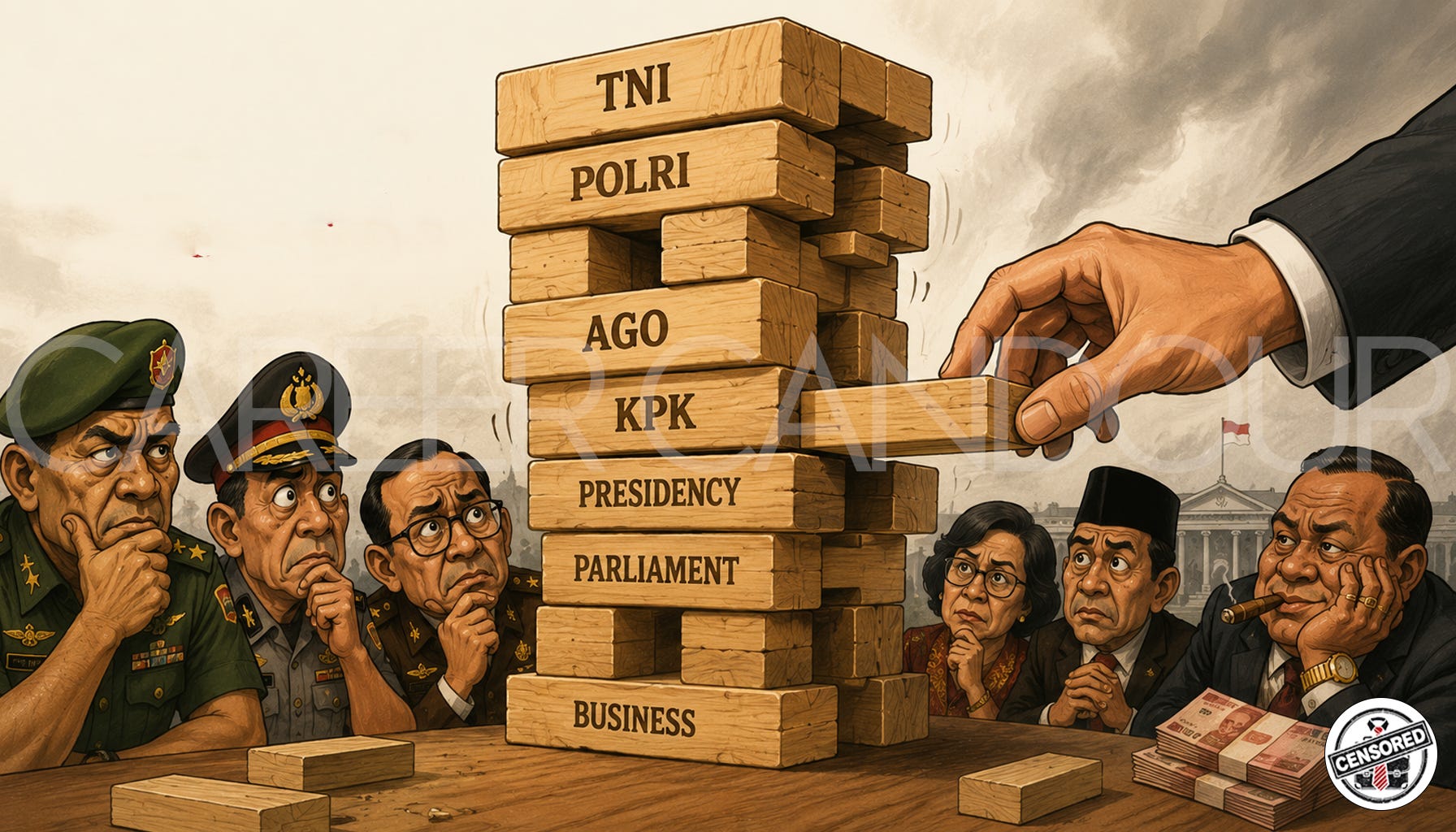
There’s a protocol that accompanies almost every major corruption investigation in Indonesia.
It begins with a press conference, involving tables covered in stacks of cash, luxury watches, foreign currencies and gold bullion.
Within hours, social media declares that this is either the beginning of a glorious national reckoning or the final collapse of the republic.
By the following afternoon, everyone has become an expert on constitutional law, police procedure and the internal politics of institutions that spend a great deal of time ensuring precisely nobody understands their internal politics.
The remarkable thing about last week’s events in Jakarta is not that they involved allegations of corruption. Indonesia, unfortunately, has never suffered from a shortage of corruption cases. Since Reformasi, successive governments have prosecuted ministers, governors, and senior business figures. Corruption investigations, depressing as it sounds, have become almost routine. They are no longer noteworthy because they exist. They become noteworthy because of who is investigating whom.
That difference is what transformed a large corruption investigation into something even larger.
On paper, the story appeared relatively straightforward.
Indonesian police announced a major investigation into alleged corruption and money laundering connected to coal procurement and state electricity contracts, carrying out coordinated searches across Jakarta and its surrounding areas.
Authorities reported the seizure of vast quantities of cash, precious metals and foreign currency, with estimates of alleged state losses stretching into the trillions of rupiah.
Had events stopped there, the headlines would probably have followed a familiar formula before disappearing beneath the next political controversy a few days later.
Instead, attention drifted almost immediately away from the allegations themselves and towards the institutions conducting the investigation.
Rumours began circulating that the investigation was drawing closer to one of Indonesia’s most influential prosecutors, Assistant Attorney General for Special Crimes Febrie Adriansyah. Reports suggested police activity around property linked to him. Other claims alleged that soldiers had appeared to protect his residence. Police denied rumours of a dramatic raid. The military explained that its personnel were present under existing arrangements relating to the protection of prosecutors. Anonymous accounts on X suddenly began speaking with extraordinary confidence about constitutional crises and institutional warfare.
Within forty-eight hours, what had begun as another corruption investigation had evolved into a national seminar on the architecture of the Indonesian state.
The fascinating aspect of this transformation is that almost everybody instinctively reached for the wrong set of analytical tools.
Outside Indonesia, particularly in English-language commentary, there is a powerful temptation to interpret events through familiar Western assumptions.
Police investigate crime.
Prosecutors prosecute crime.
Soldiers defend borders.
Intelligence agencies gather intelligence in the background.
Institutions have clearly defined responsibilities.
Indonesia has never really functioned that way.
This does not make Indonesia uniquely chaotic. In fact, one of the more persistent misconceptions surrounding Indonesian politics is that it somehow represents an exotic exception to the way modern states organise themselves, when the opposite is arguably closer to the truth. Much of the world has developed institutions whose responsibilities overlap, whose relationships evolve, and whose boundaries are shaped as much by history as by constitutional theory. It is the neat institutional separation familiar to countries such as Australia, Britain or Canada that is historically unusual rather than universal.
Indonesia’s political architecture makes considerably more sense once one stops asking why it does not resemble Westminster and starts asking why it resembles Indonesia.
A Nation Built Before Its State
There is a tendency, particularly among countries fortunate enough to have enjoyed long periods of institutional continuity, to assume that states emerge first and institutions emerge second. Governments establish armies, governments establish police forces, governments establish courts, and over time each organisation develops its own professional identity before settling into a constitutional arrangement that survives for generations.
Indonesia experienced something considerably more complicated.
When independence was proclaimed in August 1945, there was:
No mature Indonesian state patiently waiting to assume responsibility for one of the most geographically demanding archipelagos on Earth.
No nationwide bureaucracy capable of administering distant provinces.
No established security apparatus ready to guarantee sovereignty.
There was, instead, a declaration of independence, an occupying power reluctant to accept it, enormous uncertainty and, before long, a revolutionary struggle that would shape Indonesia’s political DNA for decades to come.
That distinction explains a remarkable amount about how Indonesia still thinks about itself.
Many Western militaries exist because their states already existed. Their primary purpose became defending established borders against external threats. Civilian institutions matured alongside them, gradually assuming responsibility for everything from taxation to disaster response, leaving armed forces to concentrate overwhelmingly on warfighting. The ideal relationship eventually became one in which soldiers remained almost invisible in everyday public life, emerging primarily for ceremonial occasions, overseas deployments or particularly catastrophic floods.
Indonesia’s experience was fundamentally different. The armed forces became one of the principal instruments through which the republic came into existence in the first place. The military was not merely protecting the state. It was helping create it.
Whether one agrees with that legacy is almost beside the point. Institutions develop identities through experience, and few experiences shape organisational identity more profoundly than believing one’s predecessors participated directly in national survival. It is therefore hardly surprising that the TNI has historically viewed itself not simply as another branch of government but as one of the custodians of Indonesian unity itself. Reformasi dramatically reduced the military’s formal political role, dismantling the doctrine of dwifungsi that had embedded it within civilian governance throughout the New Order. Yet ideas do not disappear just because legislation changes. Historical narratives have long shelf lives.
Geography reinforced those instincts.
It is difficult to appreciate Indonesia’s administrative challenge without first abandoning the comforting illusion that it resembles an ordinary nation-state enlarged to unusual proportions. Indonesia is large and fragmented by design. Administering thousands of inhabited islands, separated by seas, volcanoes, dense forests and frequently indifferent infrastructure, requires logistical capacities that many continental states rarely need to contemplate. Long before modern disaster agencies or sophisticated civilian logistics networks emerged, the military possessed transport aircraft, engineering units, communications systems and nationwide organisational structures capable of responding rapidly across vast distances.
History and geography, working together, created a military that inevitably occupied a broader space within national life than its counterparts in many Western democracies.
Whether that broader role should continue today is an entirely legitimate political question. Why it developed in the first place is rather less mysterious than it is often portrayed.
The same historical forces, however, were shaping another institution whose future relationship with the military would prove equally consequential.
By the time Reformasi arrived in 1998, Indonesia was confronting the end of the New Order and a more complicated question altogether:
How do you separate institutions that had spent decades growing together without accidentally creating several competing centres of power instead of one?

The Institutions Reformasi Built
If the New Order was characterised by the concentration of power, Reformasi represented almost the opposite instinct. The political mood after 1998 was that Indonesia needed new leaders and a new architecture of power altogether. Institutions that had previously existed beneath a highly centralised system were suddenly expected to become independent, accountable and, above all else, incapable of allowing another president to accumulate the authority enjoyed by Suharto.
The separation of the police from the armed forces became one of the defining reforms of that era. Under ABRI, the military and police had effectively occupied different rooms in the same institutional house. Reformasi handed them separate addresses and hoped they would become good neighbours.
History, however, has an irritating tendency to ignore constitutional aspirations.
Creating two powerful institutions where previously there had been one did not eliminate competition. Each organisation developed its own hierarchy, its own institutional mythology and, inevitably, its own understanding of what constituted the national interest. It was almost inevitable. Bureaucracies possess a remarkable ability to convince themselves that they alone truly understand how the entire enterprise ought to function.
Meanwhile, Indonesia continued building institutions. The Corruption Eradication Commission (KPK) emerged as perhaps the most celebrated symbol of Reformasi’s ambitions. For a time it enjoyed a reputation that anti-corruption agencies around the world could only envy. Ministers, governors, members of parliament and senior officials found themselves investigated with a frequency that suggested nobody had informed the KPK about the unwritten rule that powerful people were generally expected to remain difficult to prosecute.
The commission became something rather unusual in modern politics: an institution that ordinary citizens often trusted more than many elected politicians.
That popularity made it influential.
Influence, unsurprisingly, made it controversial.
It is difficult to find many countries where institutions accumulate significant authority without eventually encountering resistance from other institutions possessing equally significant authority. Indonesia proved no exception. Episodes such as the famous Cicak versus Buaya dispute entered political folklore because the metaphor captured how institutions were occasionally colliding with one another in full public view.
Power had become distributed.
Not equally.
But undeniably.
That distribution continued evolving over the following decade.
The Attorney General’s Office expanded its prominence through increasingly ambitious prosecutions.
The police developed ever broader capabilities in financial crime, cybercrime and corruption investigations.
The KPK remained important but no longer occupied quite the singular position it once had.
Intelligence agencies continued performing the role expected of intelligence agencies everywhere… namely insisting they were not involved in whatever everyone assumed they were involved in.
From the outside, this can appear bewilderingly untidy. From the inside, however, it increasingly resembles a negotiated equilibrium.
That phrase may sound disappointingly academic, but it describes an arrangement familiar to political scientists and corporate executives alike. When several powerful organisations coexist, each possessing overlapping responsibilities and differing institutional incentives, politics becomes less about fixed hierarchies and more about continuous negotiation.
Jurisdictions overlap.
Personal relationships matter.
Informal understandings develop.
Authority is exercised through legislation, convention, and precedent.
To imagine that Indonesia contains two perfectly organised rival camps, each patiently awaiting instructions from shadowy puppet masters, is therefore to mistake a rainforest for a chessboard. Forests are considerably more complicated than that.

Every Country Thinks It's Normal
One of the more persistent habits of international commentary is treating Western institutional arrangements as though they represent the inevitable destination of political development rather than one historical outcome among many.
This is understandable. Most observers interpret foreign countries through the constitutional traditions they know best.
Australians assume governments look vaguely Australian.
The French naturally believe every political problem would improve with slightly better administrative centralisation.
Americans often conclude that any institutional challenge can be solved by creating three additional agencies and allowing them to disagree in front of Congress for several decades.
Indonesia is hardly unique in this regard. Every nation quietly imagines that history has been progressing, with varying degrees of enthusiasm, towards becoming itself.
Yet the further one travels beyond the familiar democracies of north-western Europe and the Anglosphere, the more difficult it becomes to sustain the assumption that soldiers should remain permanently invisible, police should concern themselves exclusively with domestic crime, intelligence agencies should avoid public attention and every institution should know exactly where its responsibilities begin and end.
History doesn’t back that up.
South Korea spent decades under military influence before becoming one of Asia’s most successful democracies.
France maintains a state tradition that accommodates multiple national security institutions beneath a powerful executive.
Singapore developed an exceptionally capable bureaucracy in which questions of institutional effectiveness have often taken precedence over ideological debates concerning theoretical administrative purity.
Even the United States, frequently cited as the archetype of civilian governance, has accumulated such an extraordinary constellation of federal law-enforcement bodies.
The point is not that these systems are identical.
Far from it.
The point is that history leaves fingerprints on institutions, and those fingerprints rarely disappear simply because comparative politics textbooks would prefer neater diagrams.
Indonesia’s geography compounds those historical legacies. Maintaining administrative reach across an immense geography inevitably requires different assumptions about logistics, disaster response and state capacity than governing a comparatively compact continental country. When earthquakes level towns, volcanoes interrupt transport networks or remote regions require rapid deployment of engineering resources, the institutions possessing aircraft, ships, communications systems and nationwide command structures naturally become relevant. Whether that relevance should remain confined to emergencies or extend into wider civilian roles is precisely the debate Indonesia continues to have.
Supporters argue that the state should utilise its most capable institutions wherever national interests require them, provided democratic oversight remains intact.
Critics worry that temporary necessity possesses an unfortunate habit of becoming permanent habit, particularly once budgets, careers and institutional prestige begin adapting to expanded responsibilities.
The persistence of that debate may itself be evidence of democratic health. Democracies are not distinguished by the absence of disagreement. They are distinguished by their ability to keep disagreeing without anyone feeling compelled to resolve the matter with tanks.

Power Struggle or Politics as Usual?
Having travelled through seventy-five years of institutional evolution, it becomes easier to understand why last week’s events generated so much speculation.
Notice, however, that speculation is not the same thing as proof.
The confirmed facts are comparatively straightforward.
A major corruption investigation is under way.
High-profile searches have been conducted.
Allegations involve potentially enormous financial losses.
The investigation has intersected, directly or indirectly, with figures occupying influential positions within Indonesia’s legal establishment.
Public statements have been issued.
Rumours have travelled considerably faster than official information, as rumours generally do.
Everything beyond that requires more caution.
It is certainly possible to interpret the recent developments as evidence of institutional competition. History provides ample examples of Indonesia’s major state bodies asserting their respective authorities, occasionally in ways that become visible to the public. Observers therefore do not need vivid imaginations to suspect that overlapping investigations or competing jurisdictions might also carry institutional implications.
It is equally possible, however, to overinterpret ordinary legal processes simply because they involve unusually prominent individuals.
Large corruption investigations almost inevitably touch powerful offices.
Powerful offices, in turn, inevitably produce dramatic headlines.
Not every institutional interaction constitutes a constitutional confrontation.
Politics has always been conducted partly through symbolism. A photograph, a convoy, an official denial, a carefully worded statement or an unexplained deployment can influence public perception long before courts establish legal facts. Institutions understand this perfectly well. They have always understood it. Which is precisely why moments like these generate such intense public fascination.
The real story, therefore, may not be whether one institution is triumphing over another.
It may be that Indonesia has entered another period in which the balance between several powerful institutions is being recalibrated, a process that has occurred more than once since Reformasi and will almost certainly occur again.
Whether that recalibration ultimately produces stronger accountability, greater institutional rivalry or simply a different equilibrium is a question that cannot yet be answered.
It is, however, the question worth asking.

The Indonesia Still Being Built
One of the misconceptions in politics is that countries eventually arrive at a finished constitutional destination. But history dictates that States are rarely finished. They simply become different versions of themselves, each generation inheriting the previous one’s institutional compromises before adding several new ones of its own.
Indonesia finds itself at precisely one of those moments.
Whether last week’s events ultimately prove historically significant will matter far less than the broader questions they have exposed. The public conversation has drifted beyond individual allegations and towards something considerably more fundamental:
How should power be organised inside a modern Indonesian state? More importantly, who decides?
Those questions are unlikely to disappear once the news cycle moves on.
They have been asked, in one form or another, ever since Reformasi.
The difficulty, however, is that Indonesia is now confronting a very different set of circumstances from those that existed in 1998. Reformasi was, understandably, preoccupied with preventing the return of excessive concentration of power.
Fragmentation became a feature rather than a flaw.
Institutions were strengthened.
New checks were introduced.
Authority became dispersed across a range of organisations whose overlapping responsibilities reflected a deliberate suspicion of allowing any single pillar of the state to dominate the others.
Twenty-five years later, Indonesia faces a different challenge.
Excessive centralisation risks creating institutions that become too powerful to scrutinise effectively.
Excessive fragmentation risks producing institutions that become preoccupied with protecting their respective jurisdictions.
Somewhere between those two extremes lies an elusive equilibrium that every country claims to have discovered and almost none have managed to preserve indefinitely.
One can already discern several plausible trajectories.
1. Indonesia could continue refining what might be described as a managed institutional balance.
The military remains influential but constitutionally bounded.
The police continue expanding professional capabilities while remaining subject to civilian oversight.
The Attorney General’s Office strengthens prosecutorial effectiveness without becoming an independent political actor.
The KPK continues evolving within a broader anti-corruption ecosystem rather than standing apart from it.
Institutional rivalry persists, but largely behind closed doors where rivalries, if they are to exist at all, probably belong.
This would not produce many exciting headlines.
It would probably produce reasonably effective government.
2. Greater centralisation through a presidency that increasingly becomes the undisputed coordinator of multiple powerful institutions.
Several successful states operate under strong executive leadership combined with robust legal and constitutional constraints. The determining factor is whether that authority remains accountable, transparent and constrained by institutions capable of exercising genuine oversight.
3. Institutional competition could become increasingly visible.
That prospect understandably concerns many Indonesians, although it deserves careful explanation. Public disagreement between institutions is not automatically evidence of democratic decline. Democracies, after all, are built upon disagreement.
Courts disagree with governments.
Legislatures disagree with presidents.
Journalists disagree with everybody.
The more relevant question is whether disagreements remain governed by law, procedure and constitutional norms, or whether institutions begin treating one another primarily as political competitors whose legitimacy depends upon prevailing rather than cooperating.
That distinction is enormously important.
Perhaps the greatest temptation for outside observers is to interpret every high-profile investigation as confirmation of whichever narrative they already preferred before the investigation began.
Those convinced Indonesia is returning to authoritarianism inevitably discover supporting evidence.
Those convinced Indonesia is simply strengthening the rule of law discover equally persuasive examples.
Human beings have always displayed an extraordinary ability to arrange facts into stories they already wished to believe.
Indonesia deserves better than that.
The country’s political development is considerably more interesting than the comforting simplicity of binary narratives. It is neither marching inexorably towards a familiar Western destination nor retreating inevitably into its authoritarian past.
Messy processes, unfortunately, rarely produce tidy headlines.
Much of the public conversation has treated Indonesia’s institutions as though they belonged to opposing football clubs whose supporters simply await the weekend fixture. One side wins. The other side loses. Transfer window closes. Everyone goes home.
States do not function like football leagues.
At least, one sincerely hopes they do not.
Institutions compete, certainly. They also cooperate, negotiate, constrain, influence and occasionally frustrate one another in ways that make clean narratives deeply appealing and profoundly misleading. The very untidiness of Indonesia’s institutional landscape is not necessarily evidence that something has gone wrong. It may equally suggest that several powerful organisations remain capable of preventing any one of them from becoming permanently dominant.
Whether that balance is sustainable remains the genuinely difficult question.
Indonesia has repeatedly demonstrated an impressive capacity for institutional adaptation. Few observers in 1998 would have predicted the democratic resilience the country has subsequently displayed. Equally, history offers no guarantee that institutional balances, once achieved, maintain themselves indefinitely. They require continual adjustment, public trust, and political restraint
Which brings us back to the corruption investigation that accidentally became a constitutional conversation.
Years from now, the individual allegations may prove legally significant or they may not. Court proceedings will establish facts that speculation never could. The personalities dominating today’s headlines will eventually retire, be replaced or discover that political prominence possesses an alarmingly short shelf life.
The more enduring legacy of this episode may be something entirely different.
It has reminded Indonesians (and foreign observers) that institutions matter at least as much as individuals.
Governments change.
Presidents come and go.
Attorneys General, Police Chiefs and military commanders eventually hand over their offices.
The constitutional relationships between those offices, however, endure far longer. They shape how accountability functions and how power is exercised long after today’s headlines have been forgotten.
That is why understanding Indonesia requires resisting the temptation to reduce every political controversy to heroes, villains and shadowy factions manoeuvring behind closed doors. Such stories are undoubtedly entertaining. They also possess the analytical sophistication of explaining Formula One by observing that all the cars appear to be driving in circles.
Indonesia’s political architecture is more complicated than that.
It always has been.
And perhaps that is the most valuable lesson to emerge from a week in which everyone suddenly became fascinated by how the Indonesian state actually works. The raids themselves will eventually fade into history, but questions about institutional design, democratic evolution and the perpetual challenge of balancing authority with accountability will endure.
Those questions deserve more than hot takes.
At StratEx - Indonesia Business Advisory provides Indonesia-focused advisory and leadership intelligence for investors that need to understand what is really moving beneath the surface. Contact us for better visibility before making your next move in Indonesia.