


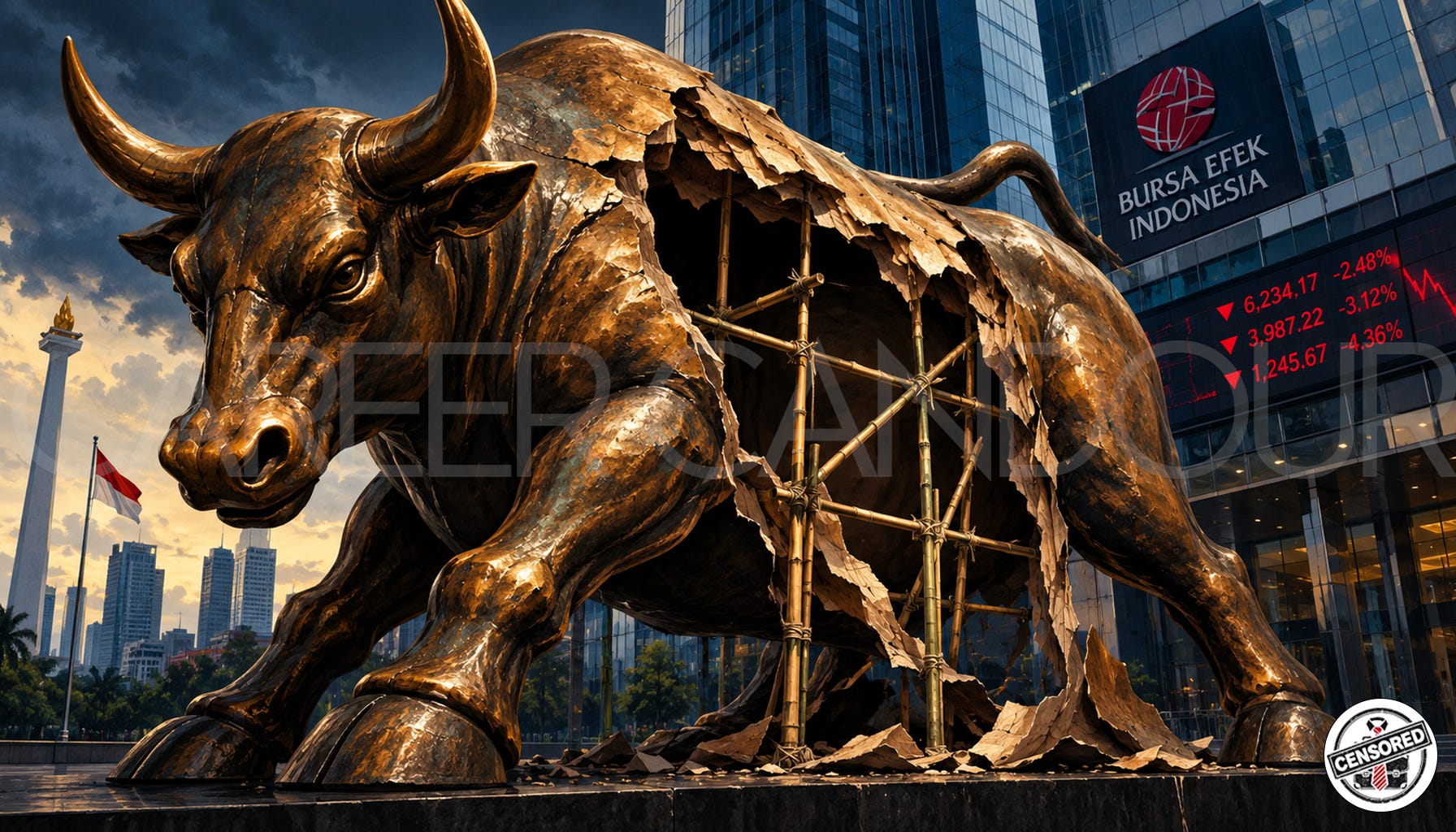
The espresso machines on the ground floor of Pacific Place were hissing at their usual frantic clip, but the chatter among the blue-lanyard crowd had an edge of desperation. It was shortly after the opening bell, and the monitors across the brokerage houses in the Sudirman Central Business District had gone an alarming shade of crimson. The Jakarta Composite Index (IHSG) was in free fall, tumbling more than 11.5% in a matter of minutes—a one-day decline not seen since the grim days of 1998.
The catalyst was not an unexpected coup or an offshore banking run, rather the MSCI had released a consultation paper proposing to yank Indonesia out of the Emerging Markets Index.
The market had prepared itself for a slap on the wrist; perhaps a demotion to Frontier Market status, alongside Vietnam and Kenya, retaining some access to international capital. Instead, MSCI skipped the Frontier tier altogether and proposed exiling Southeast Asia’s largest economy straight into Standalone Market status with Lebanon, Zimbabwe, and sanctioned Russia.
This was a formal, international vote of no confidence in the Indonesian boardroom.
The global financial system had finally called time on the dynastic paranoia, performative governance, and feudal ownership models that have governed Indonesian corporate life for half a century.
Paper Wealth
The Jakarta Stock Exchange (IDX) has never functioned like its peers in London, Tokyo, or Mumbai. It is not an instrument to distribute ownership, invite external expertise, or subject management to the disciplines of capital efficiency. It is an ornate, highly leveraged collateral engine.
Indonesia's earlier 7.5% minimum free-float threshold was raised to 15% under the 2026 capital-market reform programme. In practice, that 7.5% was an administrative illusion. Through friendly domestic brokerages, family offices in Singapore, and nominee accounts parked in the British Virgin Islands, controlling founders have been rumored to lock up all but 2% to 3% of the real, liquid float.
With an actual float of 2.5%, moving a share price requires surprisingly little liquidity. A syndicate can bid a stock to extraordinary multiples with minimal daily turnover.
The pinnacle of this financial engineering was Barito Renewables Energy (BREN). Within months of its late-2023 IPO, BREN’s market capitalization surged past IDR 1,300 trillion ($80+ billion), trading at a price-to-earnings multiple north of 500x. On paper, a modestly cash-generative geothermal utility became more valuable than Bank Central Asia (BBCA)—Indonesia’s premier commercial bank, backed by decades of compounding earnings and unmatched transactional liquidity.
The mechanism functioned smoothly until FTSE investigated the share register in late 2024 and removed BREN on the eve of its anticipated global index inclusion, revealing that just four major shareholders controlled roughly 96% of the company.
Meanwhile, Dian Swastatika Sentosa (DSSA) traded at a nominal per-share price of nearly IDR 300,000 on low volumes, before executing a 1:10 stock split in 2024 and subsequent 1:25 split in 2026 that could theoretically be perceived as maintaining the optics of public liquidity.
For professional executives inside these conglomerate pyramids, the culture this fosters is paralyzing.
When a conglomerate goes through the motions of hiring a blue-chip Chief Executive from McKinsey or an expatriate Chief Financial Officer from Singapore, the new hire quickly discovers they have stepped onto a movie set. The sustainability reports and carbon-neutral roadmaps are intended for offshore consumption; real capital allocation, dividend policy, and related-party transfers are settled by the patriarch and his children on Sunday afternoon.

A Family Deal
If the Barito phenomenon demonstrated how paper valuations are constructed, the transaction involving Bayan Resources (BYAN) in early October 2026 revealed how they are taken apart.
Low Tuck Kwong, the aging mining magnate, had seen his paper wealth fluctuate into the tens of billions of dollars as Bayan’s regular screen price hovered between IDR 11,000 and IDR 12,500 per share. Yet, when Low and his family agreed to sell a 30.25% stake (over 10 billion shares) to PT Jhonlin Baratama—the holding firm of Andi Syamsuddin Arsyad, widely known as Haji Isam—the transaction did not cross anywhere near the public ticker price.
The deal was executed on the negotiated board (pasar negosiasi) at IDR 2,588 per share; an almost 80% discount to the official public market valuation.
Low Tuck Kwong is in his late 70s. In Indonesia’s resource sector, holding crown-jewel asset, like Bayan’s Tabang coal concession in East Kalimantan, without deep, active alignment with the prevailing political establishment is hazardous. Haji Isam is a pivotal figure in regional resource politics with established connections to the national political and defense apparatus.
Crucially, Haji Isam’s finance team refused to pay the public regular board price. At IDR 2,588, Bayan was priced at around 5 to 6 times enterprise value to EBITDA—the realistic global valuation for a thermal coal asset facing long-term energy transition risks. The transaction confirmed the open secret of the market: when domestic power brokers trade real economic control, they ignore the screen price and price the asset at an 80% haircut.
The next week, Low Tuck Kwong bought 500,000 shares on the open market at IDR 11,200, and a separate purchase of 100million shares the following day, worth approximately IDR 1.12 trillion.
The institutional investors who mandate MSCI do not miss these discrepancies. They realized they were providing forced, programmatic exit liquidity at an inflated price for assets that domestic insiders valued at a fraction of that figure.

Compliance Theatre
Western investors often ask why the Financial Services Authority (OJK) or the exchange management (BEI) did not enforce free-float rules or freeze suspicious trading rings.
This assumes that regulatory bodies in Indonesia exist to regulate capital. In reality, they are bureaucratic entities navigating deep patrimonial power structures.
Civil servants are often products of an institutional culture driven by Bapakism (unquestioning deference to the patron or superior) and ABS (Asal Bapak Senang—”As long as the Boss is happy”). A mid-level market surveillance director at OJK who notices coordinated nominee buying in an energy stock does not initiate an enforcement action. To launch an aggressive investigation against a Tier-1 conglomerate is to invite a telephone call from a political party treasurer, or a retired general sitting on the target company’s board.
Some believe, the regulatory response has therefore settled into performative compliance:
When international index providers raised concerns about market concentration in early 2026, the OJK did not immediately revoke licenses or fine syndicate brokerages.
Instead, they rolled out the Full Call Auction (FCA) watch board, a mechanism that locked illiquid stocks into periodic auctions, making the live market harder to read and execution less flexible for investors.
They then announced a staggered roadmap requiring listed companies to expand their free float to 15%, with a final compliance date mandated by 2029.
The domestic establishment believed this performance would satisfy MSCI as it had in the past. They failed to recognize that institutional index committees do not work for Indonesian ministries.
By recommending Standalone Market status, MSCI indicated they were done playing along.

The Talent Drain
The nationalist response in Jakarta has been familiar: “Let the foreigners leave; we will run our own market.” Some have suggested that the newly formed sovereign investment body, Danantara Indonesia, can step in to manage state-led economic assets.
If the proposed reclassification proceeds, Indonesian equities could face significant selling pressure as benchmark-tracking and other foreign investors reassess their exposures. The ultimate effect could see Indonesia cut off from global capital.
Bank Indonesia has already had to burn foreign reserves and offer to stem the capital flight.
For the working professional, this dynamic has immediate consequences:
Managing directors halt expansion plans. When the cost of capital spikes and currency volatility undermines financial models, foreign joint ventures pause and multinational firms shrink regional headcount. White-collar hiring in Jakarta could ground to a near-total halt.
Indonesia imports the majority of its wheat, substantial animal feed (corn and soy), and a vast share of its refined fuels in US dollars. As the Rupiah weakens, the cost of living climbs. Middle-class salaries, which remain flat in Rupiah terms, lose purchasing power every week.
As formal manufacturing jobs struggle under the weight of imported raw-material costs, displaced workers are absorbed by informal services. The Indonesian labor market’s informal share, already near 60%, is expanding. College graduates are taking gig-economy driving roles rather than entry-level corporate positions.
In executive search, candidate sentiment has shifted. Senior managers, corporate counsels, and regional finance heads who were previously open to domestic leadership tracks are actively seeking placements in Singapore, Sydney, and Dubai. They are looking to protect their careers from a volatile local currency and fragile institutional governance.

Planning for Uncertainty
For professionals committed to building a life in Indonesia, surviving an institutional winter requires viewing your career and family balance sheet through an asymmetric risk lens.
1. De-Rupiah Your Labor
If your salary is paid in Rupiah by a business that depends entirely on domestic discretionary consumer spending, you are vulnerable to imported inflation and consumer belt-tightening.
Seek Currency Arbitrage: Pivot your capabilities toward organizations with foreign-currency revenue streams: export logistics, commodity supply chains, or international consultancy.
Regional Time-Zone Contracting: Indonesia shares business hours (GMT+7/8) with Singapore, Hong Kong, and Western Australia. Freelance consulting, supply chain management, compliance, and design roles serving clients in Singapore or Australia allow professionals to earn in hard currency while keeping their living costs denominated in Rupiah.
Avoid Over-Leveraged Pyramids: Be wary of high-paying leadership offers from mid-tier subsidiaries of debt-heavy domestic conglomerates. When credit lines tighten, these units are often the first to impose payroll cuts and layoffs.
2. Ditch Cash Deposito
Compare the after-tax yield on each deposit with current inflation. A nominal interest rate is not the same as a real return, and the outcome depends on the actual rate earned and the household cost-of-living basket.
Physical Gold (Logam Mulia / Antam): Gold is priced globally in US dollars. If the Rupiah depreciates by 20%, the domestic price of physical gold adjusts to reflect that drop. It remains one potential hedge for Indonesian families.
Hard-Currency Buffers: Maintain liquid foreign-currency accounts (USD or SGD) through local commercial banking platforms. A small hard-currency safety cushion provides an effective hedge against sudden policy shifts or further currency depreciation.
3. Address the Mortgage (KPR) Trap
Thousands of Indonesian professionals hold home mortgages (KPR) that began with promotional fixed rates of 6% to 7% before switching to floating rates.
As Bank Indonesia adjusts policy rates to defend the exchange rate, floating mortgage rates can climb toward 12% to 15%.
Homeowners should engage their lenders early to negotiate extended fixed-rate periods or prioritize prepaying principal to avoid compounding interest burdens. High-interest unsecured debt, especially digital consumer credit (pinjol), should be cleared immediately.

A nation’s equity market is a barometer of institutional trust. It represents a social contract among founders, management, minority shareholders, and the public.
For three decades, the Indonesian corporate establishment operated under the assumption that it could enjoy the benefits of global integration, soliciting foreign investment, listing on global benchmark indices, and borrowing against capital valuations, without committing to the transparency, regulatory independence, and accountability that underpin modern markets.
MSCI’s proposed reclassification of Indonesia to Standalone Market status exposes the limits of that assumption. The index committee has effectively signaled that they understand the underlying dynamics of the market and are no longer willing to offer benchmark coverage for it.
The question facing Indonesia’s corporate and political leadership between now and the conclusion of the MSCI consultation window in mid-2027 is straightforward:
Will they recognize this moment as a call for genuine structural reform—introducing real free-float floors, aggressive market surveillance, and an end to regulatory theater?
Or will they retreat into defensive nationalism, swap a few more bureaucrats between offices, and insist that foreign observers simply fail to understand the domestic way of doing business?
If they choose the latter, the tycoons will remain wealthy and the court transactions will continue in private. But the cost will be borne by the country’s professional class and broader workforce, watching their currency weaken, their opportunities shrink, and their economy struggle to keep pace on the global stage.
StratEx - Indonesia Business Advisory provides Indonesia-focused advisory and leadership intelligence for investors that need to understand what is really moving beneath the surface. Contact us for better visibility before making your next move in Indonesia.