


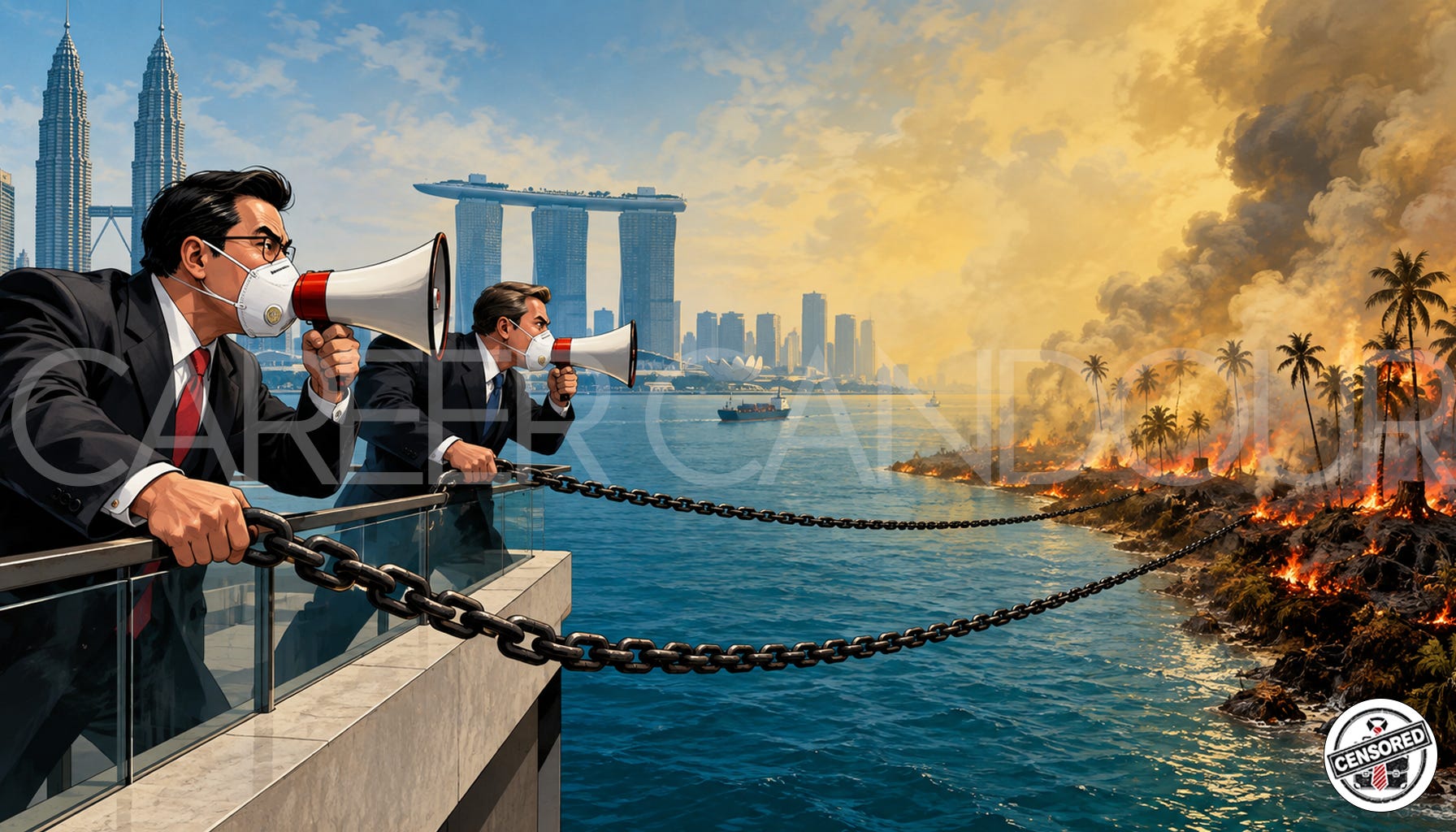
Every year, a civic panic unfolds across the two wealthiest trade hubs in Southeast Asia. In Kuala Lumpur, the Petronas Towers are guillotined at the fortieth floor by a chalky, yellow-tinted shroud; schools across Selangor and the Klang Valley shutter their windows, dispatching millions of asthmatic children home. One hour south by turboprop, the towers of Singapore’s central business district vanish into an identical, eye-watering soup; and boutique pharmacies on Orchard Road do a brisk trade selling imported N95 respirators at a three-hundred percent markup.
The accompanying political chorus is predictable. Editorials assume the solemn cadence of Victorian missionaries cataloguing the moral defects of the equator. The diplomatic communiqués take on a tone of bruised innocence: two orderly, law-abiding, clean-scrubbed modern republics have once again been set upon by an unruly, indolent neighbor to the south whose backyards are inexplicably on fire. On social media, Singaporean and Malaysian netizens unite in a rare display of cross-Causeway brotherhood, venting their spleen at Indonesian corruption, Indonesian backwardness, and the apparent Indonesian incapacity to operate a water bucket.
It’s a neat morality play. It is also an economic fairy tale.
The regional delusion is that the haze represents a foreign nuisance exported across sovereign borders by a chaotic agrarian nation to victimize the technocracies of the Malacca Strait. In reality, the smoke is the biological footprint of a highly efficient, transnational extraction machine that was designed, capitalized, managed, and publicly traded in the very capitals that now demand a refund on their clean air.
Blaming the Neighbour
For governments in Putrajaya and Singapore, the annual return of the smoke offers a political luxury: a public crisis for which the villain resides entirely outside domestic voting districts.
In 2014, Singapore passed the Transboundary Haze Pollution Act (THPA), a legislation designed to give Singaporean courts the power to levy criminal and civil penalties on foreign companies whose smoke drifts across the territorial boundary. The statute was hailed as a triumph of rules-based deterrence. In practice, its enforcement has been hindered by diplomatic sensitivities. To prosecute a recalcitrant plantation owner in Sumatra or West Kalimantan, Singaporean authorities require high-resolution cadastral maps, ground-level forensic cooperation, and the service of court notices inside Indonesian sovereign territory… all of which Jakarta has treated with little the enthusiasm.
Across the Causeway, Malaysia favors the posture of the wounded fraternal neighbor. Successive administrations in Putrajaya have dispatched high-level diplomatic notes to Jakarta, coupled with ministerial offers to send state disaster-management personnel across the water to help the Indonesians put out the flames. The subtext is always the same: Malaysia is a civilized bystander whose well-tended garden has been invaded by smoke drifting over the neighbor’s fence.
The view from Jakarta, predictably, is rather different. Indonesian politicians, fatigued by decades of being treated as the region’s delinquent tenant, have occasionally dispensed with diplomatic niceties altogether. The most unvarnished expression of this counter-sentiment remains the legendary declaration of former Vice President Jusuf Kalla, who noted that for eleven months of every year, Singapore and Malaysia enjoy the pristine, carbon-sinking oxygen produced by hundreds of millions of hectares of Indonesian rainforest without ever wiring a dime of gratitude across the water; to complain so bitterly about the twelfth month, he suggested, was bad manners.
The Western press corps, inevitably adopts the perspective of the balcony from which it reports. When an international correspondent looks out of a Marina Bay high-rise at noon and cannot see the financial district across the water, the resulting dispatch practically writes itself: modern, rules-based capitalism held hostage by the primitive slash-and-burn practices of tropical slashers.
The narrative survives because it ignores the physical architecture of the global commodity trade. The smoke, after all, does not generate itself in a vacuum. It is generated because the drained peatlands of Indonesia are some of the most profitable biological real estate on Earth. And the people who turned them into real estate are not wandering subsistence farmers with matches; they are corporate boards whose executive committees sit within walking distance of the very journalists reporting on the pollution outside.

The Land Grab
The agricultural apparatus that generates the haze is the structural inheritance of two imperial projects and a dose of twentieth-century neoliberal shock therapy.
In 1848, four seedlings of Elaeis guineensis were carried from West Africa to Java and planted in the Bogor Botanical Gardens (‘s Lands Plantentuin te Buitenzorg). For decades, the Dutch treated them as ornamental curiosities. The real legal revolution had nothing to do with agronomy and everything to do with colonial property law. In 1870, the Dutch colonial administration enacted the Agrarian Law (Agrarische Wet), which introduced the lethal administrative doctrine of the Domain Declaration (Domeinverklaring).
Under Domeinverklaring, the colonial state proclaimed any land across the archipelago not subject to European-style private ownership or proven continuous physical cultivation by natives was declared the absolute property of the Dutch Crown. Centuries of customary, collective, and indigenous stewardship (adat) were erased. The Crown then proceeded to carve up this “empty” land into seventy-five-year commercial concessions, termed Erfpacht, and leased them to European corporate syndicates. This colonial mechanism is the direct genetic ancestor of the modern Indonesian commercial plantation lease: the Hak Guna Usaha (HGU).
When the colonial empire collapsed, the two halves of the plantation belt diverged. While Indonesia descended into Sukarno’s nationalizations, Malaysia pursued a path of scientific, disciplined agrarian modernization. Under Tun Abdul Razak in the 1960s, Malaysia launched FELDA (the Federal Land Development Authority) and domesticated the corporate expertise of British plantation houses like Guthrie, Golden Hope, and Harrisons & Crosfield. By the 1980s, Malaysia was the undisputed master of oil palm genetics, processing, and estate management. It possessed the world’s most advanced plantation conglomerates, but by the mid-1990s, it had run into an immutable physical constraint: it was running out of land.
Then came 1997.
The Asian Financial Crisis was the structural breaking point where Singaporean and Malaysian capital formally annexed the Indonesian frontier. When the rupiah crashed and the Suharto regime disintegrated under the weight of its crony bank bailouts, the Indonesian banking system was placed into state intensive care under the Indonesian Bank Restructuring Agency (IBRA/BPPN). Bankrupt tycoons who had pledged vast forestry and plantation holdings as collateral for defaulted loans were forced to surrender their titles.
To secure its multi-billion-dollar bailout, Jakarta was compelled by the International Monetary Fund to sign a structural adjustment program that dismantled its longstanding nationalist ownership caps. The IMF mandated that Indonesia open its agricultural and plantation concessions to up to one hundred percent foreign equity.
A fire sale of unprecedented scale ensued. Malaysian plantation conglomerates, flush with cash, backed by domestic institutional capital, and desperate for acreage, crossed the Malacca Strait to acquire distressed Indonesian assets at bankruptcy valuations. The crown jewel of this expansion occurred in late 2000, when Malaysia’s state-backed Kumpulan Guthrie swooped in to buy twenty-five plantation companies from the Salim Group—held under PT Minamas Gemilang—for a modest sum of roughly $368 million. In an instant, a Malaysian firm gained control of nearly 200,000 hectares of prime Indonesian soil. Over the following decade, Kuala Lumpur Kepong (KLK), IOI Corporation, and Genting Plantations followed suit, establishing vast colonial-scale fiefdoms across Sumatra and Kalimantan.
Simultaneously, the Chinese-Indonesian commercial dynasties that had dominated Suharto’s New Order fled the anti-Chinese violence of May 1998, relocating their family trusts, financial headquarters, and corporate legal vehicles to Singapore. The land remained anchored in the Indonesian mud; the legal ownership, the trade financing, and the equity capital were transferred to the Lion City.
The modern plantation machine was thus assembled: an Indonesian territorial sacrifice zone, operated with Malaysian agricultural management, financed and legally insulated by Singaporean capital.

Follow the Money
To observe the modern palm oil industry is to witness a corporate Matryoshka doll, engineered to maximize the upward extraction of cash while ensuring the downward deflection of liability.
At the base of the doll sits the operational workhorse: the Indonesian PT PMA (Perseroan Terbatas Penanaman Modal Asing). This is the entity registered in Pekanbaru, Palangka Raya, or Pontianak.
It holds the HGU concession title;
It employs the local plantation managers;
It navigates the shakedowns by regional regents (Bupati);
It maintains the private security guards who clash with customary villagers.
Crucially, when an infrared satellite signature detects a conflagration the size of Manhattan within its GPS coordinates, it is the local PT whose bank accounts are frozen and whose field officers face the television cameras of the Indonesian Ministry of Environment and Forestry (KLHK).
Open the doll, however, and the Indonesian operational entity dissolves into a sophisticated web of offshore corporate architecture.
On the Malaysian side, the ownership is deeply tied to the state. Conglomerates like SD Guthrie (formerly Sime Darby Plantation), Kuala Lumpur Kepong (KLK), IOI Corporation, and Genting Plantations operate hundreds of thousands of hectares of concessions across Indonesia. These are not fly-by-night speculative operations; they are the crown jewels of the Kuala Lumpur stock exchange (Bursa Malaysia).
More importantly, they are the cornerstone holdings of the Malaysian welfare state. The shares of these plantations are held in massive blocks by Permodalan Nasional Berhad (PNB)—the national unit-trust scheme designed to uplift ethnic Malay wealth—and the Employees Provident Fund (EPF), the compulsory retirement vehicle for the entire Malaysian private-sector workforce. When an oil palm estate in Riau yields a bumper harvest, the financial beneficiaries are not shadowy offshore bandits; they are Malaysian schoolteachers, civil servants, and corporate clerks whose retirement dividends depend directly on the yield per hectare of Sumatran soil.
Meanwhile, Singapore is the brain, the banker, and the clearinghouse.
It is the global operational headquarters of Wilmar International, co-founded by Malaysian billionaire Robert Kuok’s nephew, Kuok Khoon Hong, and Indonesian-Chinese trader Martua Sitorus. Listed on the Singapore Exchange (SGX), Wilmar controls upwards of forty percent of the global processing and merchandising of palm oil.
It is the corporate home of offshored Indonesian oligarchic capital. Golden Agri-Resources (GAR), the agribusiness arm of the Indonesian billionaire Widjaja family’s Sinar Mas empire, is incorporated in Mauritius, headquartered in Singapore, and listed on the SGX. First Resources, built by the Indonesian Fangiono family, is likewise an SGX blue-chip.
Through initiatives like the Global Trader Programme, Singapore offered concessionary corporate tax rates, world-class dispute arbitration, and banking confidentiality specifically to encourage regional commodity houses to anchor their treasury, risk management, and trading desks in downtown Singapore.
Furthermore, the expansion of these estates was underwritten through syndicated loan facilities, sustainability-linked credit lines, and revolving trade credit provided by the banking pillars of the Singaporean economy.
In simple terms:
The Indonesian operational subsidiary generates the raw material and absorbs the ecological, legal, and operational risk.
The Malaysian holding companies channel the industrial profits directly into national pension funds and sovereign investment vehicles.
The Singaporean corporate domiciles, banks, and trading desks capture the high-margin trade finance fees, the treasury gains, and the tax revenues.
And when the dry season arrives, the holding companies issue sustainability reports adorned with pictures of smiling smallholders and wide-eyed orangutans, affirming their total corporate compliance with “No Deforestation, No Peat, No Exploitation” (NDPE) policies, while their processing mills purchase Fresh Fruit Bunches at market rates from middleman collection points that ask no questions about which freshly burned peat swamp produced the fruit.

Corporate Amnesia
In late August, Indonesia’s Ministry of Environment and Forestry announced that it had initiated investigations into nineteen plantation and forestry concessionaires whose lands contained major fire clusters.
Traditionally, this would have been the investigative scoop of the season. Journalists in Kuala Lumpur and Singapore would have demanded the corporate registries, cross-referenced the concession boundaries with satellite telemetry, and matched the titles to parent companies on the SGX and Bursa Malaysia.
Instead, the regional press relegated the announcement to the back pages of the business sections, because the Indonesian authorities declined to publicly release the names of the corporate suspects.
Without a named culprit, mainstream editors had no recognizable brand to put in a headline. And everyone in the industry understood the unwritten rule: the moment you begin cross-referencing corporate concession coordinates in Riau or Ketapang with listed holding entities, the comfortable binary of “clean victim city-state” versus “dirty Indonesian arsonists” collapses.
This dynamic was put on public display on September 4, when representatives from Malaysian civil society, led by Greenpeace Malaysia and human rights collective HARAM, marched not on the Malaysian parliament, but on the Indonesian Embassy in Kuala Lumpur. Their demand was not a cessation of Indonesian agricultural activity; they delivered a formal memorandum demanding that Jakarta publicly name the nineteen companies.
The activists knew precisely what they were doing. They were well aware that several of those nineteen concessions were operating as subsidiaries or joint-venture affiliates of Malaysian- and Singaporean-linked conglomerates. The protest was a public plea for a foreign government to out Malaysia’s own corporate champions, because the Malaysian domestic political system is structurally incapable of doing so itself.
The most intellectually insulting component of this is the defense offered whenever satellite coordinates unmistakably place an active blaze within an MNC’s concession: the doctrine of feigned corporate helplessness.
In their investor presentations, these conglomerates boast of enterprise resource planning (ERP) systems, AI-powered drone swarms capable of assessing leaf-canopy nitrogen deficiencies to the square meter, and real-time satellite monitoring of palm fruit ripeness.
Yet, the moment an infrared thermal sensor on a NASA satellite detects a two-thousand-hectare inferno raging across their peat concession, the corporate board in Kuala Lumpur or Singapore suddenly morphs into a collection of wide-eyed, helpless innocents. “It was an external fire,” the corporate communications department explains. “It originated on customary land outside our perimeter; it was lit by rogue, unregistered smallholders over whom we possess no operational control; our emergency response units fought bravely to contain the trespass.”
It is a defense that would be laughed out of any court in the Commonwealth. If an estate manager fails to hit their quarterly fresh fruit yield target by four percent, their employment is terminated before the next board cycle. But when that same estate manager presides over a concession where thousands of hectares of drained peat are reduced to an open-air combustion pit, corporate headquarters pleads operational amnesia. The modern multinational demands complete command-and-control over the value of the commodity, while insisting it is utterly powerless over the physical land on which that commodity is grown.
Too Close to Home
This brings us to the hypocrisy that underlies the entire haze season: the absence of domestic public protest against the financial institutions and corporate parents that facilitate the burn.
Every year, millions of educated, politically engaged citizens in Kuala Lumpur, and Singapore spend weeks coughing through their daily commutes, buying expensive air purifiers, and filling community message boards with venom directed at Jakarta.
Yet, virtually no one ever thinks to print a protest placard, walk down to the intersection of Shenton Way and Marina Boulevard in Singapore, and stand outside the global headquarters of DBS, OCBC, or Wilmar International. No crowd of angry suburban parents ever gathers outside the corporate headquarters of SD Guthrie in Ara Damansara or KLK in Mutiara Damansara to demand an explanation for why their children are inhaling sulfur dioxide.
Why?
In Singapore, under the Public Order Act, an outdoor public demonstration involving even a single person holding a cardboard sign requires a police permit—a permit that is essentially never granted for political protests against corporate champions or state-linked financial institutions. The only legal space for public dissent is the Speakers’ Corner at Hong Lim Park, where demonstrations are subject to strict registration rules.
Protesting against an Indonesian cabinet minister on Twitter or cheering the extraterritorial posturing of Singapore’s National Environment Agency carries zero political risk; it is aligned with state policy. But staging a public boycott outside a Singaporean bank that underwrites loans for a plantation group clearing peat in Central Kalimantan would swiftly bring an activist into contact with the Internal Security Department. Civic outrage in Singapore is carefully canalized outward, where it cannot disturb the domestic financial engine.
In Malaysia, the silence is driven by the national champion trap.
The plantation sector in Malaysia is viewed as the historic crown jewel of the country’s affirmative-action developmental state. When Kumpulan Guthrie was seized from British control during the “Dawn Raid” on the London Stock Exchange in 1981, it was celebrated as a seminal moment of anti-colonial economic liberation for the Bumiputera (ethnic Malay) majority. The plantation giants are the backbone of the Government-Linked Companies (GLCs) that fund the state apparatus.
To demand that the Malaysian government criminally prosecute or strip the assets of Malaysian plantation conglomerates operating in Indonesia is to demand that the state sabotage the investment returns of PNB, Khazanah, and the EPF.
The Malaysian citizen wearing an N95 mask in a Subang Jaya traffic jam is caught in a financial loop: the particulate matter scarring their lungs is being produced by a concession whose quarterly earnings will pad their own mandatory pension statement next January. And because human nature finds cognitive dissonance intolerable, it is vastly easier for the citizen to project all moral culpability across the maritime border onto an Indonesian caricature than to admit that their own comfortable retirement dividend was paid for in Sumatran smoke.

To allocate the blame for the transboundary haze accurately is not to exonerate the Indonesian state. Indonesia’s governance of its agrarian frontier remains an institutional catastrophe. The post-1998 decentralization (Otonomi Daerah) turned regional regents (Bupati) into autonomous local monarchs who traded plantation permits on protected peatlands for political campaign financing. The chaotic overlap between ministerial maps, the pervasive influence of local speculative land syndicates (cukong), and the chronic underfunding of regional forestry enforcement are real, documented, and indefensible failures of Jakarta’s sovereign responsibility.
Yet, to pretend that the haze is an Indonesian phenomenon that happens to spill over into innocent neighboring territories is an act of willful economic blindness.
The transboundary haze is the physical manifestation of ecological unequal exchange in late-capitalist Southeast Asia:
Indonesia functions as the biological sacrifice zone. It provides the cheap soil, the regulatory chaos, the loss of ancient biodiversity, the poisoned local water tables, and the lifelong childhood respiratory illness in Riau and Kalimantan that never makes the international headlines.
Malaysia provides the agronomic muscle, the corporate management machinery, and the state-backed plantation giants whose blue-chip profits support the national savings architecture.
Singapore provides the tax-incentivized corporate domiciles, the commodity trading desks, the common-law legal sanctuaries, and the sophisticated banking syndicates that wash the risk and package the profits for international investment portfolios.
It is the most successful, lucrative, and seamless cross-border resource partnership in the post-colonial developing world. It has created multibillion-dollar family dynasties, anchored national sovereign wealth funds, and enriched the state treasuries of three nations for the better part of four decades.
However, it has one structural design flaw.
The corporate lawyers on Shenton Way can craft holding structures that isolate parent entities from the torts of their Indonesian subsidiaries; the risk-management desks in Kuala Lumpur can hedge against commodity price swings; and the foreign press corps can continue to write dispatches about the backwardness of their tropical neighbors.
But when the southwest monsoon begins to blow across the Malacca Strait in the dying days of the dry season, the wind blows right past those corporate boundaries unhindered. The peatlands, drained to their breaking point to hit the quarterly yield projections demanded by investors in Kuala Lumpur and Singapore, simply catch fire and turn into air.
And as the thick, yellow-grey cloud drifts across the water, it delivers a message of terrifying simplicity: you made the money, now breathe the smoke.
StratEx - Indonesia Business Advisory provides Indonesia-focused advisory and leadership intelligence for investors that need to understand what is really moving beneath the surface. Contact us for better visibility before making your next move in Indonesia.