


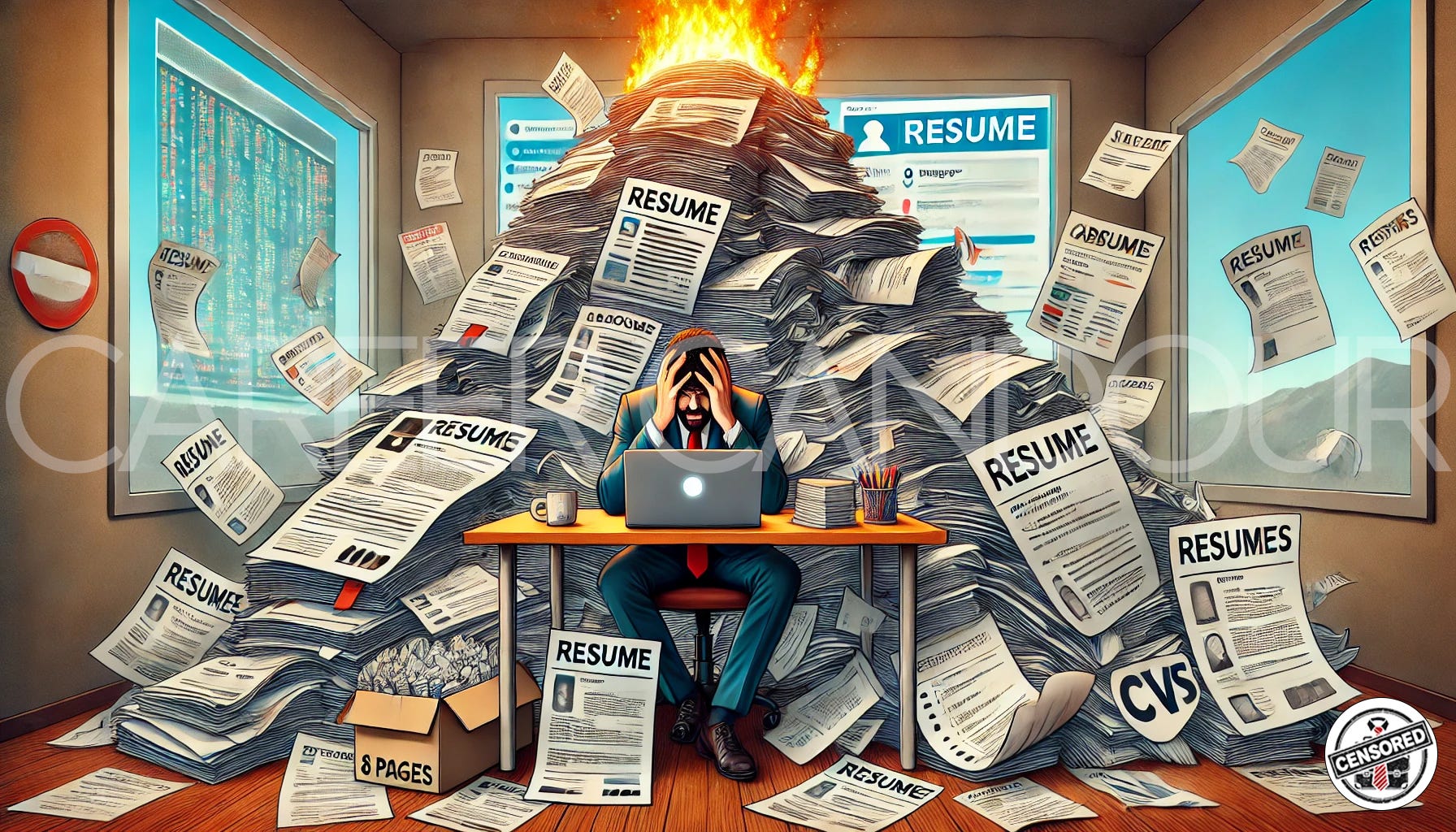
Across the globe, millions of job seekers have united in a single shared belief:
The job market is broken.
The economy is rigged.
The ATS is biased.
Recruiters are lazy.
Hiring managers are heartless.
It’s a comforting theory. It explains everything while requiring absolutely nothing of you. No uncomfortable self-reflection. No tedious editing. No painful acknowledgement that maybe your CV is not “standing out,” it is standing in the way.
Maybe the problem isn’t the job market. Maybe the problem is that people absolutely cannot write a CV if their lives depended on it.
Not because they are unintelligent, but because they are strangely committed to making the simplest document in their career the most chaotic one. They will spend hours optimising for obscure theories, while ignoring the basics staring back at them.
This article is a eulogy to the simple, basic, low-bar art of writing a halfway competent CV. We will explore why so many people fail at it, why they blame external forces instead of their own 8-page “professional novel,” and what anyone who has ever screened resumes already knows.
The Job Market Isn’t the Only Problem
Every week, desperate candidates post online like clockwork:
“Applied to 742 roles. No replies.”
“ATS systems hate humans.”
“AI rejected me .”
And honestly, fair enough. It is brutal out there. The silence is demoralising. The numbers are grim. The market can be weird, and slow.
But the comment sections always follow the same pattern. \
A chorus of sympathy.
A handful of conspiracy theories.
A few people selling a $49.99 “ATS DESTROYER” template.
And nobody, not a single brave soul, asks the forbidden question:
“Hey, mate, can we see your CV?”
Because deep down, we all know what’s coming.
It will arrive as a 7-page PDF, formatted in Microsoft Word 2007, featuring
A glamor headshot taken at a nightclub
A “Skills Chart” showing they are ★★★★★ in Communication
A 250-word explanation of what their employer does
And, naturally, a paragraph titled “Objective” from the year 1998
Recruiters aren’t rejecting these people. Humanity is rejecting these people. A CV like this does not whisper “hire me.” It screams
“I have never once Googled ‘good resume example’ because I was too busy blaming capitalism.”
This is the modern tragedy. Not that people can’t get jobs. It’s that they are sending documents that actively fight against them, then acting shocked when employers do not reward the effort.

Senior People, Please Stop Doing This
Many of the CVs that triggered this article came from people claiming to be senior.
Senior.
Not “early career, still figuring it out.”
Not “fresh graduate, used a template from a cousin.”
Senior candidates, who allegedly manage teams, present to executives, run budgets, make strategic decisions, and have supposedly reviewed CVs themselves at some point in their careers.
One might assume that sheer exposure would do something. That after years of hiring, interviewing, and rejecting people, a senior professional would absorb at least the basic laws of readable communication.
What an employer wants to see.
What details matter.
Where the current job goes. (hint: At the top)
And yet, reviewing hundreds of CV suggests that seniority does not automatically come with the ability to write a CV.
We’re seeing
CVs that begin with Education for a 45-year-old.
Roles listed oldest to newest.
Entire first pages sacrificed to personal trivia: full address, age, marital status, nationality… blood type.
Then there’s the design. Boxes. Icons. Color gradients. Text scattered across the page. A CV that looks less like a professional document and more like a menu at a brunch place that charges $18 for toast.
How does this happen? My working theory is simple.
No one has ever told them the truth. Or they were told, briefly considered it, and then chose a “modern” template that promised to help them stand out.
It did. Just not in the way they hoped.

The 6–8 Second CV Scan Is Not a Myth
Eye-tracking studies show that recruiters spend 6–8 seconds on an initial CV scan. Not minutes.
Seconds.
If a recruiter receives 400 applications and gives each one even 20 seconds, that is over two hours of pure scanning.
Not interviews.
Not shortlisting.
Not stakeholder updates.
Just staring into the void of PDFs. And that’s assuming they are not also hiring for five other roles, managing a pipeline, and being asked to “move faster.”
So yes, your CV is being judged quickly. That means your document must answer, immediately:
Who are you?
What’s your seniority?
What impact have you created?
Should we keep reading?
But instead, recruiters open CVs where the first thing they see is:
“OBJECTIVE: To obtain a challenging and rewarding role that allows me to grow professionally…”
Wonderful. Inspiring. Useless.
Or:
“Interests: Cooking, hiking, astrophysics, crocheting dinosaur hats…”
Fantastic. Unfortunately, I am hiring a Head of Operations, not selecting a best friend for a weekend retreat.
Then comes the Skills Star Rating Chart, where candidates award themselves:
★★★★★ in Leadership,
★★★★☆ in Problem Solving,
★★★☆☆ in Teamwork.
The only missing rating is the one that matters: evidence.
You know how candidates obsess about applying to hundreds of roles?
Recruiters obsess about trying to find one sane CV among the 500-word autobiographies arriving in their inbox.

The Internet Is Not Helping
What many job seekers actually do, is fascinating. Not what they claim to do. What they actually do.
They apply to 200+ jobs. Often in a scattergun, and panic-driven manner.
One minute they’re applying for “Head of Strategy,” the next they’re trying “Customer Success Manager,” then “Operations Analyst,” then “Chief of Staff,” because surely one of these will work if they just keep clicking.
This is not job searching.
Then they read doom posts about the market.
“Tech jobs vanished.”
“Hiring is frozen.”
“AI has killed my chances.”
You are not being rejected because your CV is bad. You are being rejected because society has collapsed. It’s comforting. It’s… convenient.
Next, they watch TikToks from 19 year old career gurus. Gurus who have:
Never hired anyone,
Never read 500 CVs in a weekend,
Never even used an ATS.
Yet they speak with the confidence of someone who has personally built Workday with their bare hands.
“Put your CV in a circle so ATS focuses better!”
Derrrrp.
They debate esoteric techniques like
The optimal time of day to apply,
Whether PDF or DOCX has better juju,
Whether using ChatGPT causes ATS systems to collapse.
Meanwhile, their CV still has:
5 pages
No achievements
Misaligned fonts
Random bolding
And a summary paragraph that reads like the opening credits of a low-budget documentary about ambition
It’s like watching someone buy gym supplements, study nutrient timing, debate fasted cardio, then refuse to do the one thing that actually matters.
The basics aren’t sexy. But the basics are the only thing that works.

What a Professional CV Looks Like
Here comes the part where readers say,
“OK genius, so what should a CV actually look like?”
Fine.
Let’s lay out the kindergarten-level basics. The things every adult should know. The facts so obvious they feel rude to say out loud.
1. 2 pages. Not 5. Not 8. Not “a short novel of my journey.”
If your CV is longer than a restaurant wine list, you’ve lost. And before someone gets offended, no, this is not about “hating detail.” It’s about respecting attention. Your CV is not being read in a peaceful library with soft lighting and classical music. It is being scanned in a browser tab between meetings by someone who is already late to everything.
A CV that goes on for five pages says you cannot prioritise, cannot edit, and cannot tell the difference between a career highlight and something you did once on a Monday.
2. Most recent role first. Always.
Not your first internship in 2003.
Not your degree in Sociology.
Not the award you won in Year 10 for “Best Effort.”
Your most recent role goes first because it answers the only questions that matter in the first ten seconds:
What level are you operating at now,
What kind of work are you doing,
Does it match what I’m hiring for?
When candidates list roles oldest to newest, they are essentially forcing the reader to dig through their personal museum exhibit to find out who they are today.
3. No unnecessary personal data.
No date of birth.
No religion.
No full home address.
No national ID number.
No photo unless you are in a country where it is genuinely standard or explicitly required.
This is about being professional. Your CV is not a passport application, and it is not a dating profile. It is a work document.
Also, if you dedicate the top third of your first page to personal trivia, you are voluntarily replacing your strongest selling space with details nobody asked for and nobody can legally use.
4. No graphic temples of chaos.
No tables.
No icons.
No boxes.
No charts.
No multi-column layouts.
No colour gradients.
Your CV should not look like a menu at a vegan street-food market. It should look like a clean, readable document that can survive being uploaded into an ATS without turning into a scrambled mess of missing job titles and broken dates.
You are not being hired for your ability to format rectangles. You are being hired for outcomes. Let the content do the work.
5. Write actual achievements, not job descriptions.
Bad bullet:
“Responsible for managing a team.”
Good bullet:
“Led 10-person team, reducing project overruns from 40% to 10% in 6 months.”
The first one tells me nothing. The second one tells me everything. It shows scope, timeframe, and impact. It proves you did something that mattered. If your bullets could be copied from a generic job posting, you have failed the assignment. Anyone can say they “managed stakeholders.”
Tell me what happened because you were there.
And no, “worked on” is not an achievement. It is an admission that you were physically present.
6. One-line company descriptions max.
Not a full Wikipedia entry. If context matters, give me one line. Industry, size, maybe stage. That’s it. I don’t need a history of the organisation.
I need to know what you achieved inside it.
If you spend five lines explaining what the company does, it usually means you have run out of things to say about what you did.
7. The top third of page one must make me want to keep reading.
This is premium real estate. This is the shop window. This is where you either create instant confidence or you don’t. Stop using it for your address, your star chart, and your inspirational mission statement about “thriving in fast-paced environments.”
Instead, put the basics that matter.
Your title.
Your domain.
Your strongest wins.
The scale you operate at.
The problems you solve.
The outcomes you drive.
If I can’t see your value quickly, I will assume it isn’t there. Not because I’m cruel, but because I have 399 other CVs to open and my calendar is already full.
These principles are not advanced. They are not controversial. They are the bare minimum for a CV that does not actively sabotage you. And yet, judging by what’s out there, they remain a rare skill.

If you’re applying over and over with no replies, before you accuse the market, the economy, the ATS, AI, or recruiters, please do one small thing for the sake of your career.
Check the fundamentals of your CV. Then check them again. Then ask someone honest, not your best friend who thinks everything you do is “amazing,” to check them too.
Most people are not being rejected because they are unqualified. They are being rejected because their CV is a linguistic crime scene.
It’s five pages of noise.
It’s an autobiography.
It’s a list of responsibilities with no outcomes.
It’s a document that makes the reader work far harder than they should have to.
You don’t need perfection. You just need a document that doesn’t sabotage you before the recruiter even blinks. A CV that respects time, shows impact, and makes it easy to say yes.
Fix that, and suddenly the job market looks a lot less broken.
At Career Candour we work 1:1 with professionals to rebuild CVs from the ground up. Your real experience. Your impact. Your value. No templates, no hacks. Doesn’t matter how good you are if no one can understand it in six seconds.. Want this done properly? DM us.