


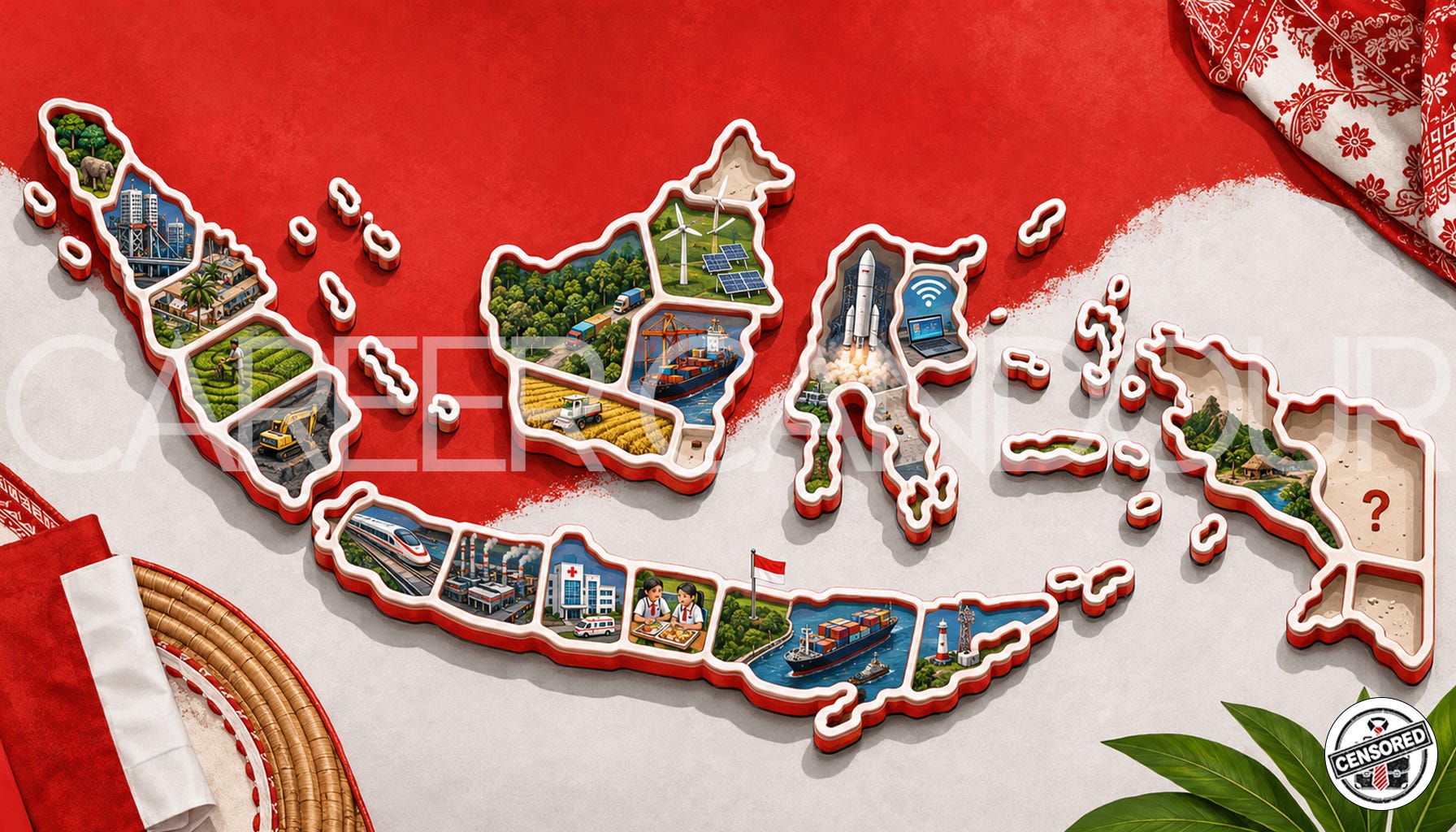
Indonesia appears to be entering a new phase in how it talks about the economy. The word now being used is ‘Prabowonomics’, and although the term still feels young, it already suggests something more than a slogan. It points toward a broader attempt to redefine what economic success should mean under President Prabowo Subianto.
Prabowonomics seems to ask a question that has followed Indonesia for decades: what is growth supposed to deliver, and for whom should it become visible first?
That question matters because Indonesia has, by many conventional measures, been a development success story. It has maintained relative macroeconomic stability, expanded infrastructure, and improved its position in global supply chains. To many outside observers, particularly investors and foreign analysts, the country has often looked like one of the more compelling long-term economic stories in Asia.
Yet inside Indonesia, the experience of progress is more complicated. Development may be visible in roads, industrial zones, digital services, and commodity exports, but for many households the economy is felt through food prices, school costs, wages, debt, job security, and the everyday question of whether life is becoming more manageable.
This is the space in which Prabowonomics is beginning to take shape.
When Prabowo says that economic development should not just be about statistical numbers, it feels true and politically interesting. No serious economist believes GDP alone captures national well-being. But no serious development strategy can simply move away from numbers into a language of moral intention. A better life is not less measurable than growth; in many ways, it is more difficult to measure properly.
Prabowonomics appears to promise a more people-centered, sovereignty-minded, state-led model of development. It may become a serious attempt to make economic growth more tangible for ordinary Indonesians. It may also test how far a government can stretch the language of welfare before the public begins asking for evidence of delivery.
For foreigners trying to understand Indonesia’s direction, the point is not to decide too quickly whether Prabowonomics is good or bad. The more useful task is to ask what it is trying to do, why it has emerged now, what it continues from the previous era, and what it changes.
What ‘Prabowonomics’ Seems to Mean
Prabowonomics is not yet a fully formalized doctrine. There is no single text that defines its principles, trade-offs, methods, or limits. Instead, it has to be aggregated through speeches, budget priorities, flagship programs, institutional choices, and the political language now surrounding economic policy.
What emerges is a view of the economy as a national project rather than a growth machine. In this view, development should strengthen the country’s capacity to feed itself, protect itself, process more of its own resources, and make welfare visible in the lives of citizens. The state is expected to be an organizer, provider, investor, and guardian of national direction.
That does not mean Indonesia is turning away from markets or foreign investment. In fact, Prabowonomics seems to want both a stronger state and continued international confidence. This is one of its defining balancing acts. Indonesia wants capital, technology, industrial upgrading, and global relevance, but it also wants more control over the terms of its own development.
This is not unusual for a country at Indonesia’s stage of ambition. Many emerging economies eventually confront the limits of simply being attractive to investors. They begin asking whether investment is creating enough domestic value, and whether growth is strengthening society or merely producing impressive aggregate figures.
Prabowo’s economic language appears to come from that concern. It carries a strong belief that Indonesia should not remain dependent on external forces to determine its development. It also reflects a long-standing anxiety in Indonesian political economy: that the country’s natural wealth, demographic scale, and strategic geography should translate into more visible national power and broader domestic prosperity.
This is where Prabowonomics differs in tone from the previous development model. The Jokowi era was often associated with infrastructure, investment, downstreaming, and practical problem-solving. Prabowo has inherited much of that foundation, but he is placing heavier emphasis on welfare, food security, national resilience, and strategic autonomy.
Jokowi’s economic story often seemed to say: build the foundations, and prosperity will follow.
Prabowo’s story seems to ask: if prosperity is the goal, why should the state wait for it to arrive indirectly?
It’s a difficult question, because once a government promises to make welfare more direct, it accepts a more intimate form of accountability. People may debate the long-term benefit of a toll road or industrial estate. A school meal, a household food bill, or a job opportunity is judged much more immediately.
That is why Prabowonomics should be understood as a shift in the emotional contract between the state and the public. It asks citizens to believe that the government can make development feel closer to daily life.
The question is whether the machinery of government can match the ambition of that promise.

What “Beyond Statistics” Means
Prabowo’s statement that development should not only be about statistical numbers is perhaps the most revealing phrase in this emerging economic language.
In one sense, it reflects a mature critique of development measurement. GDP growth can hide many things. It can rise while:
Inequality remains stubborn,
Informal workers remain insecure,
Public services vary dramatically across regions,
Households feel that the cost of living has absorbed whatever progress they were told had occurred.
This is why the global conversation about development has long moved beyond GDP alone. The issue is not whether growth matters; it clearly does. The issue is whether growth is being treated as a substitute for well-being rather than as one condition that may help produce it.
Seen generously, Prabowo’s argument is a call to make development more human. It suggests that the success of the economy should be judged not only by national aggregates but by whether people live with greater security and dignity.
But the phrase also opens a difficult question.
If development is not just about numbers, how should citizens know whether it is working?
A better life leaves evidence. Not always immediately, and not always in one grand indicator, but over time it should be visible in the condition of households, children, workers, schools, health systems, food security, and regional opportunity. If welfare is the standard, then the government needs more detailed measurement, not less.
Moving beyond GDP should mean moving toward a broader and more honest account of national progress. It should not mean replacing measurable outcomes with softer language that is difficult to challenge.
The temptation is always to celebrate statistics when they are favorable and to question the limits of statistics when they become inconvenient. The more thoughtful challenge is to create a standard that remains valid in both circumstances.
If Prabowonomics is to be taken seriously as a development framework, it will need to define what “better life” means in ways that can be observed. Does it mean
Improved nutrition?
More secure employment?
Stronger purchasing power?
Better public services?
Lower vulnerability to price shocks?
More balanced regional development?
The exact indicators can be debated, but without them, “better life” risks becoming a phrase that everyone supports because everyone can interpret it differently.
The most credible version of Prabowonomics would argue that the old statistics were too narrow and then offer better ones. It would say that GDP remains important, but that Indonesia should judge itself by whether national growth is becoming household resilience.

The State on a Plate
The free nutritious meals program is perhaps the clearest early symbol of Prabowonomics because it turns an abstract development philosophy into something immediate.
Its political appeal is easy to understand. Nutrition is one of the few policy areas where moral urgency and economic logic genuinely meet. A healthier child is a foundation for future productivity, learning, and national capacity. If Indonesia wants to become a stronger economy, it cannot treat human development as an afterthought to industrial strategy.
In that sense, the program is not merely welfare. Before a country can talk convincingly about high-value manufacturing, technological upgrading, or global competitiveness, it must confront the basic condition of its people. Human capital is not created at the university gate.
This is the strongest case for the program. Good policy is often politically useful. The question is whether the state can deliver it reliably, safely, and efficiently at national scale.
A national meals program requires coordination across layers of government, local suppliers, schools, kitchens, monitoring systems, and budget channels. It requires food safety discipline, procurement integrity, and the ability to correct problems quickly. These are exactly the tasks that determine whether a policy becomes a national achievement.
This is why the free meals program should be watched carefully but fairly. Early implementation difficulties do not necessarily prove that the concept is flawed. Large social programs often evolve through correction. But the way those corrections are handled will matter. A serious government learns from weak delivery. A defensive one treats criticism as misunderstanding.
The bigger question is whether the program will be evaluated by its stated social purpose or by the scale of its activity. Serving many meals is impressive, but the developmental question is whether the program improves nutrition, supports learning, reduces household strain, and strengthens the systems around food provision.

What Has Changed Since Jokowi
For many foreign observers, the shift from Jokowi to Prabowo may be confusing because there is both continuity and change.
Indonesia still:
Wants investment.
Wants industrial upgrading.
Sees downstreaming and resource processing as central to its future.
Wants infrastructure to support growth.
The ambition to move Indonesia up the economic value chain has not disappeared.
The change is in the logic.
Jokowi’s model was often read as practical developmentalism.
It focused on building the physical and regulatory conditions for growth.
Its symbols were concrete, logistical, and investment-facing.
It reassured many outsiders because it was relatively legible.
Indonesia was building infrastructure, improving connectivity, courting capital, and trying to turn natural-resource advantages into industrial strength.
Prabowo’s model is less content to assume that investment-led growth will automatically translate into broad welfare. It gives the state a more direct role in ensuring that development serves strategic and household-level goals.
Investors are trying to understand the new balance between state direction and market predictability. A more assertive economic state can be effective, but it also raises questions about fiscal pressure, regulatory consistency, institutional capacity, and how policy priorities will be chosen.
These concerns are ordinary questions that arise whenever a government expands its ambition. Markets tend to prefer familiar frameworks, even imperfect ones, because familiarity reduces uncertainty.
Jokowi’s achievements created a sense that Indonesia had found a workable growth formula. When a new administration adjusts that formula, uncertainty follows.
Prabowo’s supporters might argue that this adjustment is necessary. Infrastructure and investment are not enough if many people still feel vulnerable. A country cannot measure success only by how it appears to investors. It must ask whether citizens feel the economy working in their lives.
Cautious observers might ask whether Indonesia expand welfare commitments, strengthen strategic sectors, maintain fiscal discipline, and preserve investor confidence at the same time?
The transition is not just from one president to another. It is from one development emphasis to another: from the infrastructure state toward something closer to a welfare-sovereignty state.
Whether that becomes a durable model will depend on the quality of the institutions asked to carry it.

What Comes Next
The next few years will reveal whether Prabowonomics becomes a coherent economic framework or remains a broad political language attached to multiple priorities.
Indonesia is likely to place more emphasis on state coordination, social welfare, food security, strategic industries, and national control over key areas of the economy. It will continue to seek foreign investment, but with an insistence that investment align with national development goals.
For foreigners, this means Indonesia should not be understood as turning inward in a simple sense. The country is not rejecting global capital or international engagement. Rather, it appears to be trying to negotiate a different relationship with them. The message is less “come and invest” than “come and invest in ways that fit Indonesia’s national project.”
If managed well, this could strengthen Indonesia’s position. The country has scale, resources, and geopolitical relevance. A more confident development strategy could help it capture greater value domestically and build a stronger foundation for long-term prosperity. A state that invests in human capital while guiding industrial development could, in theory, address weaknesses that pure market-led growth might leave unresolved.
But the same strategy carries risks.
A stronger state can coordinate development, but it can also concentrate discretion.
National priorities can guide investment, but they can also blur into favoritism if institutions are weak.
Welfare programs can build human capital, but they can also strain budgets if outcomes are not carefully measured.
Industrial policy can create competitiveness, but only if it rewards performance rather than proximity to power.
These are the conditions under which success or failure will be determined.
A thoughtful reading of Prabowonomics should avoid the two extremes.
It should not dismiss the model as simple populism, because the underlying concerns are real.
It should not romanticize state-led development simply because the language is national and humane.
The history of development is full of governments that correctly identified problems and then struggled with the machinery required to solve them.
If Indonesia can define clear welfare outcomes, measure them honestly, protect fiscal credibility, and maintain policy predictability, Prabowonomics could become a serious evolution of Indonesia’s development model.
If it cannot, the language of welfare may become too flexible.
Every policy can be described as strategic.
Every trade-off can be described as necessary.
Every criticism can be answered by invoking a bigger national purpose.
That would make debate harder precisely when debate is most needed.
The future of Prabowonomics will not be decided by whether it sounds compelling. It already does. It will be decided by whether its promises survive budgets, bureaucracy, markets, local implementation, and the daily lives of the people it claims to serve.

Prabowonomics is best understood as Indonesia’s attempt to give economic development a more national and human meaning. It reflects a belief that growth should strengthen sovereignty, improve welfare, and become more visible in ordinary life.
But once a government says development is about better lives rather than statistics alone, it must show how those better lives will be recognized. It needs evidence.
Indonesia’s debate should move toward a more candid conversation about standards.
What should Prabowonomics be judged by?
Which outcomes matter most?
How soon should they be visible?
Which trade-offs are acceptable?
How will the public know whether state intervention is producing public value?
Indonesia may be entering a more assertive phase of economic governance. The country still wants growth, investment, and global relevance, but it wants those things to serve a broader domestic purpose. The state is moving closer to the center of the development story, and welfare is being placed closer to the center of the state’s legitimacy.
That could prove to be an important correction to a model that sometimes made national progress look clearer from a distance than it felt at home.
Prabowonomics promise is significant:
A stronger Indonesia,
A more visible form of welfare, and
A development model that asks more of growth than growth alone.
But the unanswered question is equally significant: can the state deliver enough, measure honestly enough, and adapt quickly enough to make that promise real?
Indonesia is right to move beyond narrow statistics, because they are not the whole story. But they are how the story proves it is true.
At StratEx - Indonesia Business Advisory provides Indonesia-focused advisory and leadership intelligence for investors that need to understand what is really moving beneath the surface. Contact us for better visibility before making your next move in Indonesia.
Interesting article. As it points out, Prabowo has never specifically defined what 'Prabowonomics' actually is. Prabowonomics essentially refers to the series of economic decisions made by his administration to boost growth. However, it relies on an 'old-school' approach where the government heavily intervenes in all economic activities, rather than focusing on attracting investment to create jobs and trigger a multiplier effect. While there are no tangible results yet, recent developments suggest it may not be enough to reach the target.
This may help to better understand what is going on:
The bigger picture; the Regime's world agenda.
While protesters in Indonesia may believe they have legitimate anger and causes, the fact that US-funded organizations are directing and promoting the protests indicates yet another case of hijacked-grievances. The US just demanded Indonesia open its airspace to US military aircraft, a demand Indonesia rejected. The protests are enhanced by the global energy and economic crisis deliberately created by the US war on Iran in West Asia. US control over Indonesia would threaten the Malacca Strait, further constricting Chinese maritime shipping of both imported energy and exported goods.
https://youtu.be/xAEb1KwROAA?si=iLoVFnbjNvA42c4_
We need to stop this before the world economy goes further into a crisis state, which will be controlled by the Trump regime, but only the ogliarchs will benefit. Please make the video go viral before it is deleted. Call it a geopolitical quest.