


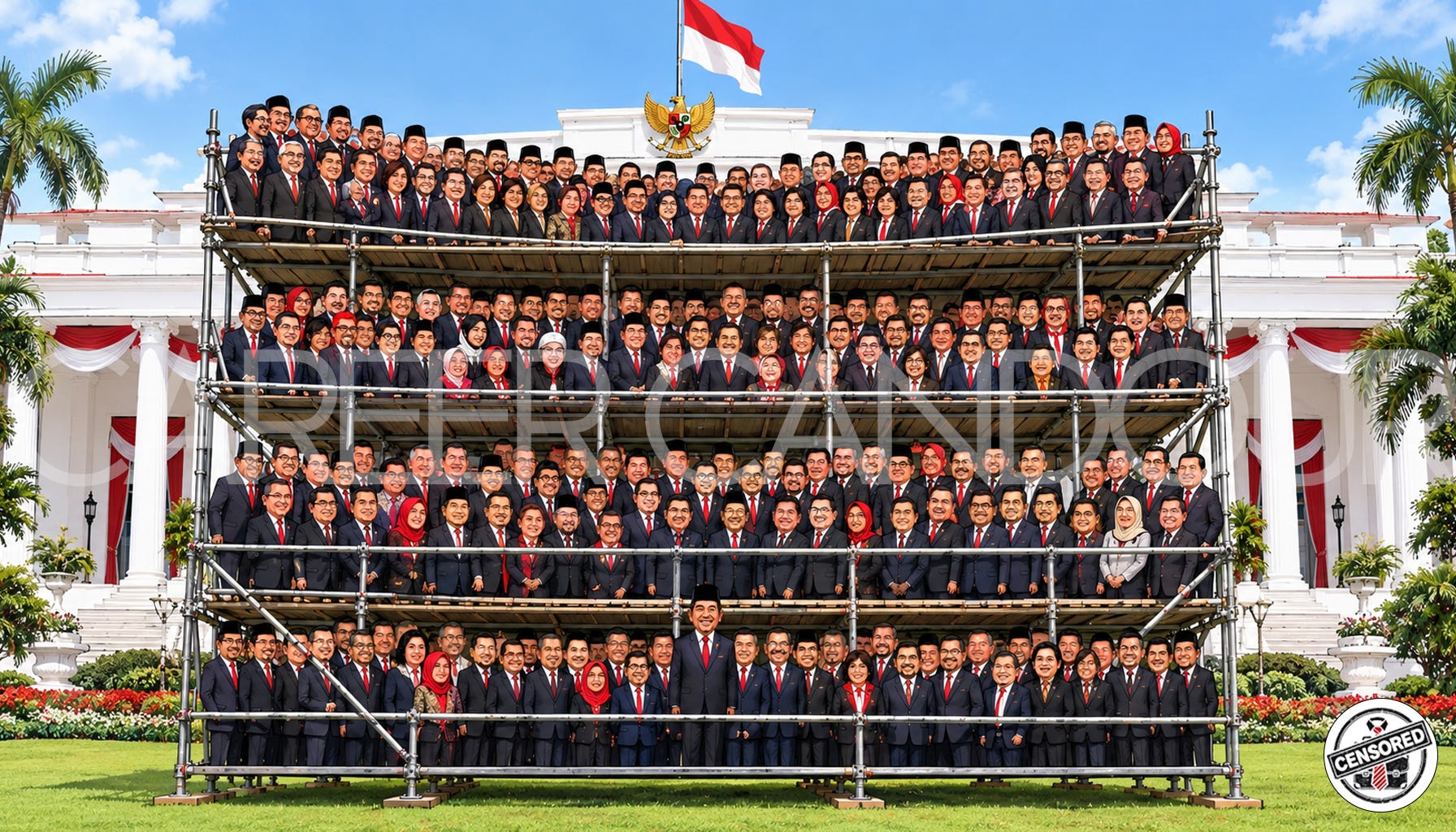
When the Kabinet Merah Putih (Red and White Cabinet) gathers on the manicured lawns of the State Palace, the lens requires a panoramic sweep usually reserved for military parades or stadium rock concerts. With 49 cabinet ministers, nearly 60 deputy ministers, and a phalanx of ministerial-rank agency heads, special advisers, and presidential envoys, the gathering represents the largest civilian mobilization of political rank since 1966. In that year, President Sukarno unveiled his legendary Kabinet Seratus Menteri (Cabinet of One Hundred Ministers), an administrative behemoth that collapsed almost immediately.
Six decades later, President Prabowo Subianto has assembled a leviathan of comparable proportions.
Naturally, the domestic chattering classes have been uncharitable. Civil society groups and editorial boards have branded the government a kabinet gemuk (a “fat cabinet”) decrying it as an engine of institutional inertia and fiscal gluttony.
The President, however, has not taken this lying down. Addressing his assembled legion of office-holders, he mounted a counter-offensive. Critics, he declared, were victims of small-minded parochialism. Indonesia, after all, is not some tidy, manicured European canton; it is an archipelagic colossus spanning three time zones and home to nearly 280 million people.
“Western Europe,” the President reminded his audience, “has around 30 separate nations. That means 30 prime ministers, 30 finance ministers, 30 defense chiefs, and 30 police commanders. Indonesia has one cabinet. Where is the inefficiency?”
It is a rhetorical masterstroke, painting bureaucratic inflation as geographic manifest destiny. It is also nonsense.
Indonesia Is Not Europe
The President’s defense rests on the willful conflation of administrative jurisdiction with sovereign statehood.
Europe possesses 30 finance ministers because it is composed of 30 distinct sovereign entities with 30 discrete tax codes, and a half-millennium track record of catastrophic internecine warfare. It has 30 defense chiefs because the Belgian army, modest as it is, does not take operational orders from Warsaw.
Indonesia, conversely, is a Negara Kesatuan—a single, unitary sovereign republic. It possesses one currency, one armed force, one constitution, and one foreign policy. To argue that Indonesia requires an executive payroll of imperial scale because Europe is divided into different nation-states is absurd. By this logic, the chief executive of General Motors ought to demand fifty chief financial officers on the grounds that fifty distinct corner shops each employ an accountant.
If one accepts the premise that Indonesia is fundamentally a disguised continent requiring a separate ministerial portfolio for every conceivable European parallel, the current cabinet is an act of half-hearted cowardice. Why stop at 48 ministries?
Where is the Coordinating Minister for Baltic Driftwood?
Where is the Deputy Secretary for Alpine Transhumance?
If the geographic distance between Banda Aceh and Merauke truly demands the creation of three distinct education portfolios, then basic intellectual consistency requires the immediate appointment of an Under-Secretary for Balkan Grievances, presumably tasked with mediating disputes between municipal party chapters in Central Java.
The European analogy is an intellectual fig leaf, tailored to flatter national vanity while justifying a domestic jobs program for the political elite.

Otonomi Daerah
The larger, more cynical omission in this continental fairy tale is the wholesale erasure of Indonesia’s real regional workforce. When the President laments the exhaustion of governing a continent from Jakarta, he speaks as though the provinces were an uninhabited wilderness, waiting for an intrepid deputy minister to disembark from a government vessel and dispense governance from a wooden chest.
In reality, Indonesia underwent one of the most radical, “Big Bang” decentralizations in modern administrative history following the fall of Suharto. The country is already partitioned into 38 provinces, 416 regencies, and 98 autonomous cities. Frontline governance does not reside in central Jakarta. By law, primary schooling, basic health clinics, local spatial planning, market licensing, and district asphalt are the direct statutory responsibility of 38 Governors and 514 Regents (Bupati) and Mayors.
If one insists on tallying sovereign functionaries against Europe, intellectual honesty demands counting the central cabinet plus these 550-odd elected local warlords and city bosses. Indonesia does not lack for political executives; it is drowning in them.
Herein lies the central hypocrisy of the cabinet’s expansion. The rhetoric evokes the desperate needs of the outer islands to justify the creation of high-level desks. Yet not a single one of these freshly minted deputy ministers will ever be found unclogging a culvert in Morotai. Their natural habitat is an air-conditioned office in Jakarta’s golden triangle, surrounded by a court of expert staff (Staf Khusus), private secretaries, and dedicated motorcade outriders.
Where the local administrator once dealt with a single, unified Ministry of Public Works and Public Housing, they must now navigate two separate ministries with competing administrative circulars (Surat Edaran). Where there was once a single Ministry of Education, Culture, Research, and Technology, there are now three distinct ministries, each with its own Director-General demanding distinct compliance paperwork.
Rather than bridging the archipelago, the Jakarta explosion imposes a ruinous “coordination tax” on the periphery, forcing regional leaders to spend their time flying to the capital to kiss three different rings instead of one.

Jobs for the Boys
To understand why the cabinet continues to metastasize, one must abandon public administration textbooks and consult the dark arts of presidencialismo de coalizão—coalition presidentialism.
Indonesia’s electoral system is a marvel of multi-party fragmentation. No single party can capture the presidency alone. To construct a viable governing majority, a presidential candidate must assemble an expansive tent—in this case, the sprawling Koalisi Indonesia Maju (KIM Plus), a parliamentary leviathan comprising nearly every major party in the legislature, along with oligarchic patrons, religious mass organizations, dynastic interests, and retired security brass.
Under the 2008 State Ministry Law, the appetite of this cartel was restrained by a hard statutory ceiling of 34 ministries. For sixteen years, that legal cap stood as a levee against patronage politics. In the twilight weeks of the previous administration, the legislature repealed the restriction, granting the incoming president total statutory freedom to carve up the state apparatus according to “governance needs.”
The consequence was immediate, institutional mitosis:
The Ministry of Law and Human Rights was severed into three distinct fiefdoms: Law; Human Rights; and Immigration and Corrections.
Education, Culture, Research, and Technology was segmented into Basic Education, Higher Education and Science, and Culture.
Forestry was pried away from Environment, satisfying both corporate logging interests and green-diplomacy optics with separate stamps and budgets.
Public Works was detached from Public Housing, creating room for the real estate lobby to have its own dedicated minister alongside an infrastructure chief.
In mature political systems, a cabinet reshuffle the incompetent are dismissed, the corrupt are purged, and the government contracts or consolidates.
In Jakarta, the reshuffle operates under an iron law of thermodynamic addition: it can add, but it can never subtract.
To sack a party-affiliated minister for incompetence is a threat to the legislative coalition; the wounded party might sulk in parliament. Thus, underperformance is resolved not through dismissal, but through dilution.
If a minister cannot manage their brief, the president does not replace them; he surrounds them with two newly created Deputy Ministers, an elevated Coordinating Minister, and a specialized Agency Head—often drawn from the upper echelons of the military (TNI) or police to ensure the civilians behave.
The result is a shadow governance structure where military generals, intelligence alumni, and oligarchic envoys sit as “deputies” over career bureaucrats, creating dual chains of command that leave civil servants paralyzingly unsure of whose signature actually counts.

How Not To Drive a Bus
Cornered by these critiques, the administration’s defenders frequently pivot to a mathematical sleight of hand: the “Ministers-per-Capita” ratio.
The arithmetic, trotted out on television talk shows with triumphant condescension, goes something like this:
Indonesia: 280 million citizens
~110 ministers and deputies = 1 political executive per 2.5 million people.
The United Kingdom: 67 million citizens
~120 total ministers (Cabinet, Ministers of State, Parliamentary Under-Secretaries) = 1 executive per 550,000 people.
Singapore: 6 million citizens
~20 cabinet members = 1 minister per 300,000 people.
“Look at the data!” the coalition pundit cries. “Indonesia is under-governed! We are practically starving for ministers!”
It is an argument that fundamentally misunderstands the concept of indivisible state overhead.
Every sovereign state requires a core baseline of ministerial architecture. Tuvalu, with an entire population that could fit inside an average Jakarta soccer stadium, still requires a Prime Minister, a Foreign Minister, and a Minister of Finance. This does not imply that if Tuvalu grew to the size of Indonesia, it would require 25,000 ministers to stay afloat.
In public administration, one must distinguish between the Fixed Cost of Strategy and the Variable Cost of Delivery:
When a population expands, the state requires more teachers in classrooms, more nurses in clinics, more agricultural extension workers in the paddies, and more judges on the bench.
It does not require more men in dark suits arguing over who gets to release the ministerial press statement. Writing a single, coherent macroeconomic policy requires one competent finance minister; it does not become five times better because five separate politicians have their signatures embossed on the cover.
Governing a vast nation is like operating a long-distance double-decker bus. As passenger numbers swell, one certainly needs a more powerful chassis, sturdier suspension, and a larger crew of ticket inspectors and mechanics.
What one does not need is twelve drivers in the front cab, each with a hand on the steering wheel, wrestling over whether to turn left toward Singapore or right toward Beijing.
To cite Singapore as a justification for Indonesia’s bloat is particularly rich: Singapore runs its lean, hyper-efficient state by consolidating portfolios. Minsters regularly “multi-hat,” with a single cabinet member concurrently running both Home Affairs and Law, specifically to ensure that the police and the courts do not spend their days fighting turf battles. Indonesia has chosen the inverse: turning a single job into three desks, three personal staffs, and three motorcades.

Who Pays the Bill?
The most immediate casualty of an expanding cabinet is institutional bandwidth—a failure of what classical organizational theorist Henri Fayol termed the “Span of Control.”
Management science suggests that an executive cannot effectively oversee more than 10 to 15 direct reports without cognitive paralysis. When a head of state has over 50 cabinet-level officials clamoring for presidential attention, governance ceases to be a series of strategic deliberations.
The plenary cabinet meeting ceases to be an engine of state and becomes an unwieldy gathering where dozens of political appointees read scripted two-minute updates from thick leather-bound binders, while the President delivers wide-ranging philosophical sermons on national resilience. Serious policy cannot be hashed out in a room of one hundred ambitious rivals; instead, it is kicked upstairs into opaque, ad-hoc kitchen cabinets, leaving the official ministries to spin their wheels in procedural limbo.
Then comes the fiscal drag. Every newly carved ministry is an institutional empire in embryo. It requires a Secretary-General, an Inspector-General, at least three Directorates-General, specialized bureaus, press secretaries, expert advisors, official residences, and security detachments.
This administrative inflation is unfolding alongside ambitious, capital-intensive state programs—most notably the signature Free Nutritious Meal (Makan Bergizi Gratis) program. At a time when the state budget (APBN) faces narrowing fiscal room, mounting debt-service burdens, and softening commodity revenues, allocating billions of rupiah to duplicate ministerial secretariats is an eccentric display of national priorities.
The state is effectively choosing to spend its marginal rupiah on the protocol requirements of the political class in Jakarta, rather than the developmental requirements of the citizens who voted for them.

Viewed through the austere lens of public administration, Indonesia’s ballooning cabinet defies organizational logic, strains state coffers, and multiplies red tape.
Yet viewed through the ruthless calculus of political survival, it is a work of near-faultless Machiavellian genius.
By expanding the executive branch until it encompasses virtually every party in the House of Representatives (DPR), every influential religious body, every major business tycoon, and every restless military faction, the administration has neutralized formal political opposition.
There is no shadow cabinet waiting to hold the government to account, because almost every figure capable of leading it is already inside the tent, happily thumbing through ministerial briefs and reviewing blueprints for their newly renovated departmental wings.
Parliamentary oversight has been rendered obsolete: a committee cannot aggressively investigate a ministry when the minister is the secretary-general of the committee chairman’s own political party.
The system is inefficient, redundant, and paralyzingly slow, but it is practically indestructible. It has achieved total stability through total co-optation.
Indonesia may not yet boast the institutional precision, the per-capita wealth, or the seamless transport networks of the European continent with which its leadership so fondly compares it. But as the black motorcades choke the streets of central Jakarta, delivering their legions of ministers, deputies, and commissars to their daily meetings, citizens can rest assured of one indisputable achievement: their republic finally possesses an executive payroll worthy of the entire European Union.
StratEx - Indonesia Business Advisory provides Indonesia-focused advisory and leadership intelligence for investors that need to understand what is really moving beneath the surface. Contact us for better visibility before making your next move in Indonesia.