

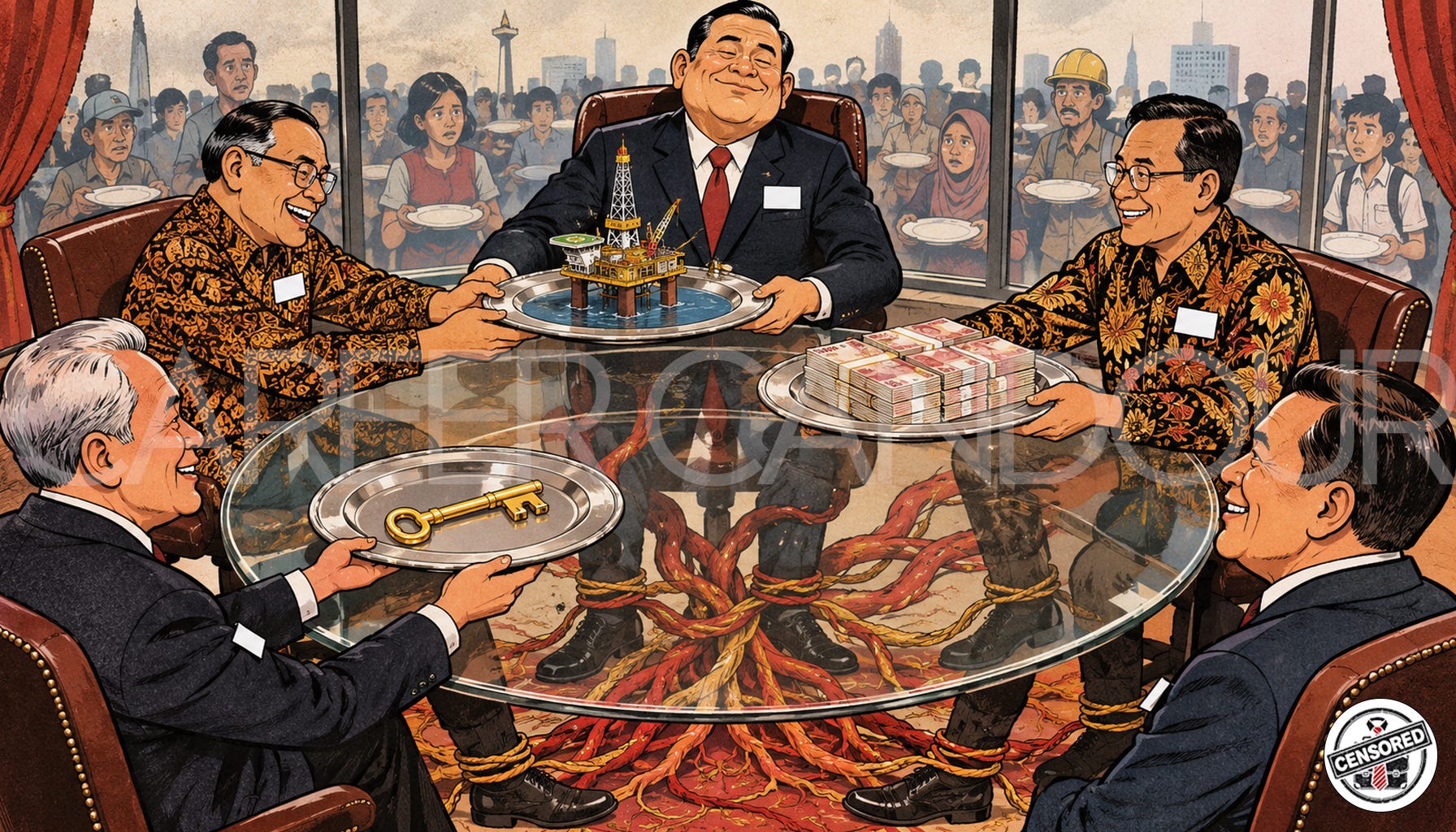
Last week, in the central Sulawesi city of Palu, President Prabowo Subianto rose before a gathering of Muhammadiyah, to issue what sounded suspiciously like a corporate risk disclosure. Indonesia’s economic system, the president declared, is an ekonomi kekeluargaan; a “familial economy”. Lest anyone suspect him of inventing a boutique doctrine on the spot, Prabowo stressed that this was no personal whim, but the sacred command of the republic’s founding fathers, entrusted to the nation and now “almost lost”.
Just two days earlier, Vice-President Gibran Rakabuming Raka, himself the scion of the previous president’s hastily assembled political dynasty, had abruptly resigned amid lingering legal challenges over his candidacy. In the same Palu address, Prabowo fumed at “buzzers” allegedly bankrolled by shadowy financiers, alleged that big money was trying to buy ministers and generals, and joked about listening for “whispers from above” to pick a new deputy. Against that backdrop, a presidential sermon about brotherly economic solidarity became instant fodder for Indonesian social media.
To appreciate the joke, one must translate kekeluargaan twice. On paper, the asas kekeluargaan means something cooperative. It’s an economy run like a communal household, pooling resources through gotong royong (mutual aid) rather than surrendering them to capitalism. In modern Indonesian street usage, however, the word has soured into two rather different idioms. When citizens say a dispute was settled secara kekeluargaan (”in a familial way”), they mean a powerful offender quietly bribed or charmed his way out of court. And when netizens read Prabowo’s quote, they immediately translated “familial economy” to ekonomi milik keluarga: an economy owned by the family.
Yet the real irony of Palu was not that Prabowo used the wrong phrase. It was that he sounded wistful about a system that was “almost lost”, when a glance at Indonesia’s corporate registries, energy concessions, and cabinet rosters suggests it has rarely been in ruder health. Stranger still, anyone trying to audit this familial economy from abroad quickly discovers that on paper, almost none of its chief beneficiaries appear to be related to one another at all.
Brother’s Keeper
Testing Prabowo’s claim that familial economics has faded requires looking no further than his own sitting room. While the president goes by Prabowo Subianto, his younger brother goes by Hashim Djojohadikusumo, chairman of the Arsari Group conglomerate. Over the past year, few businessmen in South-East Asia have mastered the art of simultaneous representation quite like Hashim. Local social media has attributed 26 concurrent roles to the president’s brother across state diplomacy, presidential task forces, foundations, party organs, and private business.
Consider his autumn itinerary. In November, Hashim has been in Antalya, Turkey, leading Indonesia’s official delegation to the UN’s COP31 climate summit as Prabowo’s Special Envoy for Climate Change and Energy, pitching global financiers on Indonesia’s vast potential as a seller of forest carbon credits (a market in which Arsari Group’s own East Kalimantan forestry holdings happen to participate). Yet two months earlier, Indonesia’s Energy Ministry had awarded the country’s largest undeveloped gas structure, abandoned for decades by ExxonMobil and Pertamina, to PT Nations Petroleum, an Arsari subsidiary, via a “direct offer” rather than an open auction. Environmentalists christened the field a “carbon bomb” and demanded Hashim resign his UN climate post. Days before the summit opened, meanwhile, he stirred a fresh domestic squall in his capacity as head of the Presidential Task Force on National Parks by floating the relocation of endangered Javan rhinos from Ujung Kulon, prompting conservationists to ask whether moving the rhinos had anything to do with gold-mining interests nearby.
Even more revealing was the Duyung offshore gas block deal in the West Natuna Sea. In 2025, the Energy Ministry redirected 100% of gas from Duyung’s Mako field away from Singaporean buyers towards domestic power generation in Batam. In July 2025, PLN, Indonesia’s state-owned electricity monopoly, signed a binding agreement to buy all of the field’s gas until 2037, not at Indonesia’s usual capped domestic price, but linked to global oil benchmarks, while committing to finance and build the subsea pipeline itself. Four months later, another Arsari vehicle, PT Nations Natuna Barat, stepped in to acquire a 75% stake in Duyung for $16m upfront alongside development commitments, backed by credit facilities from state-owned Bank Negara Indonesia (BNI).
To be fair, chronology matters. PLN locked in its Mako offtake agreement in July 2025, before Arsari signed its farm-in deal in November, and PLN genuinely needs gas for Batam. Nor is Hashim an unqualified amateur parachuted in from nowhere; he is a seasoned financier capable of mobilising capital where cautious multinationals balk, just as his nephew Thomas Djiwandono, who moved this year from Deputy Finance Minister to Deputy Governor of Bank Indonesia, the central bank, brings party and fiscal experience alongside his family ties. Still, one does not need to allege a single broken law to admire the setup. Acquiring three-quarters of a gas block after the state has mandated a monopoly buyer, indexed the price to oil, pledged the pipeline, and lined up a state bank is rather like buying a lottery ticket after the winning numbers have been whispered across the dinner table.

House Rules
If the story stopped at the Djojohadikusumo clan, it would just be a tale of one ambitious family testing the limits. What makes Prabowo’s Palu speech far more interesting, is that he was not inventing a new model. He was describing the bipartisan playbook of the Indonesian republic.
Look back no further than his predecessor. Joko Widodo arrived at the palace in 2014 as the great democratic outsider, a soft-spoken former furniture exporter from Solo with no aristocratic pedigree. A decade later, he had assembled a political dynasty.
His eldest son, Gibran Rakabuming Raka, jumped from Mayor of Solo to Vice-President;
His son-in-law, Bobby Nasution, progressed from Mayor of Medan to Governor of North Sumatra;
His youngest son, Kaesang Pangarep, became chairman of a national political party days after joining it; and
His brother-in-law, Anwar Usman, happened to be Chief Justice of the Constitutional Court when it lowered the age threshold that cleared Mr Gibran’s path to the ballot.
Indonesia’s reform-era parties run on the exact same ancestral fuel.
PDI-P, the country’s largest secular-nationalist party, remains anchored around Megawati Soekarnoputri, daughter of founding president Soekarno, with her daughter Puan Maharani presiding as Speaker of Parliament and her son Prananda Prabowo managing internal strategy.
The Democratic Party passed from former president Susilo Bambang Yudhoyono to his son Agus Harimurti Yudhoyono, now a senior Coordinating Minister.
In Indonesia’s provinces, decentralisation after 1998 multiplied local fiefdoms. Researchers counted more than 600 candidates tied to political dynasties in the 2024 regional elections. Home Affairs Minister Tito Karnavian himself recently lamented that nearly half of Indonesia’s 1,057 regional state-owned enterprises are bleeding cash because governors and regents pack them with “insiders.”
Look at Danantara, the sovereign wealth fund launched in 2025 to corral roughly $900bn of state assets. Its chief investment officer is Pandu Sjahrir, a Stanford-educated financier with a formidable résumé, who also happens to be the nephew of Luhut Binsar Pandjaitan, Jokowi’s longtime “super-minister,” as well as former Vice President Director of Luhut’s coal-and-energy firm. Or recall the Thohir brothers: for years Erick Thohir oversaw Indonesia’s state-enterprise empire (before shifting to the sports ministry in late 2025) while his elder brother Garibaldi “Boy” Thohir led coal titan Adaro.
Sociologists do not struggle to explain why this persists from the cabinet table all the way down to factory gates. In a low-institutional-trust society where commercial courts move at a snail’s pace and political allies can turn into prosecutors overnight, blood and marriage are the only truly enforceable contracts on offer. Putting your brother, nephew, or son-in-law in charge is defensive risk management. But scan that list of names again and an odd detail jumps off the page. Almost nobody shares a surname.

Who’s Who?
Permanent, inherited family surnames are not a natural feature of human societies. They are an administrative invention, imposed by centralised states from ancient China to early modern Europe so tax collectors, military recruiters, and land registries could render slippery local populations “legible” from afar.
Indonesia never completed that standardisation. Instead, its org charts and cabinet rosters are scrambled by three traditions.
The first is the Javanese baseline. Roughly 40% of Indonesians are ethnic Javanese, and traditional Javanese culture does not use inherited surnames at all. A Javanese name is an individual blessing or biographical marker that dies with its owner. When Jokowi confirmed in court testimony that he was born Mulyono before his parents renamed him Joko Widodo after repeated childhood illnesses, neither word was a surname; his father was Widjiatno Notomihardjo, and his three children carry no trace of Widodo either. Even Suharto, Indonesia’s longest-ruling strongman, left zero trace of himself on his children’s birth certificates. Though foreign newspapers wrote endlessly of “Tommy Suharto” and “Tutut Suharto”, legally not one of his six children bears Soeharto, nor do any of the six siblings share a surname with one another. Even Prabowo Subianto does not go by his aristocratic house name Djojohadikusumo, instead bestowed a name honouring his father’s younger brother killed in 1946, leaving his brother Hashim and his sister’s sons (Thomas and Budi Djiwandono) listed under different surnames.
The second thread involves Indonesia’s non-Javanese marga (clan) cultures, such as the Bataks of North Sumatra, who traditionally guard patrilineal surnames with fierce pride, yet routinely omitted them from Jakarta identity cards to avoid Java-centric clerical truncation or ethnic stereotyping, while married Indonesian women almost never adopt their husbands’ names.
The third, and most consequential for high finance, was pure Cold War political engineering. After Suharto’s rise in 1966–67, his regime issued decrees pressuring ethnic Chinese Indonesians to discard Chinese names in favour of Indonesian-sounding ones. Because there was no official conversion manual, families improvised, often fracturing across generations and siblings.
When tycoon Liem Sioe Liong became Sudono Salim, his youngest son Anthony Salim kept Salim to run Indofood, whereas his older brother, the Singapore-based billionaire Andree Halim, who long held an identical stake in Bank Central Asia, adopted Halim, an alternative Indonesianisation of Liem.
Sinar Mas founder Eka Tjipta Widjaja (born Oei Ek-Tjhong) gave most of his sons Widjaja, while his Singapore son Oei Hong Leong retained the original Oei.
Nor is the pattern confined to Chinese-Indonesian clans. South Kalimantan resource baron Andi Syamsuddin Arsyad, better known as “Haji Isam”, has placed vast listed palm-oil and agribusiness empires in the hands of his twenty-something-year-old children, Liana Saputri and Jhony Saputra. Scan the Indonesia Stock Exchange filings for those two names, and nothing links them to their father, unless you happen to know Jakarta’s social gossip.

Fine Print
None of this was designed in a smoke-filled room as a conspiracy to baffle foreign bankers. Yet at some point, an observer is entitled to ask why an otherwise thorough bureaucracy has proved so oddly relaxed about leaving the blindfold intact.
After all, when the Indonesian state genuinely wants naming legibility, it moves swiftly enough. In 2022, the Home Ministry effectively ended the era of classic one-word Javanese names like Sukarno or Suharto by requiring all newly registered citizens to carry at least two words. The reason was entirely practical, since single-word names frequently crashing international airline booking engines, foreign visa forms, and global banking systems. Western passport scanners complained, and Jakarta fixed the code.
Compare that efficiency with the loopholes left open in domestic anti-corruption enforcement. Indonesian officials are legally required to file public wealth disclosures (known as LHKPN) with the Corruption Eradication Commission. Those filings cover the official, their spouse, and dependent children, meaning they stop squarely at the front door, missing brothers, uncles, nephews, brothers-in-law, and financially independent adult children. Given that influence and capital in Jakarta routinely flow horizontally to siblings and vertically to grown heirs bearing entirely different names, the law looks right past the very rooms where the deals are struck. Similarly, Indonesia passed a Beneficial Ownership decree in 2018 to satisfy global anti-money-laundering watchdogs, requiring firms to identify the real humans behind corporate shells. Yet anti-corruption groups have repeatedly noted that those corporate filings are not systematically cross-checked against the Civil Registry’s Family Cards (Kartu Keluarga), and remain mostly opaque to public scrutiny.
The result is asymmetry. Standard Western Know-Your-Customer and “Politically Exposed Person” algorithms rely heavily on surname matching; feed Indonesia’s corporate registries into automated compliance software and half the family tree vanishes into thin air. Meanwhile, inside Jakarta’s ministries, banks, and WhatsApp groups, everybody knows precisely whose brother-in-law sits on which board.

Glass Houses
Before commentators in London or Washington shake their heads too sorrowfully at Jakarta’s “invisible” family networks, however, they might look at the name badges in their own corner offices. If Indonesia runs a familial economy masked by accidental naming diversity, the ‘gold-standard’ economies of the West run a somewhat familial economy of their own. The big difference is that they deliberately disguise it, because meritocracy is the West’s religion.
In Britain and America, inheriting a job, a film role, or a hedge-fund seat violates the national creation myth. So Western elites perform an inverted version of the Indonesian name trick and strategically scrub their famous surnames to enjoy dynastic doors in private while projecting self-made grit in public.
Stephen King’s bestselling son publishes as Joe Hill, using only his first and middle names (Joseph Hillström King).
David Bowie’s son directs films under Duncan Jones, trading his father’s global brand for his obscure legal surname.
Ronan Farrow dropped Woody Allen’s surname for his mother’s;
Meryl Streep’s daughters act under their father’s name as Mamie and Grace Gummer;
The Coppola dynasty split into Talia Shire, Jason Schwartzman, and Nicolas Cage.
Western stealth privilege is not just a Hollywood parlour game either. Step into the hard economics of North America and Europe and the “meritocracy” begins to look very kekeluargaan. Across the rich world, massive shares of billionaire capital flow from inheritance, monopoly rents, and enduring family empires. Children from the top 1% of American earners are more than twice as likely to attend elite Ivy-Plus universities as middle-class students with identical test scores, thanks largely to legacy admissions and private-school pipelines. In Britain, year after year how a tiny cluster of fee-paying schools and Oxbridge colleges continues to funnel a disproportionate share of cabinet ministers, senior judges, and media editors.
And when Western political rules wobble, the cronyism looks very familiar.
During the pandemic, Britain’s COVID-19 “VIP Lane” saw ministers and peers fast-track billions of pounds in protective-equipment contracts to friends, donors, and even a former health secretary’s local pub landlord.
Across the Atlantic, Jared Kushner raised billions from Gulf sovereign funds for his private-equity firm almost immediately after leaving the White House, while Hunter Biden traded on his father’s name abroad.
Even the compliance-evasion trick has a Western twin.
In April 2025, a U.S. Government Accountability Office report on corporate ownership flagged a case of government staff concealing conflicts of interest by having their spouse sign subcontracts under their maiden names
When European authorities tried to freeze sanctioned Russian oligarchs’ assets in 2022, investigators tracing the $600m superyacht Dilbar in Hamburg had to look past Alisher Usmanov to corporate structures linked to his differently surnamed sister, Gulbakhor Ismailova.
Every club, it turns out, knows how to keep the silverware out of sight.

It is tempting, armed with all this evidence, to shrug and conclude that every economy is familial, every elite hides behind its names, and Western lectures about Indonesian nepotism are hypocrisy. That would be half-right.
Western onlookers are often obtuse when they treat Jakarta’s kekeluargaan as some exotic tropical pathology while ignoring legacy admissions, dynastic trusts, VIP-lane procurement, and maiden-name contracting at home. Any society with concentrated wealth relies heavily on kinship.
Yet the difference between London or California and Jakarta still matters enormously, and it comes down to the thickness of the wall between the family trust and the state treasury. In the United States or Britain, familial privilege is mostly indirect and laundered through private markets: rich parents buy prep schools, unpaid internships, and venture seed money, while independent courts, procurement auditors, and competition regulators still leave enough oxygen for an outsider with no famous uncle to build a trillion-dollar firm from scratch. When politicians do try brazen insider contracting, auditors and judges tend to come knocking years later.
In Indonesia’s state-heavy model, proximity to the palace is, too often, the primary moat of business.
Which brings the story back to that stage in Palu. In an odd way, Mr Prabowo’s bluntness deserves a measure of respect compared with Western elites who pretend their privilege does not exist. Indonesia really is a familial economy. The trouble is asking 280 million citizens to celebrate a household in which only a dozen relatives ever seem to hold a key to the pantry.
StratEx - Indonesia Business Advisory provides Indonesia-focused advisory and leadership intelligence for investors that need to understand what is really moving beneath the surface. Contact us for better visibility before making your next move in Indonesia.