


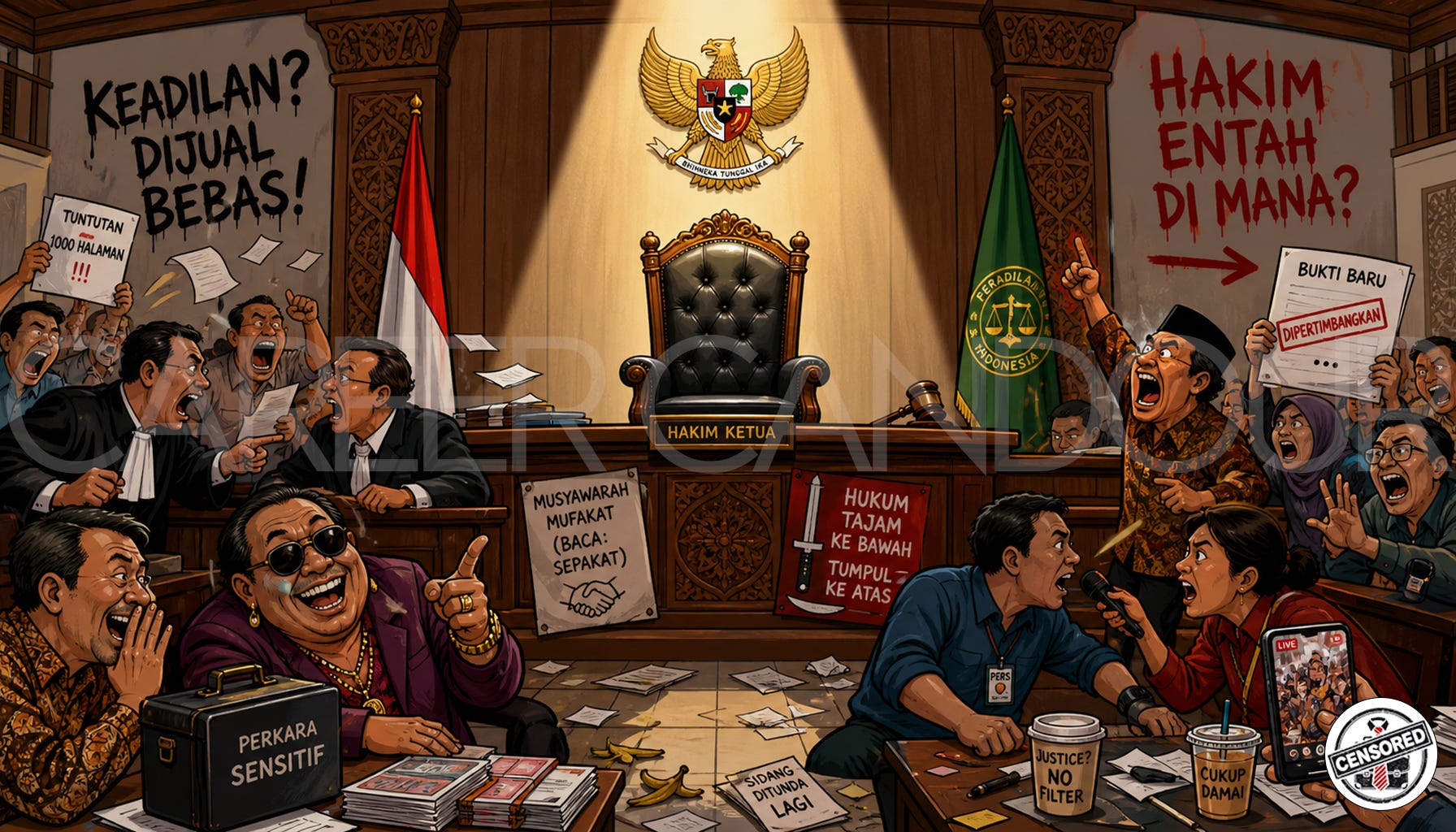
Whenever a well-connected, well-spoken, English-presenting, startup-adjacent figure is accused of something serious, there is a genre of Indonesian public commentary that emerges. Overnight, LinkedIn becomes the Constitutional Court, Instagram Stories become evidentiary hearings, and old school friends begin issuing jurisprudence from the annals of “I know him personally.”
The Nadiem Makarim Chromebook case has become exactly that kind of spectacle.
To be clear from the start: this is not an article arguing that Nadiem is guilty. Nor is it an article arguing that he is innocent. That is the court’s job.
This is about how we should think about the process, the evidence environment, the public narratives, and the very human urge to turn complex corruption trials into morality plays starring either “visionary reformer destroyed by politics” or “tech bro finally caught.”
What we do know is that prosecutors allege the Chromebook procurement caused state losses in the region of Rp2.1 trillion, including alleged overpricing and allegedly unnecessary Chrome Device Management procurement. The prosecution theory is that Nadiem allegedly steered specifications toward Google’s Chrome ecosystem and personally benefited, while the defence says he divested before becoming minister, did not profit, and was not directly involved in contracting decisions.
So yes, there may be politics. Indonesia is not a Swiss laboratory. But also yes: there may be smoke.
The Problem with “I Know Him”
The most exhausting thing about this case has not been the trial. It has been watching people announce “the truth” with the confidence of someone who read three carousel posts and once met a Google director at a panel discussion.
The pro-Nadiem public line often goes something like this:
He is a reformer; reformers make enemies; therefore this must be political. SIPLah and ARKAS threatened entrenched interests; therefore the Chromebook case is revenge.
The prosecution had more time and more witnesses; therefore the trial is unfair.
Google executives denied wrongdoing; therefore there is no wrongdoing.
Procurement oversight was invited; therefore corruption is impossible.
Nadiem is rich; therefore he would never want more money.
Some of those points deserve attention. Political prosecution is not impossible. Selective enforcement is a real concern in many democracies, and Indonesia is no exception. The question is how those concerns are being used. Because there is a difference between saying,
“We must ensure this prosecution is not politically motivated,” and saying,
“My friend is elegant and once founded a unicorn, therefore the indictment is fiction.”
This case did not emerge from thin air. The prosecution’s theory rests on claims about Chrome OS specifications, alleged state loss, alleged personal benefit, prior technical concerns about internet connectivity, and alleged links between Google’s investment history and Gojek/GoTo. Whether those claims survive beyond reasonable doubt is another matter. But pretending there is “nothing there” is not analysis.

Where There’s Smoke…
There is a lazy version of “no smoke without fire,” and there is a useful version.
The lazy version says: if someone is accused, they must have done it. That is exactly how mobs, authoritarian states, and comment sections reach legal conclusions.
The useful version says: if a serious case has made it this far, with indictments, witnesses, alleged loss calculations, institutional scrutiny, and a long paper trail, then it deserves more than fan-club dismissal.
That matters here because the pre-trial backstory already contained red flags:
The 2018–2019 pilot experience with Chromebooks and connectivity limitations;
The later movement toward a Chrome OS procurement architecture; civil-society concerns in 2021 about suitability, vendor concentration, public procurement visibility, and internet dependence;
BPKP involvement and recommendations on targeting, timing, specifications, and quantities; T
he Attorney General’s Office turning the matter into a formal case.
These facts do not equal guilt. But they do mean the case is not reducible to “some jealous bureaucrats didn’t like innovation.”
The alleged “Gojek days” background is not what the court is trying in the narrow sense. But it appears in the prosecution’s broader narrative because prosecutors have alleged that Google’s investment relationship with Gojek/AKAB/GoTo is relevant to motive or benefit. Prosecutors highlighted Google investment into Gojek’s parent company around the procurement period, while the defence position was that Nadiem had divested and was not directly involved in procurement decisions.
That is exactly the kind of thing serious people should discuss carefully. Not as proof. Not as gossip. Not as “my venture capital WhatsApp group says…” But as context.
Because yes, wealthy people can still want more money. “Rich people also enjoy being richer,” may trouble the LinkedIn motivational ecosystem. But it’s widely acknowledged.
That does not mean Nadiem did it. It means “he didn’t need the money” is not a defence.
Corporate Testimony Isn’t Gospel
One of the more amusing subplots is the apparent belief that if Google people say something, it arrives pre-certified by the angels of corporate governance.
Former Google executives testified by Zoom from Singapore and denied that Google’s investment in GoTo was connected to the Chromebook procurement.
That is important. It may help the defence. It may weaken part of the prosecution’s theory. It deserves to be taken seriously.
But “Google executives denied involvement” is not the same as “all questions are now resolved, please pass Go and collect $200”
Companies deny things.
Executives deny things.
Prosecutors test those denials.
Defence lawyers exploit weak testing.
Judges decide what has weight.
This is what trials are for.
And let us remember that large technology and software companies are not inherently incapable of corruption or misconduct. SAP, for example, agreed in 2024 to pay more than $220 million to resolve U.S. investigations into foreign bribery schemes, including conduct involving Indonesia. The SEC also said SAP’s misconduct spanned multiple jurisdictions and involved intermediaries used to pay bribes to officials.
That does not prove anything about Google in this case. It simply proves that “global tech company” is not Latin for “incorruptible monastery.”
More Witnesses ≠ Unfair Trial
Another popular argument goes: the prosecution had far more time and far more witnesses than the defence. Therefore, unfair.
This is the sort of claim that sounds powerful until one remembers how criminal trials work.
The state has the burden of proof. In corruption cases, especially ones involving procurement, technical specifications, audit calculations, institutional decisions, vendor chains, and alleged state loss, prosecutors typically present a lot of witnesses. It is the procedural price of proving a case beyond reasonable doubt.
The defence does not need to prove innocence in the same way. It can attack the prosecution’s evidence, expose gaps, undermine state-loss calculations, challenge intent, question causation, and argue reasonable doubt. A shorter defence case is not automatically an unfair defence case. Sometimes it is a strategic defence case.
That said, there have been real procedural controversies. Nadiem’s legal team protested an accelerated schedule that allegedly left only a short window to present defence witnesses and experts. Later, the court postponed proceedings until 4 May 2026 because Nadiem was hospitalised, with the judge saying the postponement was intended to protect the defendant’s right to respond and question witnesses or experts.
So yes, process matters.
If the defence was unfairly squeezed, that matters.
If hearings were delayed by illness or legal-team absence, that also matters.
If a court tries to balance speed, rights, and public pressure, that is exactly where the system gets tested.
But “the prosecution had more witnesses” is not the silver bullet some people seem to think it is. In fact, if the prosecution had brought only three witnesses and one of them was “trust me bro,” the same people would probably ask why the state was so unserious.

Scoring Points vs. Winning the Case
One major defence line attacks the state-loss calculation. Nadiem himself publicly argued that the Rp2 trillion state-loss figure was “engineered,” saying BPKP acknowledged in court that it did not compare the Chromebook purchase price with market prices.
If the alleged overpricing is a core part of the case, then how the benchmark was calculated is more than a footnote. You cannot build a Rp1.5 trillion overpricing claim on moral disappointment, and a calculator borrowed from a political consultant.
There were also reports favourable to the defence suggesting that certain testimony indicated the procurement price was within or below market range, and that devices remained in use. Those claims, if supported by court evidence, could weaken the prosecution’s overpricing and “non-beneficial” theories.
The Google testimony also appears to have challenged the prosecution’s claim that Google’s investment was tied to the Chromebook procurement. If prosecutors framed the case partly around an investment-procurement quid pro quo, then credible testimony denying linkage creates a problem they must overcome.
But again: scoring points is not the same as winning. A corruption case can survive the weakening of one strand if other strands remain strong. Or it can collapse if the central theory depends on that strand. That is why judges exist, despite the internet’s tireless campaign to replace them with polls.
The right question is not: “Did one witness help Nadiem?”
The right question is: “After all evidence is weighed, has the prosecution proved each legal element beyond reasonable doubt?”
Is This Political?
High-profile prosecutions of former ministers, startup founders, and politically adjacent figures can carry strategic meaning. The timing, the institutional incentives, the public theatre, the elite rivalries. All of that can matter.
But political context does not wash away evidence. Nor does evidence wash away political context. The two can coexist.
A prosecution can be politically useful and factually grounded.
It can be politically motivated and still expose real misconduct.
It can be legally weak but narratively powerful.
It can be legally strong but selectively pursued.
Adult life is cruel like that.
What is intellectually lazy is using “political prosecution” as a universal solvent. Pour it over every inconvenient fact and watch the whole case disappear.
Ask whether:
The prosecution is consistent,
Similarly situated actors are being pursued,
The legal theory is coherent,
The state-loss calculation is robust,
Exculpatory evidence is being fairly considered,
Procedural rights are respected,
Witnesses are being tested properly.
That is very different from saying: “He built ARKAS, therefore the empire struck back.”
SIPLah and ARKAS may have disrupted procurement ecosystems. But it does not automatically answer the Chromebook procurement question. Indonesia already has procurement systems across sectors. Digital procurement reform does not create a permanent moral forcefield around every later procurement decision.
This is where the same people who say, “Trust institutions, trust data, trust systems,” ask us to trust personal familiarity, elite respectability, and character references from people with an emotional conflict of interest.
Yes, the Attorney General’s Office should be scrutinised.
Yes, the prosecution should be tested.
Yes, the defence should be heard.
Yes, public opinion should avoid mob justice.
But no, “I know his family” is not Exhibit A.
We know the prosecution has alleged serious wrongdoing involving Chrome OS specifications, state losses, CDM, and benefit through corporate-linked structures. We know the defence has denied wrongdoing, attacked the state-loss calculation, argued divestment and non-involvement in procurement, and produced testimony that may challenge the Google-investment theory. We know procedural controversies have emerged around defence time, virtual testimony, illness, and scheduling. We know public opinion is split between those who see a reformer being punished and those who see a familiar pattern of elite impunity finally being tested.
What we do not know is whether the prosecution has proved guilt beyond reasonable doubt.
And that phrase matters: beyond reasonable doubt.
Not beyond LinkedIn doubt.
Not beyond family WhatsApp doubt.
Not beyond “he seems nice” doubt.
Not beyond “Google said no” doubt.
Not beyond “the AGO is political” doubt.
Legal doubt.
If Nadiem is acquitted, that does not necessarily mean every concern was imaginary. It means the court found the case legally unproven. If he is convicted, that does not automatically mean every conspiracy theory about him was true. It means the court found the legal elements satisfied.
Justice requires that distinction.
The fan-club version of reality cannot handle it. The mob version cannot handle it either. Both want certainty before the process is finished. Both want the trial to confirm a worldview already written in advance.
The rest of us should want evidence tested properly, claims separated from gut feel, political context examined without becoming an escape hatch, and public commentary humble enough to admit that knowing someone personally is not the same as knowing what happened.
At StratEx - Indonesia Business Advisory we organisations make sense of Indonesia’s complex operating environment. Contact us to understand the real-world context behind policy, enforcement, markets, and public sentiment.