


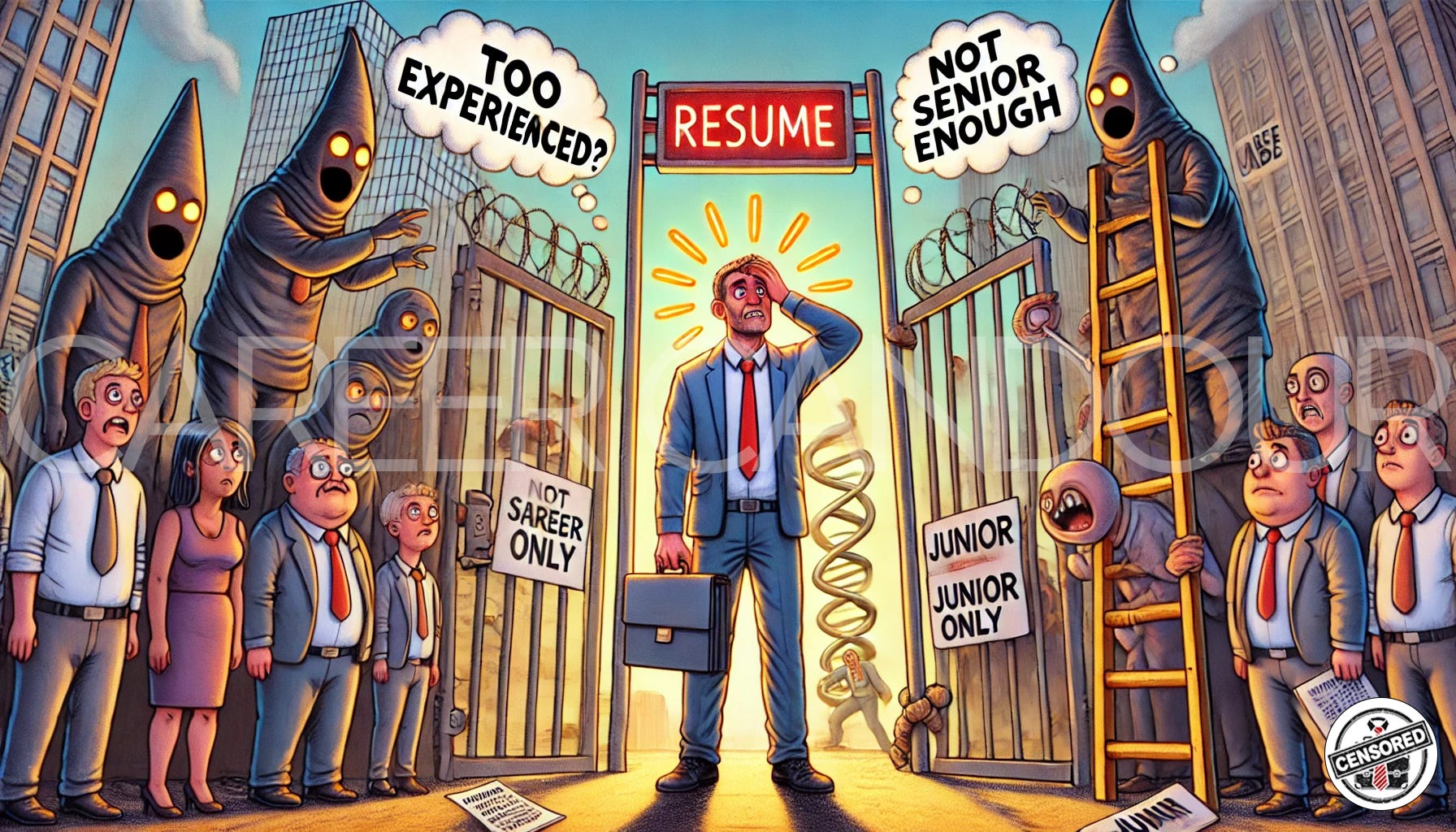
Are you a mid-career professional in your late 30s to mid-40s? If so, you may have officially reached that life stage where:
You have too much experience to pass for “hungry junior talent.”
You have not enough experience to be mistaken for “visionary leadership material.”
You cost more than a 28-year-old.
You have just enough grey hair to set off an algorithmic red flag in the Applicant Tracking System (ATS).
Welcome to the barbell-shaped labour market, where companies adore hiring either:
Fresh-out-of-university optimists who can be convinced that ping-pong tables count as “benefits”, or
VPs and Directors-for-Life who are paid handsomely to have opinions, visions, and the occasional all-hands speech written for them by someone younger.
You, unfortunately, are neither.
In fact, you’re the one group the market seems to have collectively agreed to pigeonhole as “expensive, inconvenient, and not quite senior enough.”
You’re highly employable. Deeply experienced. And somehow treated like you’re asking for a job as King of Norway when you apply for a normal role.
Which is why a new movement is sweeping job-seeking circles:
It might be time… to dumb down your CV.
Yes, we know it contradicts every smug LinkedIn influencer who told you to “shine bright like a diamond” and “own your worth.” But those were the good times… and the good times are no more.
Mid-Career, Meet the Modern Job Market
If you ask economists whether we’re in a recession, they will say absolutely not.
GDP growth is… fine.
Markets are… fine.
Employment numbers are… doing something vaguely positive-looking.
Meanwhile:
Layoff announcements read like seasonal fashion drops.
Entire departments are quietly “streamlined.”
Companies brag about efficiency gains like a Victorian industrialist showing off his new steam-powered child-labour machine.
But don’t worry! It’s not a recession, they tell us.
It’s just:
A global recalibration.
A cyclical adjustment.
A productivity-optimisation pivot.
This is all, allegedly, perfectly normal.
But the truth is, the mid-career crisis is structural
The Perfect Storm: Choose Your Favourite Scapegoat
Overhiring during the pandemic boom.
AI panic (which is affecting junior roles more, but let’s throw it on the bonfire).
Outsourcing (why pay for Carl from Croydon when Carlos from Córdoba will do it for 30% less?).
The slow death of middle management (flat orgs are in; stable careers are out).
A labour market shaped like a barbell with no middle rungs left on the ladder.
It’s an employment ecosystem designed by a drunk economist and a bored venture capitalist. And you are standing in the squishy middle, where all the forces converge, and where opportunity once lived.
Which brings us to your CV.

The Problem With Being “Too Good” on Paper
Being “highly experienced” used to mean you were valuable. Wise. A resource. Someone who knew how to fix the machine without Googling the manual.
Now?
It’s a risk factor.
Hiring managers see your CV and think:
“Will they be too good at this?”
“Will they leave the moment a better offer appears?”
“Will they judge me for being 31 and managing someone older than me?”
“Will they want a salary that requires meaningful budget planning?”
Meanwhile, algorithms analyse your CV and go:
“Candidate appears expensive. Reject.”
You’ve become the workplace equivalent of a beautiful, powerful, respectable luxury car…. immediately discarded when someone remembers they could get a Toyota Yaris.
And this is where the cognitive dissonance kicks in:
If you’re too experienced, you won’t get the job.
If you’re not experienced enough, you won’t get the job.
If your experience is exactly right, a 29-year-old already applied with a lower salary expectation.
It’s no wonder the mid-career job market feels like the Bermuda Triangle of employability.

The Strategic Glow Down
Welcome to the Glow Down Era.
We’re not lying. We’re not falsifying. We’re not forging diplomas in basements like failed tech founders. And we’re not regressing to caveman speech:
“I DO WORK. I GOOD WORK. GIVE JOB?”
We’re simply reframing and re-contextualising.
For years we were taught the opposite.
Polish everything.
Maximise every bullet.
Inflate the language until each role sounded like you personally rebuilt civilisation.
Your CV was meant to read like a highlight reel. Promotions. Leadership. Strategy. Impact. You were supposed to look like a rocket on a steady upward trajectory.
Unfortunately, rockets are expensive. And in this market, expensive objects get grounded.
So now we do something radical.
We soften the presentation.
We sand down the sharp edges of competence that make hiring managers nervous.
We stop trying to look impressive and start trying to look hireable.
The goal is no longer awe. The goal is comfort.
The mechanics are simple and slightly tragic.
1. Emphasise the player. Whisper the coach.
❌ “Managed a team of 12 across three regions.”
✔️ “Oversaw delivery of X project, collaborating closely with cross-functional teams.”
💪 “Personally delivered key components of X project with cross-functional coordination.”
Same reality. Fewer alarm bells. You're just emphasising what matters for the level you're targeting.
2. Highlight doing over directing.
❌ “Owned the £5M transformation roadmap”
✔️ “Contributed to initiatives that improved outcomes.”
You are back in the trenches where employers like you.
3. Let older glory quietly recede.
It’s not lying to say:
“Earlier career experience in [field], additional details available upon request.”
That’s not deceit. Think of it as… mystique.
4, Remove qualifications that make you sound like you might lead a coup.
PhDs, MBAs, Fellowships, astronaut training programs? Remove as needed.
5. Use the summary to control the narrative.
This is where you can work miracles.
A summary like:
“Experienced leader seeking opportunities to apply strategic thinking and drive organisational transformation”
…will get you rejected from every job requiring actual work.
But try:
“Senior [X] professional refocusing on hands-on roles where I can work closely with teams to deliver meaningful outcomes.”
Suddenly you’re not overqualified, you’re aligned.
You are not shrinking yourself. You are simply fitting through the door that currently exists.

Reframing Your CV Is Not Dishonest
There is a persistent belief, that a CV must present the complete and unfiltered truth of your professional life.
Every role.
Every credential.
Every accomplishment since your first internship.
Anything less is framed as dishonesty. The reality?
Recruiters do not WANT the full truth about you.
They want the version that fits the box they’ve already decided on.
This is made worse by automation. Applicant tracking systems reward pattern matching. A single senior keyword can push your application into the wrong salary band or flag you as “overqualified” before a human ever sees your name. At that point, radical honesty is inefficient.
A CV is not a confession.
A CV is not a memoir.
A CV is not a eulogy for your career potential.
A CV is a marketing document.
And marketing is about relevance, not totality.
Leaving out advanced degrees? Ethical.
Compressing early roles? Ethical.
Reframing senior responsibilities as collaborative execution? Ethical.
You are not misrepresenting the truth. You are positioning yourself for the job that exists, not the job the economy promised you when you were 25 and naïve.
In good markets, we glow up.
In bad markets, we glow down.
In this market, we glow however the hell we must.
A Practical Guide to the Glow Down
Enough philosophy. Enough labour market sociology. Enough staring out of the window wondering where it all went wrong.
It is time to make edits.
1. The Summary
Replace “leader” with “senior IC who enjoys being hands-on”
The summary is where most mid-career professionals accidentally torpedo themselves. This is where people write things like “transformational leader”, “strategic visionary”, or “results-driven executive”. Which sounds great if you are applying to run a division. Less great if you are applying for a senior individual contributor role where the budget is described internally as “tight but brave”.
So we tone it down.
You are not a “global change agent spearheading cross-functional excellence”. You are a “senior practitioner who likes solving problems directly”.
And let’s be honest. After fifteen years of meetings, you probably do enjoy being hands-on. Especially since no one is handing out teams to manage anymore unless you are also signing the office lease.
2. The Experience Section
Start each job with what YOU personally delivered
This is the big one.
For years you were trained to talk about scope. Team size. Budgets. Strategy. The higher you climbed, the less you described what you actually did.
Now we reverse it.
Lead with action.
Not what you oversaw.
Not what you shepherded.
Not what your seven direct reports executed while you approved slide decks.
What did you do with your own two hands and one overworked brain?
“Designed.”
“Built.”
“Implemented.”
“Analysed.”
“Shipped.”
Make yourself look dangerously competent at doing things again. Employers trust doers. They get nervous around overseers.
3. Leadership Bullets Go Last. If At All.
Some hiring managers love it. Others interpret it as “salary expectations incoming”. It is polarising.
So if you must mention leadership, tuck it at the bottom.
“Mentored two juniors.”
“Coordinated cross-team efforts.”
Gentle. Non-threatening. No headcounts that require spreadsheets.
4. Education: Only Keep What Serves the Story
This one hurts emotionally.
Yes, you earned the MBA. Yes, you paid for it with money, time, and a portion of your soul. Yes, it is framed somewhere.
But if you are applying for a mid-senior IC role that pays half your tuition cost, leading with it can backfire. It signals expense. Ambition. Expectations.
Education is a tool. If it supports the story you are telling, keep it. If it distracts from that story, quietly move it down or remove it for that application.
5. LinkedIn Must Support the Illusion
Finally, consistency.
Your CV cannot say “steady, practical contributor” while your LinkedIn screams “GLOBAL TRANSFORMATION DIRECTOR DISRUPTING ECOSYSTEMS”.
Hiring managers do check. And nothing says “confusing candidate” faster than two completely different personal brands colliding.
Pick one narrative. Stick to it. Align the language everywhere.
You are telling a coherent story.

Mid-career job seekers are not imagining this.
They are not lazy. They are not entitled. They are not “blocked by limiting beliefs” or whatever inspirational phrase LinkedIn has decided to weaponise this week.
This is not a mindset problem. It is math.
If you are in your late 30s or 40s, you are stuck in a structural squeeze that has everything to do with cost, optics, and risk tolerance. You are:
Too expensive for junior roles.
Too junior for the expensive ones.
Too experienced to start over cleanly.
Too human to be automated away.
Too competent to be easily slotted under someone insecure.
It is not personal. It just feels personal.
So what’s left?
Strategic reinvention.
Radical reframing.
The art of the Glow Down.
In this market, broadcasting your full brilliance is less “impressive” and more “alarming.” You want to look capable, not threatening. Useful, not expensive.
Call it cynical. Call it survival. But until the barbell bends back into something resembling a ladder, this is the game.
You already have the experience.
Now you just need the strategy.
At Career Candour we work 1:1 with professionals to strategically reframe CVs for today’s market. Hands-on impact. Clear value. Zero intimidation factor. No hacks. No BS. Doesn’t matter how good you are if recruiters never call. Want this handled properly? DM us.