


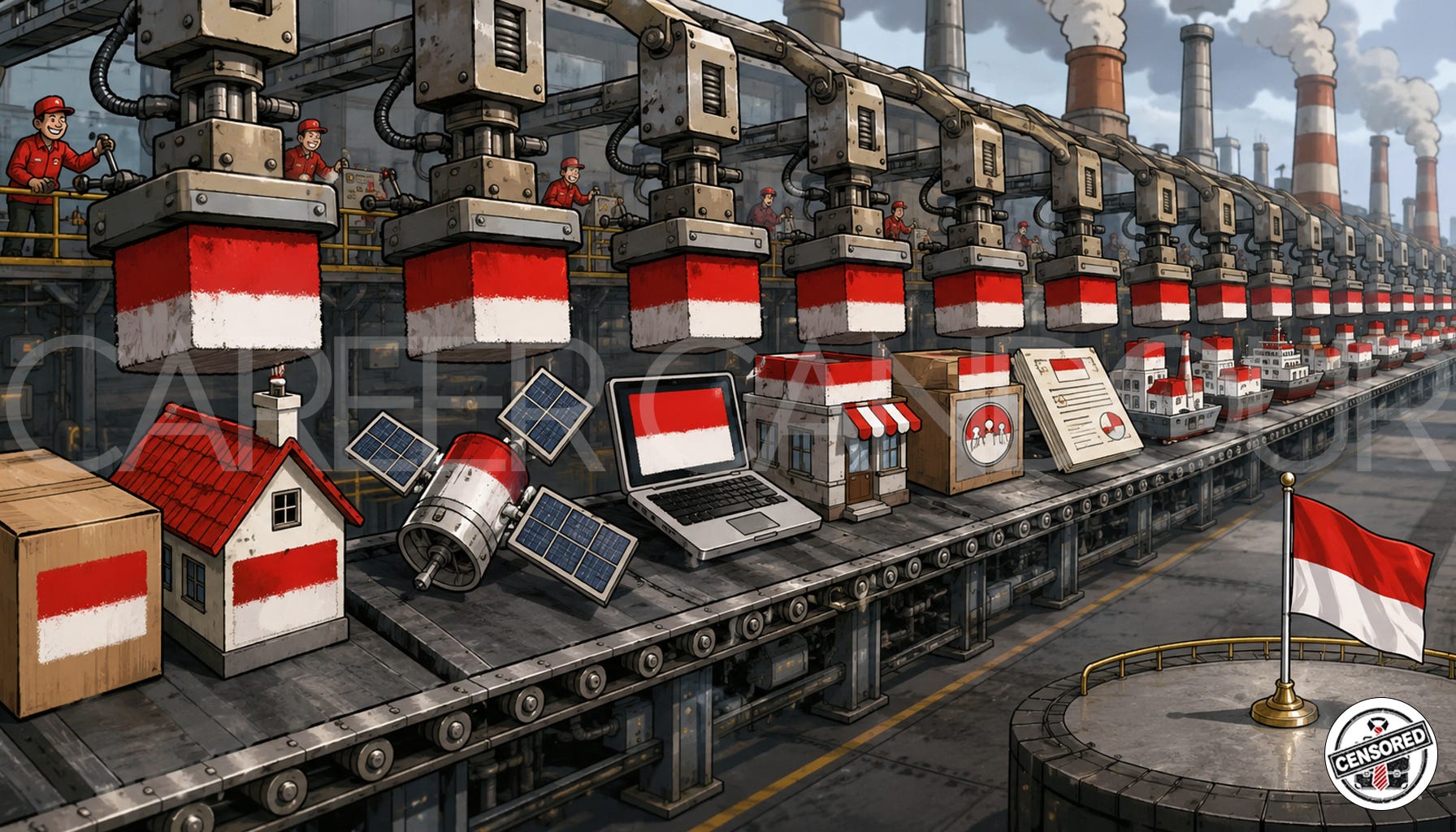
Spend any meaningful amount of time in Indonesia and you’ll begin to notice Merah Putih is everywhere.
Not just fluttering above government buildings or hanging proudly from homes every August as the country celebrates Independence Day. That is entirely understandable. Most nations reserve their flags for moments of ceremony, and remembrance. Indonesia does all of that too, and with genuine enthusiasm. But Merah Putih has transcended the flagpole, wandering into boardrooms, ministries, and branding meetings. It has become attached to village cooperatives, artificial intelligence initiatives, satellites, vaccines, media companies, investment funds, logistics projects and an increasingly eclectic collection of programmes that seem to have reached the same conclusion.
At first, it feels rather charming. Here is a young country, immensely proud of its hard-won independence, wearing its patriotism openly. Coming from a country (Britain) whose own flag is plastered across tea towels, souvenir mugs and the occasional pub during international football tournaments, I hardly arrived in Indonesia expecting to lecture anyone on restraint. National pride, after all, is not an exclusively Indonesian invention.
Yet after a while, something begins to feel a little different. The phrase Merah Putih does not only appear frequently; it appears strategically. It no longer seems confined to commemorating the nation. Increasingly, it appears to endorse things.
Programmes become Merah Putih.
Companies become Merah Putih.
Bold government initiatives become Merah Putih.
That observation is not intended as criticism. It is rather… a question. Because the more one learns about the history of Merah Putih, the less surprising its ubiquity appears. Unlike many national flags, Indonesia’s did not emerge from an already established state. In many respects, it helped create one. The red and white banner became the visual language through which millions of people, separated by oceans, languages, ethnic identities and centuries of local history, began imagining themselves as members of the same nation. That is one of the great political success stories of the twentieth century.
Which is precisely what makes its modern evolution so fascinating.
This is not an article arguing that patriotism has gone too far. Rather it is asking:
At what point does a national symbol stop solely representing the nation and begin functioning as a transferable brand?
When does a flag cease to be simply a reminder of shared sacrifice and become, intentionally or otherwise, a source of borrowed credibility for whatever happens to be standing beside it?
The distinction may seem academic. It is anything but.
First Things First
To understand why Merah Putih appears almost everywhere in Indonesia today, one must first appreciate that Indonesia itself is, in many ways, an extraordinary historical achievement.
Unlike Britain, France or Japan, Indonesia inherited something altogether more improbable. At independence in 1945, it was attempting to transform a sprawling colonial possession into a nation. The challenge was immense. Stretching across a vast distributed geography, home to well over a thousand ethnic groups and hundreds of living languages, the Dutch East Indies had been administered as a single colony, but few people thought of themselves as belonging to a single national community.
A villager in Aceh had little reason to imagine his future as intertwined with that of a fisherman in Maluku or a farmer in Central Java. Local identities ran deep. They still do. Javanese, Sundanese, Batak, Bugis, Balinese, Dayak, Papuan and countless others possessed rich histories of their own, each with traditions, languages and cultural identities that long predated the concept of Indonesia itself. If ever there were a place where a common national identity seemed improbable, it was here.
This required more than constitutions and government ministries. Nations are not just held together by legal documents, rather they are sustained by stories, rituals and symbols.
Indonesia possessed perhaps the greatest nation-building toolkit of any newly independent state.
There was Pancasila, an attempt to articulate a philosophical foundation broad enough to accommodate extraordinary diversity.
There was Bahasa Indonesia, itself a remarkable political decision.
Rather than elevating Javanese, the language of the largest ethnic group, the 1928 Youth Pledge explicitly declared Bahasa Indonesia the language of unity. It was an act of linguistic pragmatism, avoiding the resentment that might have accompanied privileging one dominant culture over hundreds of others.
Then there was Merah Putih.
The flag became the emotional shorthand for an idea that was still in the process of being invented. It flew during the struggle for independence. It appeared in stories of sacrifice, resistance and national awakening. Under Sukarno, Merah Putih became woven into the very performance of statehood. Mass rallies, monuments, carefully choreographed ceremonies and the visual language of revolution all reinforced the same message: this flag represented not simply territory, but destiny.
That symbolism only deepened during the National Revolution. Independence was fought for. More than 100,000 Indonesians experienced violence, displacement and upheaval before sovereignty was finally secured. Whatever one thinks of the myths that inevitably accumulate around nations, the emotional connection forged between the flag and sacrifice was entirely genuine. Merah Putih became, quite literally, something people had died beneath.
It is difficult to overstate the importance of that historical inheritance. Merah Putih accumulated its authority slowly, through decades of shared memory. It came to represent unity, sovereignty, and a common identity without requiring Indonesians to abandon older ones. In a country where diversity was both its greatest strength and political challenge, the flag performed an extraordinary amount of cultural heavy lifting.
Viewed from that perspective, the omnipresence of Merah Putih is understandable and inevitable. If a simple combination of red and white helped persuade hundreds of millions that they belonged to the same national story, why wouldn’t later generations continue reaching for that same emotional vocabulary?

...Then Something Changed.
At some point Merah Putih appears to have undergone a change.
It became an adjective.
There is Koperasi Desa Merah Putih. There are discussions of AI Merah Putih, Vaksin Merah Putih, Satelit Merah Putih, investment vehicles, media organisations and an expanding ecosystem of initiatives carrying the same patriotic prefix.
To be clear, governments brand things. Politicians have always understood that names matter. Nobody ever proposed calling legislation the “Moderately Competent Administrative Efficiency Act”. Programmes become:
“New Deals”,
“Great Societies”,
“Levelling Up”,
“Patriot Acts”, or
“National Missions”
…because language shapes perception.
The interesting question is why Merah Putih has become such an attractive label.
Political scientists speak of the accumulated trust, respect and emotional authority that societies invest in certain symbols over time. Symbolic capital possesses value precisely because it has been earned slowly and expended carefully. The more revered the symbol, the more valuable it becomes to anyone fortunate enough to stand beside it.
Closely related is what might be described as legitimacy transfer. If people already trust the flag, some of that trust naturally rubs off on whatever the flag endorses. Not consciously, perhaps. We assume expensive wine tastes better, that bookshelves make television experts more knowledgeable, and that a government initiative carrying the nation’s most sacred civic symbol probably deserves the benefit of the doubt.
Civil servants are patriots too, after all. Ministers genuinely believe their projects serve the national interest. Branding an initiative Merah Putih may simply reflect sincere optimism.
Even so, one cannot help wondering whether the country’s most treasured civic symbol is beginning to work rather harder than its designers ever intended.
Somewhere in Jakarta, one imagines an exhausted branding consultant cautiously clearing his throat during a meeting.
“I was just wondering,” he ventures, “whether perhaps we’ve used Merah Putih rather a lot recently.”
There is a long silence.
A few nervous glances around the room.
The consultant is never seen again. Rumour has it he now works in an office whose only responsibility is naming roundabouts.
The joke, of course, exaggerates reality.
Only slightly.
Because beneath the humour lies a genuine observation. The more frequently a sacred symbol is attached to ordinary programmes, however worthwhile those programmes may be, the more that symbol begins performing two jobs. It continues to represent the nation, while also functioning as a source of credibility for projects that have yet to earn reputations of their own.

Here's The Problem
What happens when entirely ordinary governance problems occur inside programmes carrying extraordinarily powerful national symbolism?
Every government, regardless of ideology or geography, faces the same uncomfortable realities.
Large infrastructure projects run over budget.
Public money attracts private interests with the reliability of moths around a porch light.
Some programmes succeed brilliantly. Others disappoint. A few descend into scandal. None of this is uniquely Indonesian; it is simply the price of asking imperfect human beings to administer very large organisations with very large sums of money.
The difference lies not in the problems themselves, but in the language surrounding them.
Imagine two identical government initiatives. They have the same objectives, the same budget, the same procurement process and the same risks. The only difference is their names.
One is called the National Village Cooperative Programme.
The other is called Koperasi Desa Merah Putih.
If questions later emerge about procurement, governance or implementation, the facts remain identical. But the presence of Merah Putih changes the context in which those questions are being asked. Criticism, however carefully framed, is no longer directed only at the programme itself; it can also be perceived as challenging something with a much deeper national significance.
This is because symbols create emotional connections that facts alone rarely achieve. Political psychologists describe this as affective framing: our feelings about a familiar symbol subtly influence how we perceive the unfamiliar object standing beside it. Marketing executives discovered this long ago. Politicians were not far behind.
Recent debates surrounding Koperasi Desa Merah Putih illustrate the dilemma rather well. The initiative is undeniably ambitious. Envisaged as a nationwide network of village cooperatives, it promises to strengthen rural economies, shorten supply chains and improve local prosperity. There is no shortage of worthy objectives. Nor should there be. Governments ought to be ambitious.
Yet ambition, particularly when accompanied by enormous public expenditure, inevitably attracts scrutiny. Even before allegations of wrongdoing emerged, Indonesia’s Corruption Eradication Commission (KPK) publicly recommended safeguards around governance, procurement and transparency, recognising that a programme of such scale naturally carried significant corruption risks. Subsequently, Indonesian Corruption Watch (ICW) questioned aspects of proposed procurement, raising concerns about potential price mark-ups and the opportunities for rent-seeking that large purchasing programmes can create.
This is precisely where patriotic branding becomes interesting.
Questions about implementation become questions about commitment.
Scepticism about budgets begins sounding like scepticism about the national project itself.
Nobody need explicitly accuse critics of lacking patriotism; the symbolism has already done much of the heavy lifting.
One finds similar tendencies wherever governments borrow heavily from national mythology.
In the United States, legislation bearing words such as “Patriot” or “Freedom” has often enjoyed an immediate rhetorical advantage over opponents, who find themselves arguing against a concept rather than a policy.
In Britain, few politicians casually propose abolishing institutions prefixed with “Royal”, because the word itself carries centuries of accumulated legitimacy.
Indonesia, however, occupies a particularly fascinating position because Merah Putih possesses an unusually concentrated form of symbolic authority. It is shorthand for independence, sacrifice, unity and the moral legitimacy of the Republic itself.
Which is precisely why it should probably be borrowed sparingly.
If Merah Putih represents the sacrifices made to establish an independent Indonesia, then surely the principles associated with it include transparency, accountability and the right of citizens to question those exercising power in their name. One could argue that programmes carrying the nation’s most sacred civic symbol should invite more scrutiny, not less. After all, if one is prepared to borrow the prestige of the flag, one should also be prepared to inherit the standards it represents.

Can You Overdo It?
The value of symbols depends almost entirely upon collective belief.
A banknote is decorated paper until millions of people agree otherwise.
A medal is shaped metal until society collectively decides it signifies exceptional courage.
A national flag is coloured fabric until history, memory and sacrifice transform it into something capable of moving entire populations.
The same principle operates in reverse.
The more frequently a symbol is deployed for ordinary purposes, the greater the risk that its extraordinary meaning slowly begins to dissipate.
Imagine, for a moment, that Britain embarked upon a similar strategy.
Royal Fish & Chips.
Royal Broadband.
Royal Artificial Intelligence.
Royal Window Cleaning Services.
Royal Office Stationery Procurement Taskforce.
Initially the word “Royal” would lend an air of dignity. After a while less so.
Or consider the fate of the word “artisan”. Once it suggested craftsmanship and unusual quality. Today one half expects to encounter artisan bottled water, artisan printer cartridges and artisan Wi-Fi routers. When every loaf of supermarket bread becomes “artisan”, the word eventually stops telling us anything at all.
That creates a particular problem for any cherished national symbol.
Its power derives partly from its rarity.
Ceremonies matter because they are not everyday occurrences.
Monuments command respect because they are exceptional spaces.
Flags inspire emotion because they are associated with moments of collective significance rather than routine administration.
One begins to wonder whether Merah Putih risks becoming a victim of its own success.
To be clear, there is nothing inherently inappropriate about naming a genuinely national endeavour after the nation’s flag. Some initiatives deserve precisely that level of symbolism. The question is not whether the phrase should ever be used.
It is whether it should be used for almost everything.
Every time Merah Putih is attached to a programme, a company, an investment vehicle or a policy initiative, a tiny portion of the emotional authority accumulated over generations is invested in something considerably more temporary.
Governments change.
Ministers retire.
Policies fail.
Companies disappear.
The flag stays.
Perhaps the greatest compliment one can pay to Merah Putih is not to invoke it constantly, but to preserve the sense that it stands slightly above the everyday business of politics and commerce. Not because politics is unworthy, but because symbols capable of uniting hundreds of millions of people should probably not be required to sell quite so many press releases.

There is an old political instinct, found in almost every country, that whenever an argument becomes difficult one should stand a little closer to the flag. It is understandable. National symbols possess an authority that governments can only envy. They represent continuity where politics represents change; permanence where administrations come and go.
Indonesia’s Merah Putih deserves every ounce of that authority.
Few modern nations were required to imagine themselves into existence quite so deliberately. Fewer still succeeded as spectacularly. The flag is both a reminder of independence, and one of the instruments through which independence became psychologically possible in the first place. It helped persuade people separated by thousands of kilometres, hundreds of cultures and countless local histories that they belonged to the same story.
That achievement deserves admiration.
It also deserves protection.
Because symbols this powerful should remain larger than whichever government happens to be in office, whichever programme happens to be fashionable or whichever ministry happens to be unveiling its latest strategic initiative complete with optimistic promotional video and inspirational orchestral soundtrack.
The revolutionaries who fought beneath the Merah Putih, fought so Indonesians could govern themselves.
And self-government is an untidy business.
It requires disagreement.
It requires uncomfortable questions.
It requires investigative journalists, sceptical citizens, awkward auditors and the occasional parliamentary committee that ruins everybody’s afternoon.
None of these diminish the nation. On the contrary, they reflect confidence in it.
If the flag belongs to everyone, then it must belong equally to those who applaud governments and those who criticise them. It cannot become the rhetorical property of whichever institution happens to be standing nearest the microphone. The moment questioning a programme begins feeling emotionally similar to questioning the flag itself, something valuable has slipped out of alignment.
Perhaps none of this is happening. Perhaps Merah Putih is simply experiencing an unusually busy period in Indonesia’s branding ecosystem. Symbols, after all, have survived far worse.
Then again, perhaps it is worth asking the question now, while the answer still matters.
At StratEx - Indonesia Business Advisory provides Indonesia-focused advisory and leadership intelligence for investors that need to understand what is really moving beneath the surface. Contact us for better visibility before making your next move in Indonesia.