


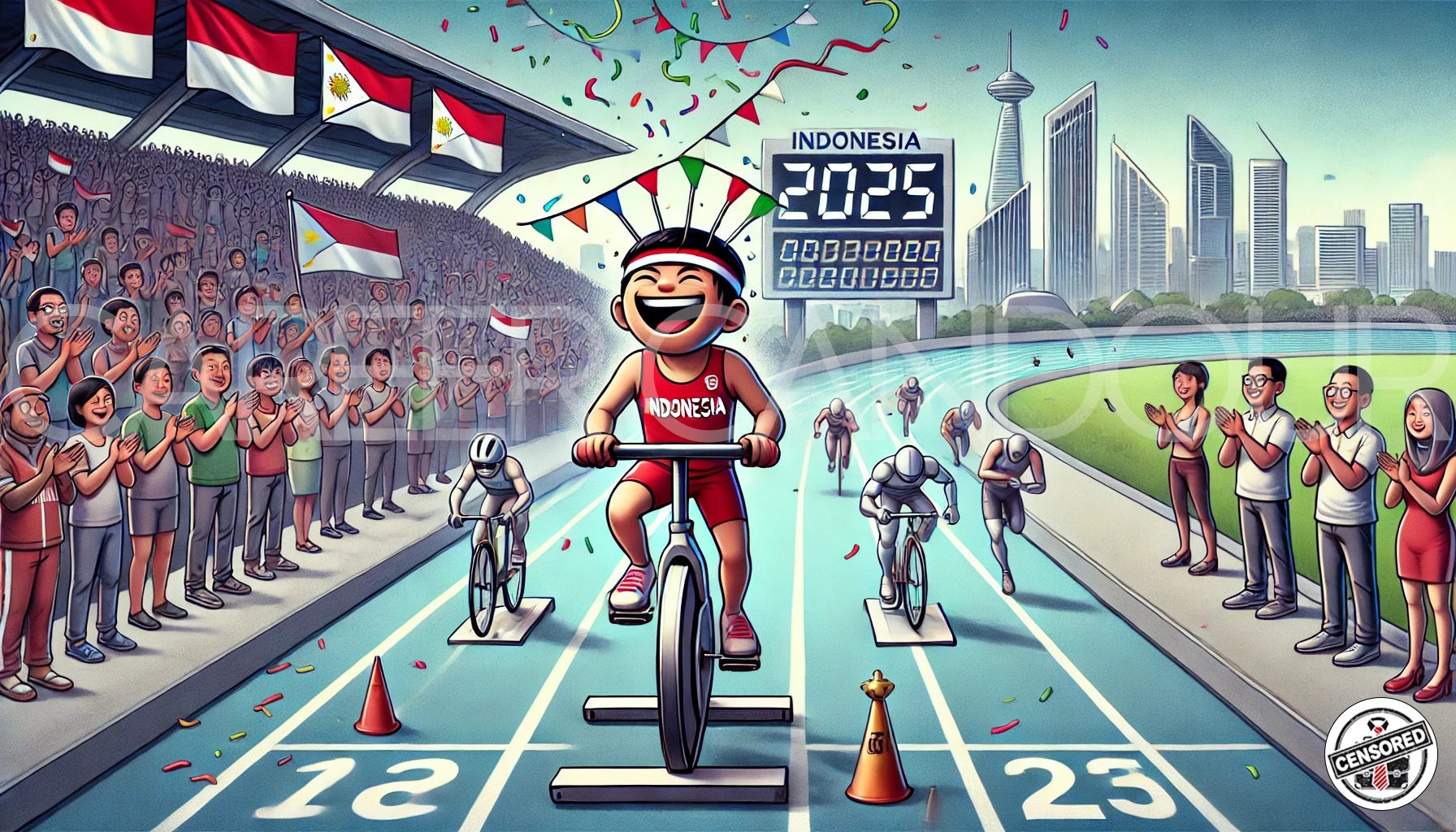
For a country with 283 million people, and enough nickel, palm oil, and idealistic press releases to power several small economies, Indonesia continues to enjoy describing itself with terms like rising, emerging, or practically developed. There’s always a narrative.
A new airport ribbon-cutting.
A Bappenas plan with bold fonts.
A minister on stage somewhere explaining how the economy is “transforming.”
And then, INSEAD drops the latest Global Talent Competitiveness Index…
And that data, annoyingly, speaks.
Indonesia’s score improves, yes, but marginally. Meanwhile, The Philippines sprinted past, Thailand crept forward, and Vietnam retained its momentum. Brunei and Mongolia also continued their quiet, competent strolls ahead.
And Indonesia? Still stuck behind every country it insists it’s superior to, and only outperforming the region’s disaster pile. The truth is, this annual ritual has become an index of missed potential.
“We Improved!”: The Annual Tradition of Confetti for Baby Steps
Every time a global index drops, somewhere in Jakarta a press release is drafted, declaring progress, celebrating marginal gains, and finding the silver lining in a fairly ordinary cloud. The 2025 GTCI results were no exception. Indonesia’s score climbed a respectable-sounding 0.93 points. Fire up the LinkedIn graphics! The announcement basically writes itself:
“Indonesia Improves in Global Talent Ranking.”
But context is cruel. Because while Indonesia was busy polishing its talking points, the Philippines climbed nine spots and overtook Indonesia without much fanfare. Not through a tech breakthrough or radical policy shift, but by simply moving faster. From 84th to 75th.
Thailand and Vietnam kept pace with quiet competence. Even Malaysia, weighed down by its own baggage, still operates at a much higher tier.
Meanwhile, Indonesia remained locked in place at 80th. Not falling. Not rising. Just... there. And while domestic analysts cheered the technical score bump, the GTCI itself wasn’t fooled. It doesn’t care about intention. It cares about outcomes and whether:
Your people are learning more,
Your firms are training better,
Your systems are more open,
Your innovation capacity is expanding.
These things don’t respond to speeches. They respond to reform, execution, and competition. And that’s the part Indonesia still seems to be treating as optional.

The Talent Pipeline: Wide, Energetic, and… Surprisingly Shallow
Indonesia has no shortage of people. Every year, millions graduate, enter the workforce, switch industries, start careers. The raw human energy is there. But if the GTCI’s Grow pillar tells us anything, it’s that this energy rarely converts into deep, resilient talent.
The 2025 report is unambiguous: the Grow score fell significantly. From 39.41 to 34.28. Indonesia sank.
The reasons are layered, but painfully familiar.
1. Formal Education: Plenty of Policy, Not Enough Progress
Education in Indonesia is a story of high hopes and low bandwidth. “Merdeka Belajar” is a nice phrase. But the actual freedom to teach, innovate, and adapt is tangled in paperwork, assessments, and inconsistent local implementation. The system is perpetually being repaired while in motion.
2. Vocational Education: Underrated and Underdelivering
The very schools that are supposed to fuel Indonesia’s industrial ambitions continue to operate with lower status, weaker funding, and minimal employer partnerships. Students are often funnelled into programs that sound useful but offer little real-world traction. It’s a system that produces diplomas more efficiently than it produces job-ready workers.
3. Lifelong Learning: All Talk, No Training
The corporate world loves the idea of empowerment, but balks at the cost of upskilling. “Training” often means one webinar and a motivational poster. GTCI metrics show firm-level training is rare, shallow, and unevenly distributed. Outside a handful of elite companies, ongoing talent development is more myth than method.
So yes, Indonesia has a talent pipeline. But like many things here, it’s more impressive in concept than execution.

Why Digitise When Excel (Mostly) Works?
In theory, Indonesia is a digital powerhouse. The average Indonesian owns more smartphones than books, navigates daily life with e-wallets, orders lunch from a super app, and doomscrolls through TikTok for sport. From a consumer standpoint, the country looks modern, connected, and ready for the Fourth Industrial Revolution.
But look into how firms actually operate, and the picture changes fast. According to the GTCI, Indonesia ranks 127th in enterprise software adoption, 118th in cloud computing, and still struggles to get more than a modest share of businesses online in any structured way. That’s a sign that many businesses are still operating in a paper-first, instinct-second, Excel-saves-the-day environment.
The reasons are well known but persistently ignored.
The economy is dominated by SMEs, many of which are understandably more focused on survival than transformation. For them, digitisation is an optional extra.
Risk aversion is cultural and structural. The average SME owner isn’t looking to overhaul their workflow. They’re looking to not make mistakes. And enterprise software sounds like a learning curve… and a gamble.
There’s a talent bottleneck. You can’t run cloud systems if no one on your team knows what the cloud actually is. Skilled tech professionals are scarce and expensive, and most are vacuumed up by unicorns or move overseas.
In sectors where market protection still reigns, there’s simply no pressure to get more efficient. If you’re winning the game by standing still, why run?
This creates a strange duality: a digitally sophisticated population and a digitally hesitant business ecosystem. GTCI penalises this.

“We Want to Compete Globally… But Also Prefer to Compete Alone”
Indonesia says it wants to be a global player. A regional hub. An innovation engine. The problem is that being competitive in a globalised economy means letting the world in. And Indonesia, on almost every indicator of openness, politely declines.
The GTCI’s Attract pillar is a sobering list of missed opportunities:
131st in migrant stock.
114th in international students.
117th in financial globalisation.
Still among the most restrictive in FDI.
Well below average in tolerance toward minorities and immigrants.
This is a systemic contradiction.
Indonesia wants to boost productivity, but refuses to integrate the kind of global talent that often drives it.
It wants to grow its innovation economy, but won’t build the kind of open, international environments where innovation actually happens.
Talent ecosystems are about exchange, circulation, and collision. Indonesia’s is designed for containment.
Compare this to regional peers.
Singapore proactively attracts top-tier global talent and builds policy around it.
Vietnam invites foreign investment like it’s preparing for a national open house.
Philippines weaponises English proficiency and diaspora connectivity into a soft-power talent strategy.
Even Thailand and Malaysia have clearer pathways for importing expertise.
In Indonesia, foreign talent is seen as a threat. Immigration is burdened by regulation. Even international students face unnecessary hurdles. It’s a resistant stance rather than a hostile one, shaped by history, politics, and a persistent belief in self-reliance.
But in today’s economy, isolation is stagnation. And when the rest of the region embraces connection while Indonesia hesitates, the scoreboard reflects that.
Indonesia’s GTCI story isn’t one of dramatic collapse or crisis. That would at least provoke urgency. Instead, it sits in the more frustrating category of quiet inertia. The country is simply not progressing fast enough to matter. And in a hyper-competitive region like Southeast Asia, that distinction makes all the difference.
The strategy being followed feels designed for a slower world. A world where scale and potential were enough. But today’s metrics reward systems that adapt, open up, and invest in depth, not just size. Indonesia’s neighbours appear to have accepted this. Out of necessity or foresight, they are shifting gears. Meanwhile, Indonesia coasts.
There are bursts of reform, sure. Headlines of transformation. Moments of policy noise. But they rarely shake the foundations. And those foundations, of education, openness, talent development, remain oddly untouched.
So when the next GTCI report lands, don’t be surprised if the numbers shift by decimal points, the rankings hold steady, and the declarations of progress ring once again. Not because nothing is being done. But because not enough is changing.
At StratEx - Indonesia Business Advisory we help Indonesian firms move from reactive HR to long-term talent strategy. Contact us to redesign your people systems, upskilling pipelines, and organisational strategy to compete regionally and win globally.