


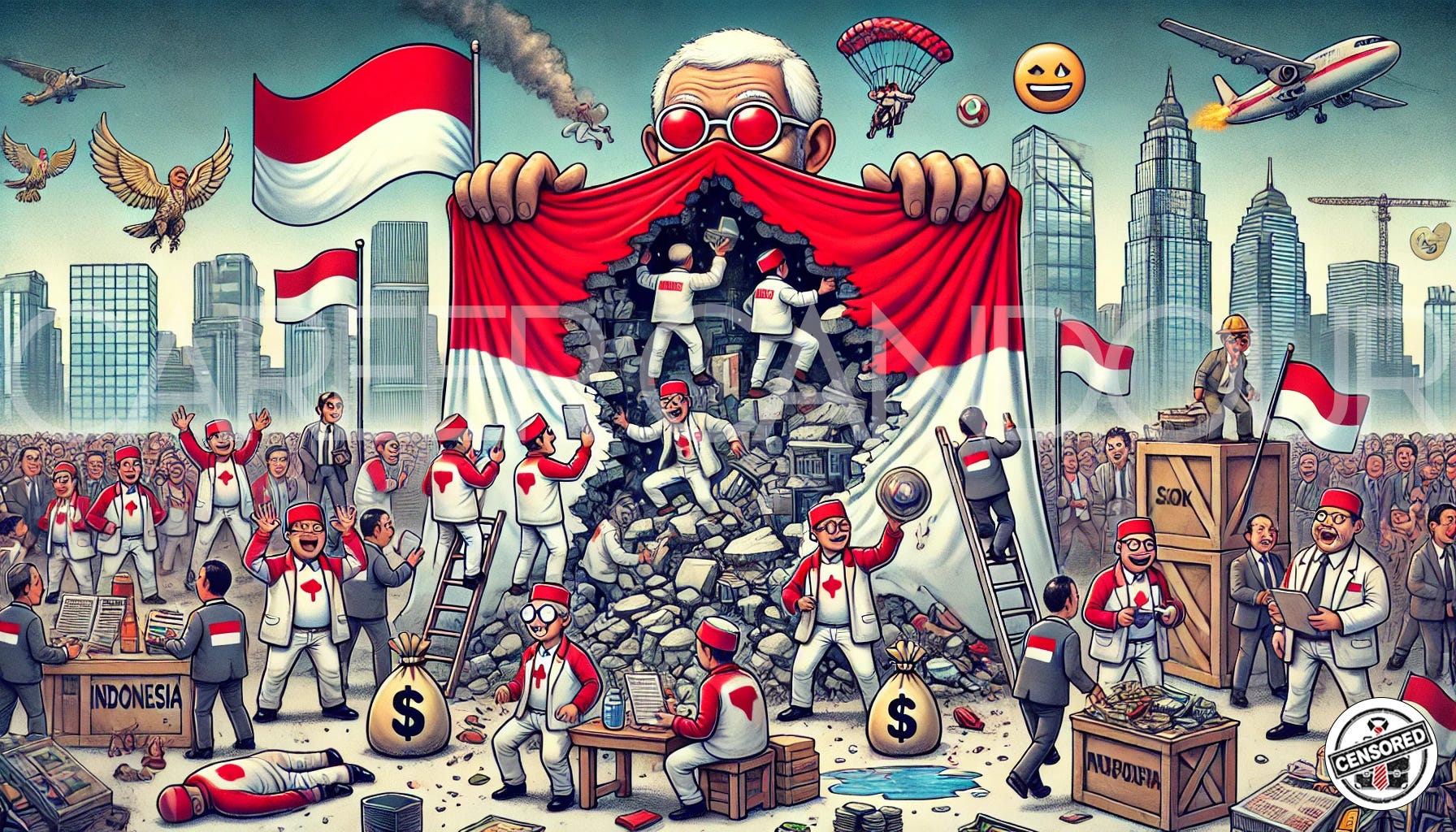
There are many products Indonesia has exported over the years: palm oil, coal, tin… TikTok soft boys. But perhaps the most profitable export of the 2018–2022 era was something far more ethereal: national pride. Not the quiet, earned kind, but the leveraged, securitised version that can be bundled into decks, IPO prospectuses, and LinkedIn manifestos, then wrapped tightly around Indonesian companies whose corporate headquarters somehow kept ending up in Singapore.
You remember the script because it was repeated everywhere, often verbatim.
“Invest in our unicorn. It’s your patriotic duty.”
“Quit your boring stable career and join us on this mission.”
“Buy shares in this IPO. Own a piece of Indonesia’s future.”
“Ignore any critics. They just don’t love the motherland like we do.”
It worked. For a while. Until valuations cratered, fraud allegations began surfacing, layoffs tore through the industry, and the loudest defenders of karya anak bangsa were spotted in Tiong Bahru, explaining that their relocation had absolutely nothing to do with liquidity events.
Meanwhile, the Indonesians who believed the dream were left holding devalued ESOPs, and underwater IPO shares.
Now, just a 18 months later, the drums are beating again. And those pointing out the obvious are once more branded enemies.
So let us be precise. This is not anti-Indonesia. It is anti using Indonesia as camouflage while accountability, and capital are exported elsewhere.
National Pride: Now Available as a Startup Marketing Tool
There is a long, respected tradition of nationalism being used to inspire unity, pride, and genuine nation-building. It is meant to raise standards, create shared responsibility, and align personal ambition with collective progress.
And then there is Indonesia’s startup marketing department.
This version took nationalism, stripped it of obligation, blended it with venture capital incentives, and repackaged it as branding. Add a handful of fashionable terminology like financial inclusion, empowering SMEs, and Industry 4.0, then serve it to investors, employees, regulators, and the public as a premium product. The result was Karya Anak Bangsa.
The rules of this brand were simple.
Critics were not wrong, they were anti Indonesian.
Questions about revenue quality or cost structure were not analytical, they were unpatriotic.
Requests for governance, controls, or independent oversight were dismissed with a hint of cultural defensiveness, as foreign thinking.
And if retail investors lost half their savings in a heavily promoted IPO, that was reframed as a necessary sacrifice for national progress.
At the height of the cycle, Indonesia produced national mascots disguised as tech companies. Each one delivered a polished monologue about Indonesia’s digital destiny, amplified across billboards, conferences, and social media, until the distinction between business performance and national pride became conveniently blurred.
Behind the curtain, the picture was far less sentimental.
Board meetings happened offshore.
Cap tables read like an index of global capital.
Founders who had spent years invoking patriotism discovered a sudden enthusiasm for relocating once liquidity arrived.
Pointing this out was treated as heresy. Any discomfort caused by the facts was reframed as negativity. The logic was emotional and airtight.
Wrap weak governance in the flag.
It was a clever trick. It worked. And it only looks elegant if you avert your eyes from the damage it left behind.

Wealth Extraction: The Real Series A, B, and C
Let’s take a short walk down memory lane…
1. The Hype
The messaging was relentless and emotionally calibrated.
“Invest in the future of Indonesia.”
“An opportunity of a lifetime.”
“Retail investors deserve a piece of the nation’s digital prosperity.”
It sounded democratic. This was participation. Buying shares was framed as belief. Opting out was framed as cynicism.
What tended to be omitted from this narrative was a quieter set of transactions already underway. Many insiders had, by this stage, executed secondary sales, exercised stock options, and taken meaningful amounts of risk off the table. The patriotic call to arms coincided neatly with capital being parked in safer jurisdictions, often before the opening bell ever rang.
2. The Performance
The listings themselves were choreographed events. Fireworks, speeches, emotional soundtracks, breathless commentary about historic milestones. Retail participation surged as people bought into the promise of a new economic era.
Global champions.
High quality jobs.
Homegrown companies that would finally put Indonesia on equal footing with Silicon Valley.
And it worked because people wanted it to be true. The story was aspirational, coherent, and well told. Skepticism felt impolite.
3. The Collapse
Reality arrived quickly.
Share prices slid, then fell.
Retail investors watched paper gains vanish.
Employees realised their much touted equity compensation was worth less than a daily commute.
The founders who had urged collective belief appeared suddenly well insulated from the fallout.
What followed was predictable. Layoffs, down rounds, aggressive cost cutting, and the familiar language of restructuring. In some cases, allegations of accounting irregularities surfaced. In others, the numbers simply failed to add up.
Yet instead of sustained anger toward those who engineered the spectacle, criticism was redirected outward. Defensiveness replaced accountability. And the bag was passed, cleanly and efficiently, to those who had been told it was their patriotic turn to hold it.

How to Reboot a Failed Ecosystem in 12 - 18 Months
Normally, a circular economy refers to sustainability, reuse, and learning from waste. Indonesia’s startup scene has adapted the concept with impressive creativity. Instead of recycling materials, it recycles narratives.
The cycle begins predictably.
First, a high profile company implodes.
Sometimes it is outright fraud.
Sometimes it is valuations detached from reality.
Sometimes it is weak governance dressed up as aggressive growth.
Often it is all three, bundled together for convenience. The damage is real and visible.
Jobs disappear.
Capital evaporates.
Trust takes a hit.
Next comes the spectacle.
Headlines multiply.
Investigations are announced.
Social media fills with indignation.
A handful of long form posts circulate, heavy on disappointment and hindsight.
Panels are convened.
Podcasts record special episodes.
For a brief moment, everyone agrees that something went badly wrong.
Then comes the ritual cleansing.
Statements are issued.
Lessons are declared learned.
Global best practices are invoked.
Stronger regulation is promised.
The language is reassuring and vague, which is exactly the point.
After that, time does the rest of the work.
Two quarters pass.
Attention shifts.
A new technology captures the imagination.
Macroeconomic indicators improve just enough to restore optimism.
Fresh graduates enter the workforce without the scar tissue of the previous cycle.
And then, the memory fades.
Into this vacuum steps a new founder, with a fresh slide deck and a familiar tone. The words change slightly.
AI replaces e commerce.
Sustainability replaces logistics.
Nusantara replaces Jakarta.
The drumbeat of national pride returns, louder than before.
Skeptics raise their hands.
Some are Indonesians who lived through the last collapse.
Some are outsiders who have seen this movie in other markets.
They ask basic questions. About numbers. About controls. About incentives.
The response is immediate and emotional.
They are negative.
They lack faith.
They are thinking too Western.
The implication is clear. The problem was never the behavior. The problem was the memory. And memory, in this ecosystem, is designed to be recycled into enthusiasm as quickly as possible.

Warning: The Drums are Coming Back… And Louder Than Ever
This is the part of the article where we pretend this is educational content…
The rule is simple.
If someone is aggressively invoking nationalism while denying or minimising the previous crash, run. Not slowly. Not politely. Run like your financial future depends on it, because statistically speaking, it probably does.
This instinct should sharpen the moment certain phrases appear.
“Don’t listen to foreigners. They don’t understand Indonesia.”
What this usually means is that the business cannot withstand comparison with healthier markets, so criticism must be disqualified at the source.“We need to support local champions.”
Translation: emotional loyalty will be substituted for basic scrutiny. Questions about margins, governance, or sustainability will be reframed as betrayal.“We don’t have time for critics. We have to scale.”
This is often code for urgency as a defensive tactic. Scale first, check later. Ideally after the round closes.“This is karya anak bangsa.”
By the time this line is deployed, the founders have often already reduced their personal exposure. Patriotism is encouraged. Risk is socialised.“Don’t be negative. Be proud.”
Negativity here usually means arithmetic. Pride is expected to do the heavy lifting that fundamentals cannot.
Against this noise, the critics sound remarkably boring.
Some are Indonesians who were laid off, diluted, or burned the first time around.
Some are outsiders who have worked in markets where growth was forced to coexist with discipline.
They ask unfashionable questions. About audited numbers. About controls. About why wealth keeps exiting the ecosystem instead of compounding within it.
These people are not attacking Indonesia. They are defending it from another avoidable self inflicted wound.
Ignoring them is how you end up with an even more expensive sequel nobody asked for.
Indonesia has real potential. There is no shortage of capable builders, both Indonesian and international, who would happily commit time, capital, and expertise to creating companies that endure. None of that is in dispute.
What is in dispute is the idea that potential alone is protective. It is not.
Potential does not inoculate an ecosystem against bad governance, fabricated numbers, warped incentives, or extractive behaviour repackaged as vision.
Potential does not neutralise charismatic founders who speak fluently about national destiny while quietly ensuring their own financial destiny is secured elsewhere.
If Indonesia wants a tech ecosystem that is credible rather than cyclical, it has to make a basic distinction.
Criticism is not disloyalty.
Asking for accountability is not a lack of faith.
Patriotism is not a substitute for fundamentals,
National pride is not a revenue model.
The real betrayal does not come from people pointing at obvious red flags. It comes from those who wrap themselves in symbolism to deflect scrutiny, then exit with the upside while others are left holding the risk.
The warning signs are already reappearing. The defensiveness is predictable. The language is familiar.
The response should be equally familiar, but better executed.
Listen to those who have seen this fail before.
Pay attention to incentives, not slogans.
Choose merit and execution over noise.
And when the noise becomes too loud, and the questions too unwelcome, do the most rational thing available.
Run.
Loving Indonesia does not require suspending judgement. It requires refusing to be misled in its name.
At StratEx - Indonesia Business Advisory help founders, boards, and investors in Indonesia build leadership teams, governance structures, and operating models. Contact us to align talent, incentives, and strategy to withstand cycles, not hype.