


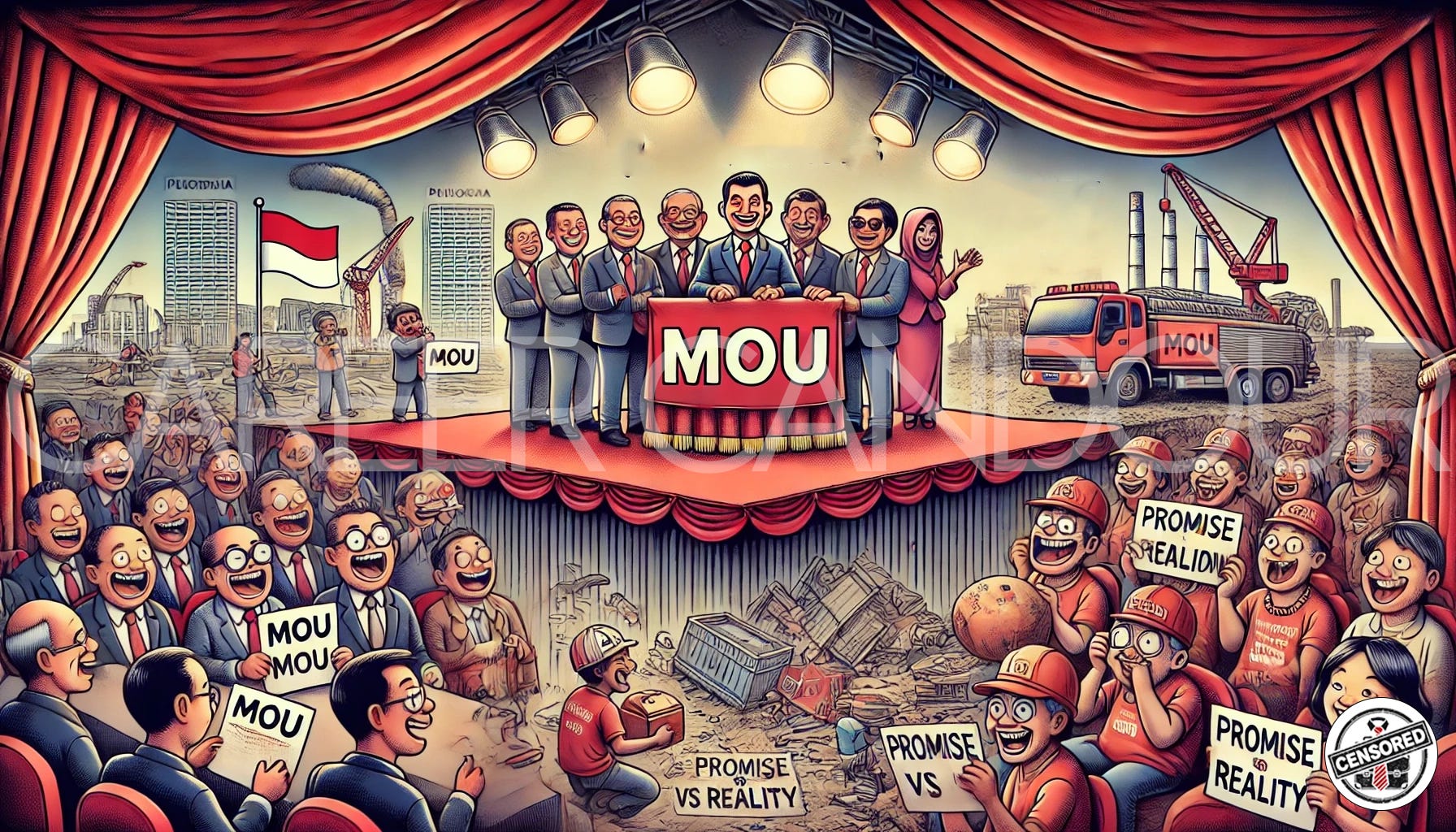
If Indonesia ever went to the Olympics for signing Memoranda of Understanding, the country would sweep the podium, and then convene a high-level dialogue to explore the feasibility of maintaining peak signing performance over the next five to ten years.
And yes, there would be a press release.
You see, MoUs hold a special place in Indonesian public life. Its a sign of ambition, coordination, and just enough forward momentum to feel like something important has happened. A signing ceremony delivers a neat sense of completion. Pens are lifted, hands are shaken, cameras flash, and for a brief moment the future appears fully booked.
Long tables.
Carefully arranged flags.
Officials leaning forward with the seriousness of people about to unlock economic destiny.
The announcement follows with reassuring precision.
Billions in potential investment.
Strategic sectors.
Mutually beneficial cooperation.
For a few days, it works, and the impression settles in that progress has been secured.
Then attention drifts. The next announcement arrives, and the previous document remains where it was left, waiting for the part where someone turns possibility into something measurable.
How MoUs Became a Habit
The relationship between Indonesia and the Memorandum of Understanding is long, and layered. No one can quite agree when it started. Some point to the 1970s, when foreign investors arrived and the government discovered that signing documents created a reassuring sense of forward motion. Others suspect it goes further back, rooted in a diplomatic instinct to keep things open-ended and safely non-committal.
What changed in the 2000s and 2010s was volume and visibility. Indonesia began hosting more summits, more forums, more carefully staged encounters between ministers and multinational executives.
The format settled into something efficient and repeatable.
Delegations enter.
Speeches reference partnership and shared prosperity.
A number appears, usually in the billions.
Pens are lifted.
Documents are signed.
Applause follows on cue.
From there, the machinery runs itself.
The press release lands.
Headlines convert “intention” into “deal” with confidence.
Social media fills with images of handshakes and flags.
For a few days, the future looks unusually well-organised.
MoUs thrived in this environment because they offered the best of both worlds. They allowed Indonesia to show ambition at scale while avoiding the slower, messier work of implementation. It is far easier to announce a railway than to negotiate land acquisition for one. It is far more enjoyable to discuss green industrial strategy than to navigate permits, financing gaps, and local resistance.
They also come with very little downside.
MoUs do not complain when ignored.
They do not escalate disputes.
They do not ask why nothing has happened eighteen months later.
They wait to be remembered… or forgotten.
And so the relationship deepened, because MoUs rarely disappoint loudly enough to cause concern.

When MoUs Turn Into Something Real
To be fair, and in the interest of not sounding completely unhinged, some Indonesian MoUs do eventually grow up and become real, functioning pieces of the economy. These are the rare cases that officials point to, usually accompanied by a slide deck and a tone that suggests, “See, we told you this would work.”
They are the outliers. The MoUs that made it out alive.
Take the Morowali Industrial Park. What began as a series of early agreements with Chinese industrial partners has turned into a sprawling nickel processing hub that now sits at the center of global supply chains. It produces millions of tons of material, employs tens of thousands of workers, and has helped reposition Indonesia as a serious player in downstream industry. It required years of capital, coordination, and political backing. It also required someone, somewhere, to keep pushing long after the signing ceremony ended.
The Pomalaa HPAL project offers a similar arc. It started life as a familiar, harmless MoU. An ‘expression of interest.’ But this one kept going. It evolved into a definitive agreement involving Vale, Huayou, and Ford, backed by serious money and tied directly to Indonesia’s electric vehicle ambitions. Construction is underway. Financing is being arranged. The idea survived contact with reality, which already places it in the top tier of MoU outcomes.
Then there is the Cirata floating solar project. Announced within a broader Indonesia–UAE cooperation framework, it moved from concept to construction and is now operational, feeding electricity into the grid. For policymakers, it functions as a reliable example whenever questions arise about whether renewable energy commitments are translating into actual capacity. For other MoUs, it serves as a reminder that expectations can, occasionally, be met.
The Jakarta MRT sits slightly outside the usual MoU narrative but still belongs in the same family. Built through long-standing cooperation with Japan, supported by financing arrangements and technical partnerships, it represents what happens when frameworks are followed by sustained execution. Trains run. People use them. It is an outcome that feels almost radical in its simplicity.
These successes share a pattern.
They involve partners who can fund and build.
They align with national priorities, which keeps them politically relevant.
They move beyond early-stage language into binding agreements that assign responsibility and timelines.
Most importantly, they continue to receive attention after the press conference.
So yes, MoUs can lead to real things. They can underpin industrial clusters, energy projects, and transport systems that reshape parts of the economy.
They just do so selectively.
For every Morowali or Cirata, there are many others that remain exactly where they started. Filed, referenced, occasionally mentioned, but never quite activated. The success stories are real, and worth acknowledging. They are also rare enough to be memorable, which is why they are used so often to justify everything else.

When MoUs Don’t Go Much Further
For every Morowali or Cirata that makes it to fruition, there is a much larger number of MoUs that opened strong and then drifted off somewhere between “initial enthusiasm” and “pending further discussion.”
The opening scenes are convincing.
A signing ceremony with confident smiles.
A headline number large enough to feel historic.
Mentions of jobs, technology transfer, regional transformation.
A future that appears briefly within reach.
Then the calendar fills up.
Meetings are scheduled, then rescheduled.
Feasibility studies are commissioned and take their time.
Permits begin their journey through the administrative labyrinth.
Investors reassess.
Market conditions evolve.
The project remains alive in theory and increasingly abstract in practice.
The numbers, unfortunately, have a habit of interrupting the narrative. Around 40 to 50 percent of investment commitments eventually translate into realised projects. Some earlier waves of foreign commitments, particularly from China, hovered closer to 7 to 10 percent. Renewable energy targets have seen realisation levels around 30 percent in certain periods.
And yet, each new MoU arrives with the energy of a fresh start. The context rarely follows it onto the stage. The audience applauds as if the previous announcements were unrelated.
There are reasons for this pattern. MoUs are designed to be non-binding. They are meant to open conversations, not close deals. That flexibility is convenient when circumstances change. It is less helpful when expectations have already been set in public.
Once the real work begins, the tone shifts.
Land needs to be secured.
Regulations need to be navigated.
Financing needs to be locked in.
Coordination between institutions becomes more consequential.
Each step introduces opportunities for delay, reinterpretation, or quiet retreat.
If the successful MoUs are the headlines, the majority are closer to background noise. They remain in the system, referenced occasionally, waiting for conditions that may or may not arrive.

Why MoUs Keep Getting Signed
MoUs are popular everywhere. Governments sign them, photograph them, and occasionally even follow up on them. Indonesia has simply taken this global habit and refined it into something closer to an art form. At this point, the MoU is less a tool of policy and more a reliable unit of political output.
1. They Deliver Instant Gratification
Few actions in government produce such clean, immediate results. Within minutes, a signing ceremony generates images, headlines, and a narrative of progress. A minister can stand in front of a banner, hold up a folder, and confidently suggest that billions of dollars are now in motion. The audience is given a complete story. Something has been agreed. Something big is coming.
The fact that the “something” still needs feasibility studies, permits, financing, and several years of negotiation is a detail best reserved for later. Preferably much later.
2. They Are Comfortably Low Risk
MoUs allow leaders to claim momentum without accepting meaningful exposure. If the project moves forward, it becomes a success story. If it does not, the explanation is ready.
Market conditions changed.
Investors reconsidered.
Technical issues emerged.
The MoU itself remains blameless. There is no courtroom drama. No breach of contract. No public reckoning. Just a gentle fade into administrative memory.
3. They Sound Larger Than Life
The numbers do a lot of work. Announcements framed in the tens of billions carry weight, regardless of how tentative the underlying commitments might be. A headline can suggest certainty even when the document itself is careful to avoid it.
This creates a useful ambiguity. Officials can speak in terms of ambition. Investors can interpret flexibility. The public sees scale. Everyone leaves with a slightly different understanding, and no one is technically incorrect.
4. They Fit the National Operating System
Indonesia’s approach to decision-making values discussion, alignment, and leaving options open. MoUs fit neatly into that system. They formalise intent while keeping doors ajar.
MoUs reflect a broader preference for gradual commitment and managed uncertainty. They also happen to look very good in photographs, which never hurts.
Taken together, the appeal becomes clear. MoUs deliver visibility, preserve flexibility, and carry minimal downside.

Indonesia’s enthusiasm for MoUs sits comfortably within global norms, just with a little more ceremony, and a few more flags. None of this is troubling. Every country enjoys a well-timed announcement. Indonesia has just turned it into a minor art form.
And that’s OK… as long as everyone understands what they’re looking at
An MoU is:
Not a contract
Not a guarantee
Not a project
Not a job-creation machine
Not a forecast of future GDP
Not the Second Coming of Industrialisation
An MoU is:
A conversation starter
A diplomatic gesture
A political performance
A maybe (if the stars align and nobody drops the ball)
The country’s track record offers a balanced view, if one is willing to look past the press releases. Some agreements have matured into real infrastructure and industrial capacity. Others have taken a more contemplative path, remaining in a prolonged state of potential.
So where does that leave us?
With the only intelligent conclusion:
Celebrate MoUs for what they are. Political postcards. From the future. But never mistake them for the future itself.
If Indonesia ever wants more of those MoUs to turn into real factories, real infrastructure, and real growth, it will take:
Regulatory certainty
Serious follow-through
Better coordination
Stronger institutions
And a little less faith in the divine transformative power of a signing ceremony
Will this happen?
That’s the million dollar question.
At StratEx - Indonesia Business Advisory we support clients through regulatory, commercial, and local complexities to deliver real results in Indonesia.. Contact us to help identify, structure, and execute investments that actually move forward.