


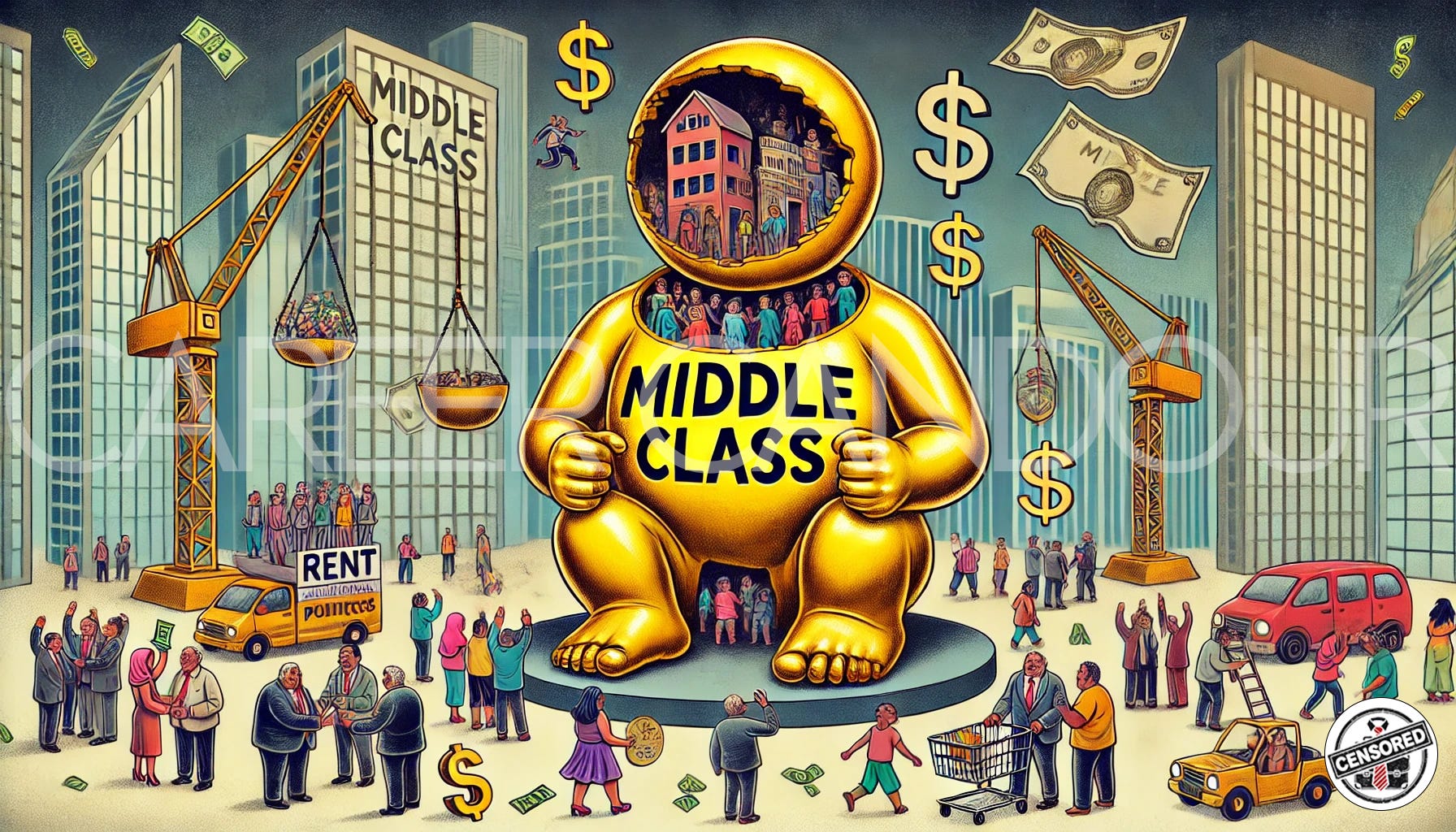
For years, Indonesia has declared that it has a massive, unstoppable middle class. A large domestic consumption engine, rising prosperity, and a statistic that makes foreign investors salivate.
“Sixty million middle-class Indonesians!”
Politicians beamed. Economists nodded. Consulting firms added clip art of shopping bags to slides. Investors threw money at Indonesian unicorns.
And the public? They shrugged and said:
“Middle class? Sure. That sounds… nice. Am I? Really? Wow. Thanks.”
It was like being called tall, or handsome. Not necessarily true, but flattering.
But then, the “middle class” started shrinking. Dramatically. From roughly 60 million to 48 million in just 5–6 years. Suddenly the numbers didn’t feel quite as comforting..
Maybe the middle class was never what we thought it was.
Maybe the whole narrative was built on a definition so generous it could turn survival into success.
Which raises the obvious question:
Is “middle class” in Indonesia a serious economic classification, or just a very polite compliment?
The 3.5× Poverty Line Problem
Indonesia’s official “middle class” threshold comes from a very respectable World Bank framework. It says:
You are “middle class” if your per-capita consumption is 3.5–17× the national poverty line.
That sounds scientific. So what’s the poverty line?
Well, it’s… low. Not “low” as in “budget-friendly.” Low as in “this is what we decided counts as survival.” It’s built around a simple concept:
Can a person consume enough calories not to die, plus afford minimal non-food items.
Minimal, here, is doing a lot of work. It does not include a phone, school fees, or internet,. It also does not include the psychological comfort of knowing you are not one medical bill away from financial ruin.
As of 2024, the poverty line sits around Rp 580–600k per person per month. Multiply that by 3.5 and you get the bottom rung of the “middle class” ladder:
3.5 × 580k ≈ approx. Rp 2.0 million per person per month.
That’s the number. According to this model, at Rp 2 million per person, you are now economically secure.
Meanwhile, in actual Jakarta, Rp 2 million per person buys you half a month’s rent in a kost, or three modest dinners in a mall if you behave. It does not buy the lived sensation of being “middle class” in a city where the price of comfort is always rising.
Most Indonesians know this intuitively, which is why nobody actually believes the definition. But economists cling to it anyway because, technically it works.

Jakarta Is Not “Indonesia Average”
Indonesia is not one economy. It is a collection of realities stacked on top of each other, all technically in the same country, all living in very different price universes.
Jakarta is its own creature. Rent can feel like Singapore, traffic can feel like Manila. Salaries often feel like someone forgot to update them since the early 2000s. You can earn what looks like a “decent” wage on paper and still spend half your life doing mental arithmetic in the supermarket.
Then you have Surabaya and Medan, which are expensive in a way that still feels vaguely human. The malls exist, but you can still live without constantly wondering whether your next promotion will simply be absorbed by rent inflation.
Rural Java is a different planet. Life is frugal. People stretch money further. Some costs are lower because the economy is built around local living, not global consumption. Your social status is less likely to depend on whether you own a car and more on whether your motorbike is still alive.
And then there are remote areas like Papua and parts of NTT, where the “cost of living” is not about lifestyle at all. Prices are shaped by geography, supply chains, and scarcity. You are budgeting for survival.
Yet national statistics love a single story.
One poverty line.
One middle class threshold.
One neat “average.”
This is why a Jakarta worker earning UMP, around 5 million, does not feel middle class, but on paper, some analysis frameworks make them look like they're knocking on the door of economic glory.
A single national middle class definition makes Indonesia sound simpler than it is.

Global Prices, Local Salaries
If you look at Indonesia within Indonesia, the idea of being “middle class” at Rp 2–4 million per capita can make sense mathematically. The numbers work. The feeling does not.
Because the minute you step outside the country, even just to Changi Airport, it becomes painfully obvious:
Indonesia’s statistical middle class is not global middle class.
You can feel middle class at Soekarno-Hatta and become humbled somewhere between Terminal 1 and a Singaporean sandwich.
Globally, a common lower bound for “middle class” is roughly $11 per person per day (PPP). Converted crudely, that is something like Rp 5–6 million per person per month. That is the level where you are not just surviving. Where you have a little room to breathe, save, plan, and occasionally buy something because you want it, not because you must.
Which means:
Indonesia’s official middle class lower bound sits below what global frameworks would call “not poor.”
Many Indonesians who are “middle class” domestically are, in global terms, still hovering uncomfortably close to poverty.
Domestically middle-class Indonesian can become an overnight economic tourist abroad.
Now imagine foreign investors hearing “Indonesia has 60 million middle-class consumers” and picturing iPads, Michelin dinners, condo mortgages, private cars, and Bali twice a year. Instead, the reality is often data plans, kopi chains, a Honda Scoopy, and a phone bought on installments.
No wonder expectations get misaligned. Everyone is technically correct.

Why “Middle Class” Feels Good to Hear
Calling people “middle class” is like being called handsome, even if you look like a potato. It tells you that you are doing okay, and that your life is moving in the right direction.
Who wants to wake up and hear the real version?
“Statistically, you’re vulnerable. You’re 2 shocks away from eating Indomie for dinner all year. Your kid’s education is precarious. Have a great day.”
Nobody wants to refresh the economy app and get emotionally humbled before breakfast.
People want to feel they’re rising, moving toward a brighter future.
Governments want citizens to feel stable and proud.
Businesses want to tell investors there are millions of new customers ready to buy shampoo, smartphones, and SUVs.
So “middle class” becomes a collective mood booster. A way to make hard realities feel like temporary inconveniences rather than structural problems.
Even if the numbers are massaged. Even if Jakarta’s real middle class probably starts around:
6 to 7 million per person,
or 18 to 28 million per household.
Even if that means the true, honest-to-God middle class is likely closer to 10 million people than 48 million.
But who in power wants to say that out loud?

Why Nobody Wants to Redefine It
Imagine an Indonesian policymaker standing at a podium and declaring:
“Good evening. According to new, globally realistic definitions, millions of you are no longer middle class. In fact, many of you are one broken motorbike away from vulnerability. Also, our economy is not as robust as we’ve been telling you. Thank you.”
Imagine what would happen next.
Redefining the middle class honestly is political dynamite. It changes the story overnight. It would:
Shrink the group dramatically (from 48 million to maybe 10 million).
Reveal that upper-middle-income poverty is still widespread (as high as 60%, per World Bank’s UMIC line).
Shatter the narrative that Indonesia is a massive emerging consumer market.
Terrify investors who imagined Gucci-buying, Tesla-driving Indonesians.
Make politicians suddenly look… ineffective.
So it is no wonder everyone avoids the topic. The public gets a compliment. Officials get bragging rights. Investors get a fantasy. Consultants get contracts.
“Middle class” feels affirming, but completely detached from what is actually happening.
So is it time to redefine the Indonesian middle class honestly?
Absolutely.
Will anyone with real power do it?
Of course not. Because the real, uncomfortable, regionally-adjusted, globally-benchmarked, Jakarta-priced truth is politically expensive.
Indonesia’s real middle class is much smaller than anyone admits, far more fragile than anyone wants to acknowledge, and drastically overhyped in ways that make foreign investors think everyone here is one payday away from buying a Dyson.
And once you say it out loud, you cannot unsay it. You cannot quietly walk it back with a press release and a new infographic.
Instead, Indonesia continues using a definition that is
Economically technical
Politically convenient
Emotionally flattering
It produces optimistic charts. It keeps the narrative neat and exportable.
Still, maybe it is time. Maybe it’s time to say:
“Middle class” should mean something real. Something that resonates with lived experience. Something honest. Even if it hurts.
Because at some point, even flattery starts feeling old.
And when that day comes, Indonesia might finally redraw the line and discover that the middle class is not 48 million, but something far smaller, far truer, and far more deserving of the name.
Until then, enjoy the compliment. You’re middle class. Probably. Sort of. Technically. Maybe.
Just don’t check your bank account.
At StratEx - Indonesia Business Advisory we support companies and investors with compensation frameworks and Indonesia-specific advisory. Contact us (or DM me) if you're interested to attract / retain talent, and scale sustainably in Indonesia.