


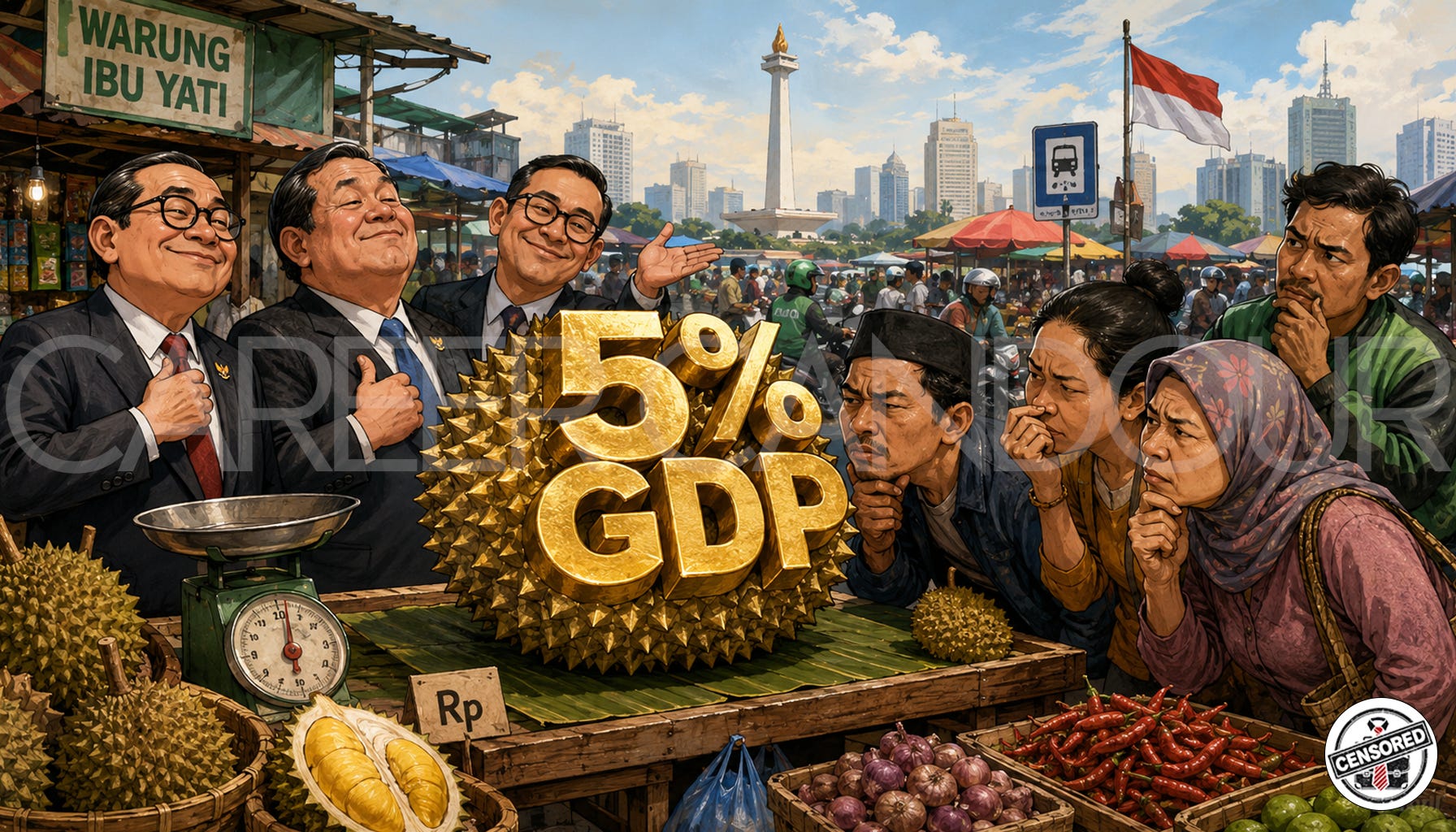
Indonesia’s GDP number has become weirdly reliable. Whatever else is happening, it usually ends up somewhere around 5%. Not 2%, which would cause panic. Not 7%, which would raise eyebrows. Just a nice, sensible, respectable 5%.
That does not mean it is fake. Indonesia is a big economy, and big economies can keep moving even when parts of the country are clearly struggling. The issue is more basic: does the number pass the smell test?
Because when households are squeezed, while the GDP numbers says, “Actually, everything is broadly fine,” people are allowed to sniff the air a bit.
Indonesia is already using real GDP for the headline figure, so this is not a case of officials waving around the bigger nominal number and hoping nobody notices inflation. The question sits inside the real GDP number itself.
What is holding it up?
Which parts of the economy are doing the heavy lifting?
Why does the final result so often look neater than the rest of the picture?
A number can be official and still deserve questioning. It can be calculated using accepted methods and still be used in a way that oversells the economy. It can be true and still not tell the full story.
What GDP Leaves Out
Indonesia reported real GDP growth of 5.11% in 2025, which is strong by global standards and useful if you are trying to tell a reassuring story about the economy. It gives officials a crisp message: growth is solid, the economy is resilient, the plan is working. Lovely. Everyone can go home.
But GDP does not tell you whether people are actually doing better. It tells you that measured output increased. That matters, but it is not the same as saying wages are rising properly, jobs are improving, or households have more breathing room at the end of the month.
This is where the smell test starts.
A 5% growth rate driven by rising wages and healthy private demand smells one way.
A 5% growth rate held together by big projects, trade effects, and households spending because they still have to eat smells quite different.
The problem is that public discussion often treats those two versions as if they are the same thing. The number comes out, officials describe the economy as resilient, and the conversation quickly moves on to the next press release. The actual composition of growth gets treated like something for analysts to pick over later.
But the details are the whole point.
Private consumption matters because it is such a large part of Indonesia’s economy.
Investment matters because it can move the headline even when households are not feeling much benefit.
Trade matters because it can help the number in ways that sound better than they are.
These are the difference between “people are doing better” and “the spreadsheet looks fine.”
A GDP number can look impressive while the lived economy feels ordinary at best. That is because GDP is not designed to describe ordinary life. It measures output, not security. It measures activity, not whether the activity produces a better month for the average household.
That matters in Indonesia because the growth figure is often used as a broad certificate of economic health. A strong GDP number becomes proof that policy is working, that critics are exaggerating, and that any discomfort people feel is somehow separate from the real economy. This is where the number starts doing political work.

The Year-on-Year Trick
Indonesia usually puts the year-on-year GDP figure front and centre. That means the economy is compared with the same quarter a year earlier. It is a valid comparison, but it is also very good at making things look smoother than they felt at the time.
In the first quarter of 2025, Indonesia reported 4.87% growth compared with the first quarter of 2024. That sounds fine. Close to 5%. Nothing to see here. But in the same release, the economy contracted by 0.98% compared with the previous quarter. Same economy. Same release. Different smell.
Year-on-year figures are useful, but they are also very good at making a rough patch look less rough. People do not experience the economy as a comparison with the same quarter last year. They experience it through what changed recently.
That is why the choice of headline matters. If the public hears the year-on-year number first, the economy sounds steady. If the public hears the quarter-on-quarter contraction first, the economy sounds much weaker. Both versions can be technically correct, but they do not have the same political effect. And politics, as ever, has a keen interest in which technically correct fact gets the spotlight.
Then came the second quarter of 2025, when GDP growth came in at 5.12% year-on-year. That was stronger than many expected, and it raised questions because other indicators were not clearly pointing to such a strong rebound. The official data also showed 4.04% quarter-on-quarter growth, which makes sense after a weak first quarter, but the surprise still needed more explanation than “the economy is resilient.”
A strong rebound after a weak quarter is possible. A stronger-than-expected GDP print is possible. But when the number beats expectations while other indicators look softer, the proper response is to explain the gap in detail.
Which sectors drove the rebound?
Which components surprised?
How much came from investment?
How much came from government spending?
Was trade helping because exports were strong, or because imports were weak?
The number that gets the headline is usually the one that makes things look steady. That might be technically honest, but it is also very convenient.

Inside the 5%
Once you break GDP into its parts, the 5% number becomes less mysterious. It also becomes less comforting.
Consumption is the big one because Indonesians spend a lot as part of the economy. So even if household spending grows at a moderate pace, it can still make a large contribution to GDP. Officials can point to that and say the consumer is resilient. But “resilient” can mean a lot of things. Sometimes it means confident. Sometimes it means people are still spending because life keeps sending bills.
A household can keep spending while feeling poorer. People buy cheaper brands. They delay bigger purchases. GDP still records the spending, but not the sentiment.
There is no line item for “bought it, but hated the price.”
This is one of the great tricks of consumption data. It can look like strength from above and stress from below. A family that cuts back on quality, postpones a purchase, or burns through savings still appears as part of the consumption story if money changes hands.
Investment is where the smell test gets more interesting. Gross fixed capital formation helped support growth in 2025, and in some quarters it did a lot of work. That can be good if it means productive investment that raises future income. But investment can also mean big construction projects, capital-heavy activity, and spending that lifts GDP before ordinary workers see much benefit.
This is where the “gap-plugging” suspicion becomes more understandable. If household demand is not obviously booming, investment can help keep the headline looking healthy. If domestic demand looks uneven, trade can help. If one part of the story feels weak, another part can pick up the slack.
Investment-led growth can be very good. A country needs infrastructure, productive capacity, and all the unglamorous things that make future growth possible. But it also matters who benefits, how quickly, and whether the investment creates broad income gains or simply produces a good quarterly number. A new project may add to GDP long before it improves the financial life of the average worker.
Net exports are a perfect example of why GDP can smell better than the underlying story. If exports rise strongly, great. That is real strength. But net exports can also improve when imports weaken. If imports are weaker because domestic demand is soft, GDP can still get a boost from something that is not exactly a sign of national vitality.
The 5% figure can be made up of completely legitimate components that still do not mean what the headline makes them sound like.
Consumption can reflect pressure.
Investment can reflect projects more than prosperity.
Trade can flatter the result because imports are weak.
That is why the question is not whether the number is right. The more useful question is what kind of right it is. Some numbers are right in a way that clarifies. Others are right in a way that leaves the public with exactly the wrong impression.

GDP vs. Real Life
The strongest reason to question the GDP story is the gap between GDP and the indicators that usually tell us whether growth is broad-based.
Wages are the obvious place to start. Official data showed the average employee wage rising from IDR 3.04 million in February 2024 to IDR 3.09 million in February 2025. That is an increase of only 1.78%, while real GDP growth was still around 5%.
If the economy is growing at 5% and wages are rising by less than 2%, people are entitled to ask where the growth went.
Maybe it went to capital.
Maybe it went to sectors that do not employ many people.
Maybe it showed up in profits, projects, or parts of the economy that do not touch average workers much.
Fine. Explain that.
But do not sell it as a simple story of national economic health.
A wage gap like that proves that GDP is saying something narrower than the public is encouraged to hear. It suggests that the gains from output growth may not be flowing through pay packets in any obvious way. That should be a major part of the story, not a footnote.
Business indicators and consumer signals have also made the picture harder to swallow at different points. When surveys soften or durable-goods demand weakens, a strong GDP print should come with a clear explanation of why those indicators are not telling the full story. Instead, GDP often gets treated like the boss number.
The Q2 2025 ‘controversy’ mattered because it made that gap conspicuous. The 5.12% growth figure beat the median analyst expectation of 4.8%, while independent economists pointed to weaker indicators in the real economy and asked for more detail… which is exactly what analysts are supposed to do.
The lazy response is to frame the debate as a choice between trusting the official number and believing in a vast conspiracy. That is a very convenient way to avoid the interesting part: reconciliation.
If GDP is strong while wages are weak, explain the wage gap.
If GDP is strong while business indicators are soft, explain the sector difference.
If investment carried the quarter, say what kind of investment did the carrying.
The public can handle detail. What people distrust is the feeling that a neat number is being used to end a conversation that should be starting.
A number can pass formal checks and still fail to convince people because the surrounding evidence does not line up neatly. In that situation, the job of officials is to earn trust by making the explanation harder to dismiss.

Who Checks the Number?
Indonesia’s GDP is produced by BPS and follows recognised national-accounting standards. The data are not being made up on a napkin behind a ministry building. Indonesia is working inside the same broad statistical system used elsewhere, and outside institutions use the data.
But that does not mean every GDP release is independently audited by some global referee. International institutions do not rebuild Indonesia’s GDP from raw surveys every quarter. They monitor standards, publication practices, and methodology. That is useful, but it is not the same as someone checking every assumption line by line and giving the number a holy blessing.
This distinction matters because GDP is politically valuable. A stable 5% growth number reassures investors, supports government credibility, and gives officials a clean line when the rest of the data are less cooperative.
Every government prefers a strong growth number to a weak one.
Every finance minister would rather talk about resilience than stagnation.
Every administration knows that GDP is not just a statistic;
GDP is an indicator to markets, voters, ratings agencies, investors, and anyone else trying to decide whether the country is on track. A number with that much political value should never be treated as if it exists in a vacuum.
So the answer is not to shout “fake” every time GDP comes out. The answer is to show more of the working.
Break down investment properly.
Explain when trade is helped by weak imports.
Make revisions easy to track.
Address the gaps between GDP and wages, surveys, or other real-world indicators directly.
That would build trust.
Indonesia does not need a conspiracy debate. It needs a “show your working” debate. If the number is solid, the details should make it stronger. If the details make people more suspicious, that is not the public’s fault.
Indonesia’s 5% growth figure may be right. The country has enough real economic activity to make it plausible. But the way the number gets used is the problem. Too often it is treated like proof that the economy is fine, when it should be treated as the opening stanza.
Year-on-year growth can make the economy look smoother than quarter-on-quarter movement.
Consumption can support GDP without proving households feel good.
Investment can lift the headline before workers see the benefit.
Net exports can improve because imports are weak.
Wages can lag far behind output.
None of that proves the numbers are cooked. It does show why the headline should not get a free pass.
The next time Indonesia reports another 5% growth figure, the serious response is to ask what validated the number, what contradicted it, and what the official explanation leaves out.
Because the issue is not whether Indonesia’s GDP number can be defended in a technical sense. It probably can. The issue is whether the story built around it can survive contact with the rest of the data.
That is the smell test.
Show the working.
At StratEx - Indonesia Business Advisory provides Indonesia-focused advisory and leadership intelligence for investors that need to understand what is really moving beneath the surface. Contact us for better visibility before making your next move in Indonesia.