


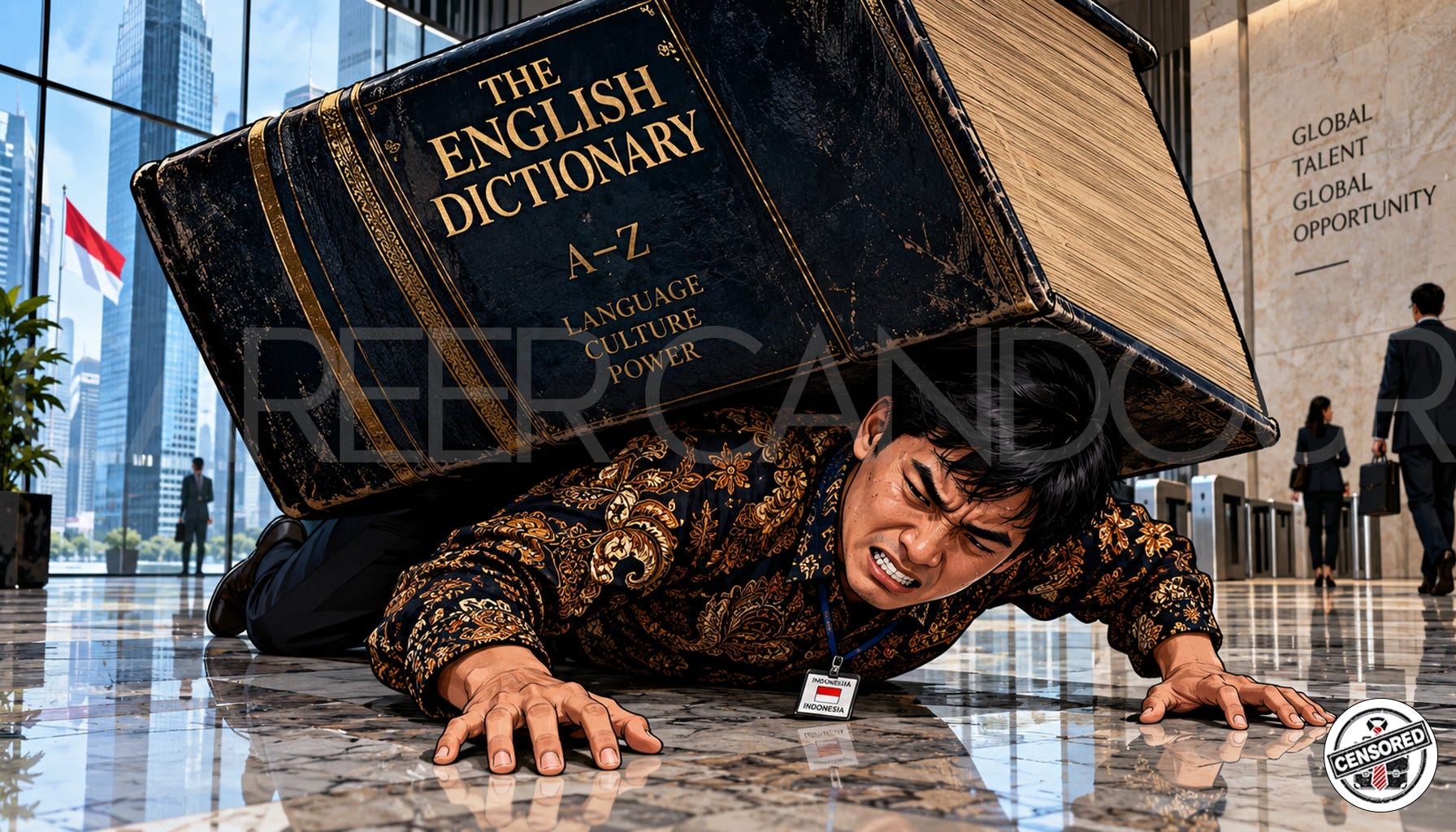
In the Élysée Palace, seated across from Emmanuel Macron, the Indonesian president, Prabowo Subianto, recently struck upon an idea of diplomatic generosity: Indonesian schoolchildren, he declared, ought to be instructed in French. A few months earlier, during President Lula’s visit to Jakarta, he floated a similarly visionary proposal: Indonesian classrooms should embrace Portuguese. Rumors soon rippled through the diplomatic corps that Spanish, Arabic, and Russian were also in the queue, awaiting only an appropriate state dinner with a foreign head of state before being drafted into the national curriculum.
While the President was scattering romantic pledges of polyglot brotherhood across the G20, the Education First English Proficiency Index (EF EPI) delivered its annual verdict on global linguistic competence. The report aggregated the test results of approximately 2.2 million adults across 123 non-native English-speaking countries and regions.
Indonesia scored an unimpressive 471.
This placed the biggest economy of Southeast Asia at 80th in the world. It was relegated to the “Low Proficiency” tier, well behind Nepal (514), Bangladesh (506), and Bhutan (479). While Jakarta’s political class was indulging in fantasies of primary schoolers parsing Racine and Camões, the report revealed that the median Indonesian university graduate would struggle to comprehend a corporate memo drafted in Manchester.
The question of whether this linguistic deficit is actively strangling the country’s economic ascent is routinely dismissed by local boosters who point to the domestic market, the nickel boom, and the shopping malls of Senayan. Yet beneath the surface of Indonesia’s self-satisfied insularity lies a profound cognitive dissonance. Does a giant like Indonesia require the global lingua franca to join the league of advanced nations, or has English become a lifestyle accessory for Jakarta’s elite?
The Regional Class
At the top of the 2025 index stands Malaysia, with a score of 581, and the undisputed number one in Asia. Its ascent was admittedly facilitated by Singapore, having posted scores so stellar for a decade, being removed from the non-native index altogether and reclassified as a native-speaking territory. Yet Malaysia’s triumph is real enough. Despite decades of nationalist flip-flops regarding whether mathematics should be taught in Malay or English, the administrative memory of the British Civil Service and an export-driven tech cluster in Penang have sustained an ecosystem where business can be transacted without an interpreter.
Further down the rankings, the Philippines sits at 569, with its army of call-center operators and corporate shared-service accountants continuing to extract billions of dollars from Western balance sheets. The real drama, however, is unfolding in the middle of the pack, where Vietnam and Thailand are staging a slow-motion morality play on the mechanics of modernization.
Vietnam scored 500, firmly entrenching itself in the “Moderate Proficiency” tier. A decade ago, it was an agrarian straggler; today, it is a primary beneficiary of the multinational retreat from China. This ascent is no accident of geography. It is the product of an obsessive national mobilization. Armed with Chữ Quốc Ngữ, Hanoi hitched its economic wagon to global manufacturing. When Samsung and Foxconn arrived, the Vietnamese state and an anxious, exam-obsessed Confucian middle class recognized English as an industrial passport. It made English compulsory from the third grade, tied university graduation to standardized language tests, and spent heavily to ensure that an assembly-line supervisor in Bac Ninh could coordinate component tolerances with an engineer in California.
Then there is Thailand, which slumped to 402, sinking toward the company of Cambodia and Rwanda.
Thailand’s collapse into the “Very Low” band is a demonstration of the “Tourism Trap.” To the casual tourist sipping a cocktail on Koh Samui, Thailand appears thoroughly internationalized. But this exposure is paper-thin. It is the shallow, transactional patter of the night market:
“Hello mister,”
“Tuk-tuk one hundred baht,”
“Foot massage?”
Thailand’s education system, bureaucratic and resistant to foreign interference, treats English as an exotic specimen to be memorized for multiple-choice tests rather than a corporate operating system. When Thai students sit for standardized tests measuring real-world listening comprehension and written synthesis, the tourist illusion evaporates.
And where, in this regional tableau, does Indonesia sit?
At 471, Indonesia occupies a twilight zone: not quite as untethered from reality as the Thai tourist corridors, but entirely lacking the hungry, export-driven discipline of the Vietnamese. It is stuck in a dazed, inward-looking middle. To understand how an economy of this scale arrived at such an impasse, one must go back nearly a century, to a moment of brilliant nation-building that inadvertently laid the foundations for modern linguistic complacency.

The 1928 Trap
In October 1928, a gathering of earnest young nationalists in Batavia committed an act of political genius known as the Sumpah Pemuda (Youth Pledge). They proclaimed one motherland, one nation, and one language: Bahasa Indonesia.
Rather than adopting Javanese, the tongue of the dominant ethnic group, they selected a Malay-based literary standard with roots in Riau Malay, the fluid trading lingua franca of the coastal ports. It was one of the most successful social engineering projects in post-colonial history. From Aceh to the Papuan highlands, and across seven hundred indigenous vernaculars, the newly minted republic gave its citizens a common voice.
The irony of this triumph, however, is that Indonesia became a victim of its own success.
In India, Nigeria, or the Philippines, linguistic fragmentation was so acute and regional rivalries so vicious that English had to be retained as the administrative glue to prevent the state from tearing itself to pieces. An engineer from Tamil Nadu speaking to an executive in New Delhi has little choice but to use the language of the former colonial masters. But Indonesia solved its internal communications puzzle so thoroughly that it created a self-sufficient linguistic Galapagos.
Today, 280 million Indonesians can be born, educated, entertained, governed, married, and buried entirely within the ecosystem of Bahasa Indonesia. A domestic consumer can watch twenty different national television channels, navigate a homegrown digital economy, binge domestically produced horror films, consume thousands of TikTok memes, and complete a doctorate in public administration without ever having to parse a single complex sentence in English.
In China or Japan, the sheer size of the domestic market is matched by a ruthless state-directed apparatus that systematically translates the world’s scientific and technical literature into the vernacular. Japan’s Meiji modernizers spent decades inventing native kanji compounds for Western concepts of physics, chemistry, and constitutional law. China employs armies of translators to convert MIT machine-learning pre-prints into Mandarin shortly after publication.
Indonesia, by contrast, has achieved linguistic self-sufficiency without the technical translation infrastructure. It spends less than 0.3% of its GDP on research and development. The domestic book publishing market is tiny; foreign academic treatises are rarely translated, and when they are, the print runs rarely exceed a few thousand copies. As a result, the average educated citizen is marooned: perfectly capable of engaging in sophisticated domestic political discourse but insulated from the global knowledge frontier. English was relegated to a secondary school chore.

The Internal Border
Ask the average resident of Central Jakarta where the best English in the country is spoken, and they will casually point east toward Bali. Similar to the Thai fallacy, the reasoning is that the island is packed with Australian surfers, European digital nomads, and high-end resort staff.
However, in the 2025 index, Denpasar managed a mediocre score of 477.
Haggling over the price of a surfboard or explaining the nuances of a floating breakfast does not translate into the analytical literacy demanded by a standardized CEFR examination. Once again, functional service-sector pidgin was mistaken for structured fluency.
The only cities to cross the 500-point threshold into the “Moderate” tier belong to a tight, incestuous club on the island of Java. Jakarta leads with 523, closely trailed by Surabaya (519), Surakarta (516), Bandung (505), Salatiga (504), Malang (502), and Yogyakarta (501). It is an archipelago within an archipelago. The commercial centers and historical university towns of Java function on an entirely different cognitive plane from the rest of the republic.
Outside this Javanese academic redoubt, the numbers drop off a cliff.
Sumatera averages 462;
Sulawesi sits at 460;
Kalimantan registers 440;
Papua manages 437;
While the spice islands of Maluku… 416.
Yet the geographical divide is trivial compared to the socio-economic chasm. In modern Indonesia, English operates as a class moat.
Spend an afternoon in Sudirman Central Business District (SCBD) or the cafes of Senopati in South Jakarta (Jaksel), and you will be inundated by a local patois heavily seasoned with “which is,” “literally,” “prefer,” and “make sense.” Behind this pastiche lies a ruthless economic reality. The top tier of the modern Indonesian economy—venture capital, corporate law, multinational FMCGs, management consulting, and high-growth fintech—are almost entirely staffed by a gilded caste.
These are the alumni of Jakarta’s elite private academies (Jakarta Intercultural School, British School Jakarta, Pelita Harapan) and Western universities. They speak English with the unforced, mid-Atlantic cadences of affluent global citizens.
A brilliant, hardworking graduate from Universitas Hasanuddin in Makassar or Universitas Andalas in Padang may possess a formidable intellect and an unshakeable work ethic. But when they arrive at an interview for a junior analyst position at an international investment fund in Jakarta, they are confronted with a forty-minute business-case interview conducted in rapid-fire corporate English. The gate slams shut.
Because the Indonesian state school system treats English instruction as an afterthought, the language ceases to be an escalator for social mobility. Instead, the children of the elite inherit fluency like a trust fund, while the graduates of regional state universities are shunted into low-productivity civil service clerical tracks, state-owned enterprises (BUMN), or the domestic informal sector.

Beyond Nickel
The developmental skeptic can mount a compelling historical case. The Asian industrial miracles of Japan in the 1960s, South Korea in the 1970s, Taiwan in the 1980s, and China over the past three decades, did not build their industrial empires on the back of fluent English.
A factory floor does not run on conversational nuance. When an operator is stamping an automotive chassis, wiring a solar panel, or calibrating a machine tool, they do not require the vocabulary of an Anglo-American corporate board. They require strict Standard Operating Procedures (SOPs), rigorous baseline numeracy, vocational discipline, and clear visual schematics.
This truth is currently visible across Sulawesi. Under the banner of hilirisasi, vast industrial complexes have materialized in places like Morowali and Weda Bay.
These mega-smelters are essentially Chinese turnkey operations. They were financed by Chinese state banks, built with Chinese blueprints, and are operated by Chinese technical directors communicating through bilingual intermediaries or translation software. Raw dirt enters one end; battery-grade nickel matte exits the other. Billions of dollars in export revenues are generated, yet hardly a word of English is uttered throughout the entire supply chain. Indonesia has effectively proven that it can haul its GDP per capita up from $4,000 to $5,000 through raw capital allocation, resource coercion, and industrial muscle.
The challenge begins when an economy tries to go any further.
The economic history of the developing world is littered with nations that reached the lower rungs of the “Middle-Income Trap” by moving dirt and assembling widgets, only to slam into an unyielding ceiling. To move from $5,000 to $30,000 per capita—the stated ambition of the government’s “Indonesia Emas 2045” blueprint—an economy must transition from being a passive consumer of other people’s technology to an active creator of its own. It requires “absorptive capacity.”
Here, the 471 score transforms into a structural barrier. When an advanced foreign pharmaceutical firm or semiconductor design outfit enters a market, it does not just look for land and cheap electricity; it looks for thousands of local engineers who can read technical white papers, debate architectural revisions with teams in Munich or Santa Clara, and write clean, standardized code.
Because Indonesia lacks this broad-based technical fluency, multinational tech giants consistently look past it. Microsoft, Google, and Apple make ceremonial visits, sign non-committal memorandums of understanding, and then build massive engineering and R&D campuses in Malaysia or Vietnam.
Even more glaring is the institutional penalty Indonesia pays in the race for corporate power. Geographically, demographically, and economically, Jakarta ought to be the undisputed capital of ASEAN. It represents over a third of the bloc’s GDP. Yet, when multinational corporations establish their Regional Headquarters (RHQs), they choose to set up in Singapore or Kuala Lumpur.
The rationale is simple. An executive running a regional operation across ten countries cannot spend their days struggling through translational misunderstandings with mid-level managers. They need an administrative talent pool that can draft a multi-jurisdictional contract or conduct a cross-border audit without friction. Indonesia is thus relegated to the status of a giant branch office: a vast, lucrative market to be plundered, but an intellectual backwater whose destiny is managed from boardrooms across the Malacca Strait.
Faced with such an economic bottleneck, one might expect the national leadership to mount an urgent, single-minded crusade to overhaul basic education. Instead, the country has been treated to a display of presidential statecraft.

90,000 Teachers Short
To observe President Prabowo’s recent international pronouncements is to watch the aristocratic imagination detach from an unfortunate institutional reality.
The son of Sumitro Djojohadikusumo—one of the republic’s founding intellectual aristocrats—Prabowo spent his formative years at private academies in London and Zurich, absorbing four European languages. To a man shaped by the cosmopolitan finish of mid-twentieth-century European private schools, the acquisition of languages is viewed through the lens of personal cultivation: an elegant, cultured accomplishment that demonstrates high breeding and broad-mindedness.
It is this nostalgia that he has been projecting onto the world stage. Flushed with the diplomatic thrill of international summits, the President has treated language policy as a form of bilateral flattery. To promise Macron that Indonesian children will learn French, or to tell Lula that they will study Portuguese, costs nothing. It is a diplomatic gesture that delights foreign hosts, strokes their linguistic vanity, and generates warm handshakes for the state television cameras.
Back home, however, the Ministry of Education is presiding over a structural emergency.
Roughly 90,000 schools across Indonesia do not have a single qualified English teacher. In tens of thousands of primary classrooms, English is not taught at all, or it is assigned to an exhausted, underpaid homeroom teacher who must frantically look up vocabulary on a smartphone five minutes before the bell rings.
Meanwhile, Indonesia’s performance on the OECD’s Program for International Student Assessment (PISA) has slid back toward its historic lows. Large swathes of fifteen-year-old Indonesian students struggle to extract basic factual meaning from a paragraph written in their native Bahasa Indonesia.
The idea that an education system currently struggling to teach millions of children the rudiments of primary school arithmetic can suddenly deploy an army of certified Portuguese instructors to East Nusa Tenggara is an exercise in pure bureaucratic surrealism. The DPR’s Commission X, which oversees education, was left to publicly plead for basic institutional coherence, wondering aloud how a ministry that cannot supply English textbooks to rural Sulawesi is expected to source French pedagogues for secondary schools in Kalimantan.
Every hour spent by a rural schoolchild attempting to decipher the grammatical genders of French nouns is an hour stolen from basic literacy, computational thinking, or the acquisition of the one international language that actually carries a measurable economic return.

In the end, Indonesia will not collapse because its English proficiency is ranked 80th in the world. The country is simply too large, its domestic consumption too resilient, and its resource base too valuable for it to slide into ruin.
Instead, it risks facing a fate far more insidious: an indefinite stagnation.
The dream of “Indonesia Emas 2045” may become another tropical illusion. Without a deliberate, massive democratization of functional English, Indonesia will remain trapped in the middle: an economy brilliant at digging up raw minerals and selling snacks to itself, but incapable of creating high-margin intellectual property, exporting sophisticated digital services, or anchoring the regional knowledge economy.
The most probable vision of 2045 is not an Indonesian Silicon Valley or a global financial hub on the shores of Jakarta Bay. It is an Indonesia that has settled happily into its linguistic silo: vast, resource-rich, fiercely patriotic, and contentedly provincial. It will continue to refine its nickel, applaud its leaders’ grand tours, and watch its corporate strategies drafted by executives in Singapore. And somewhere in a regional regency, a classroom of confused children may find themselves sitting beneath a portrait of the President, dutifully practicing their Portuguese irregular verbs, preparing for a world that has already moved on without them.
StratEx - Indonesia Business Advisory provides Indonesia-focused advisory and leadership intelligence for investors that need to understand what is really moving beneath the surface. Contact us for better visibility before making your next move in Indonesia.