


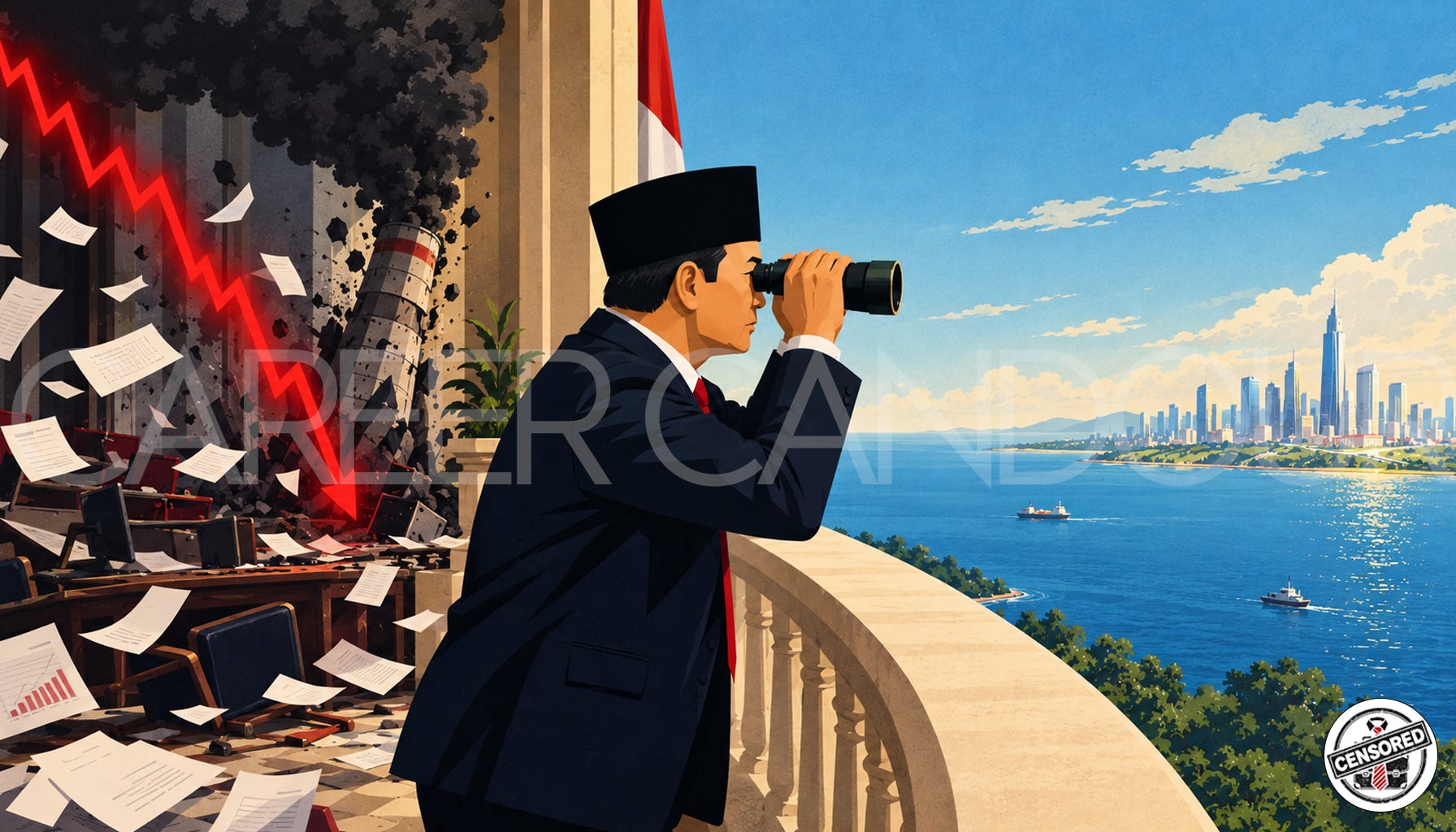
In Jakarta, history is understood to move in only one direction. The state has even set a deadline. By 2045, the centenary of its escape from Dutch servitude, the country will achieve Indonesia Emas, a status that promises to elevate the Republic into a peerless global titan.
To hear the ministerial class tell it, this ascension is ordained by geological providence. Indonesia sits across the equator, dripping with the raw battery metals of the green future, blessed by favorable demographics, and animated by an ancient, impervious dignity.
Yet when a three-line spreadsheet changes in New York or an air-quality monitor flickers red in downtown Kuala Lumpur, the change in posture is instant. The posture of the unshakeable titan dissolves, replaced by the hyper-ventilating outrage of an empire under imperialist siege.
Should the Jakarta Composite Index (IHSG) take a tumble, it is not because an ill-conceived regulatory change broke the exchange’s price-discovery engine; it is an act of economic warfare orchestrated by shadowy financiers in Singapore.
Should the skies across the Malacca Strait turn yellow with the dense haze of burning peat, it is not because regional barons set fire to the concessions; it is a smear campaign run by Western trade saboteurs jealous of domestic cooking oil.
The Western observer, uninitiated in the art of Indonesian administrative statecraft, might mistake this habit for simple foolishness. It is nothing of the sort. The world, it must be said plainly, does not spend its weekends plotting the fiscal or moral destruction of Indonesia. Whitehall does not stay awake at night devising ways to depress the share price of state-owned banks, nor does the American National Security Council convene task forces to tamper with the palm oil harvest in Riau.
The conspiracy theory is the state’s favorite, time-tested operating software. It functions as a billion-dollar Teflon shield, constructed with remarkable cynicism by a ruling class that has discovered that yelling about foreign imperialists is cheaper, and infinitely safer, than the indignity of basic domestic accountability.
The Siege Mentality
To understand why worldly Indonesian politicians routinely adopt this stance, one must understand how the Indonesian elite is educated. One does not stumble into the higher echelons of the state bureaucracy, the military command, or the cabinet without a pilgrimage through Lemhannas (the National Resilience Institute) or a similar institution.
It is here that the foundational dogmas of modern Indonesian statecraft, known as Ketahanan Nasional (National Resilience) and Wawasan Nusantara (The Archipelagic Outlook), are injected into the bloodstream of the political class.
The core curriculum does not concern itself with mundane matters like municipal sewage systems or the enforcement of minority-shareholder rights. Instead, it offers an almost theological vision of the globe, grounded in what might be called the Geography of Envy.
The doctrine runs as follows:
Indonesia is the Zamrud Khatulistiwa, the Emerald of the Equator.
It is blessed with unimaginable ecological wealth, boundless soil, oceanic bounty, and critical maritime choke points.
The rest of the world, by contrast, is cold, overcrowded, and rapidly running out of food, fuel, and raw materials.
It is an intoxicating worldview. It transforms every domestic shortfall into proof of national virtue.
If Indonesia’s infrastructure projects stall, it is because external actors are actively subverting them.
If foreign capital flees, it is not because the regulatory landscape changes on a whim; it is because global capital cannot bear to see a developing nation stand upright.
To be fair to the original authors of this paranoia, it was not always entirely imaginary. Sukarno, had good reason to look over his shoulder. In the late 1950s, the CIA did indeed finance regional rebellions, provide covert air support to right-wing mutineers in Sumatra and Sulawesi, and work tirelessly to destabilize his left-leaning regime. Sukarno responded by inventing the acronym Nekolim—Neo-Kolonialisme, Kolonialisme, dan Imperialisme—a catch-all that lurked behind every price spike and peasant revolt.
While the CIA moved on decades ago, the Indonesian elite kept the script. The generation currently holding the levers of power, men whose formative professional years were defined by the 1997–1998 Asian Financial Crisis, has turned historical trauma into a reflex. The IMF’s structural adjustment program was real; the covert operations of 1958 were real.
But in contemporary Jakarta, that legitimate historical pain has decayed. A doctrine once designed to resist foreign conquest has become a bureaucratic excuse for why the local civil aviation authority cannot keep a radar system running in rainy weather.

Blaming Singapore
This reflex was put on display when global index provider MSCI committed the crime of consulting the international investment community about whether the Indonesia Stock Exchange (BEI) ought to be reclassified from Emerging Market status to a Standalone Market.
To the sober financial technocrat, MSCI’s consultation was about as conspiratorial as a routine dental cleaning. For months, foreign institutional fund managers had been tearing their hair out over Jakarta’s capital market microstructure. The exchange, in its infinite wisdom, had rolled out the Full Call Auction (FCA) board for troubled and volatile stocks. This mechanism concealed the order book, blinded real-time bids and asks, and replaced standard price discovery with transactional ambiguity.
Add to this a collection of massive, conglomerate-backed tickers that had achieved astronomical, index-distorting valuations despite possessing real, tradable free-floats that would embarrass a privately held convenience store, and the result was predictable. Algorithmic and passive funds, which operate according to mathematical mandates rather than diplomatic etiquette, began to look elsewhere.
When MSCI suggested that an exchange where shares could not be reliably bought, sold, or priced might belong in the same penalty box as Lebanon or Zimbabwe, the Jakarta Composite Index promptly dropped, shedding double digits in a matter of sessions.
Did the Financial Services Authority (OJK) or the exchange governors convene an emergency working group to fix the order-matching engine?
Did they look at the opaque shell companies sitting in the Cayman Islands that mask the true ownership of these domestic mega-caps?
They did not. Instead, the former Trade Minister and an array of political luminaries took to social media to expose the real culprit: the Republic of Singapore.
In a series of videos, it was said that Singapore’s sovereign wealth funds had secretly orchestrated the MSCI move. Singapore, sitting on its clinical little island across the strait, was deliberately engineering a panic in Jakarta to force down the price of Indonesian assets, allowing its state-backed funds to swoop in and buy strategic domestic firms on a fire sale.
President Prabowo Subianto himself joined the chorus, assuring the public that the Republic “is not afraid of MSCI’s intimidation.”
Yet, Singapore is, by a comfortable margin, Indonesia’s single largest foreign investor; its sovereign funds have billions of dollars tied up in Indonesian telecommunications towers, banks, and logistics parks.
Temasek and GIC were forced to issue denials, and former Deputy Foreign Minister Dino Patti Djalal had to publicly point out that one does not generally cultivate foreign investment by accusing one’s primary financier of being a financial terrorist.
Yet much of the domestic audience loved it. The blame had been shifted. The drop was not caused by clumsy regulatory experiments or domestic market manipulation; it was a foreign sponsored raid. The domestic oligarchs went back to their golf courses, safe in the knowledge that their free-float calculations would not be inspected this week.

Sovereign Smoke
Every few years, the peatlands of Sumatra and Kalimantan are set alight to clear ground for another sweep of oil palm and timber plantations. The resulting aerosol blanket drifts northwest, smothering Singapore, southern Malaysia, and southern Thailand in a sulfurous, respiratory nightmare.
For years, the Ministry of Environment and Forestry (KLHK) has operated under a policy of defensive sovereignty regarding domestic environmental issues. When regional satellites show a continuous, uninterrupted plume of dark grey particulate matter billowing across the Malacca Strait, senior ministry officials step to the microphones to declare that no transboundary haze has crossed the border.
The smoke detected by monitors in Kuala Lumpur, they suggest, must be of local origin; perhaps the Malaysians have been burning their own leaves? The wind directions calculated by regional meteorological services are waved away as politically motivated fabrications.
Former Vice President Jusuf Kalla codified this into a geopolitical axiom: “For 11 months, they enjoy nice air from Indonesia and they never thank us. They have suffered for one month and they get angry.”
The psychological mechanics here are remarkable. Clean atmospheric air is claimed as an Indonesian sovereign export for which the neighbors have failed to remit payment, while the toxic uncontrolled illegal burning is reclassified as an unpatriotic foreign lie.
This same logic has been mobilized with even greater ferocity to combat the European Union’s Deforestation Regulation (EUDR). The EUDR is undoubtedly a bureaucratic piece of Brussels over-reach, demanding strict geospatial tracking for every crate of crude palm oil (CPO) and cocoa entering the single market.
Yet, rather than tackling the practical work of modernizing the national land registry, expediting the “One Map Policy,” and sorting out smallholder land titles, ministers recast the entire affair as a modern continuation of the Dutch East India Company.
The Europeans, the public is told, are engaging in “eco-imperialism.” They are trying to starve Indonesian farmers because their own uncompetitive rapeseed and sunflower oils cannot compete with the productivity of the tropical palm.
While that protectionist impulse certainly exists in the European farm lobby, deploying it as a universal defense allows the state to avoid answering why it continues to shield concession maps from the public eye.
The same defense is used to deflect from the industrial carnage of the nickel downstreaming (hilirisasi) program. When foreign observers note that workers are incinerated in explosions at sub-standard smelters in Central Sulawesi, or that high-pressure acid leach (HPAL) plants are filling coastal waters with chemical runoff, it is not treated as a workplace safety crisis or an ecological crime.
It is dismissed as Western jealousy. The West, having already mined their own hills, cannot bear to see Indonesia melt their own dirt into stainless steel. Domestic failure is thus elevated to the status of an anti-colonial struggle.

The Traitor Card
What, then, of the voices who point out that this rhetoric is unhinged? What happens to the men and women within Indonesia who can read a balance sheet, interpret satellite imagery, or calculate the true fiscal yields of a tax holiday?
They are met with the most debate-ending label in the Indonesian political lexicon: antek asing—the foreign lackey.
To call an intellectual an antek asing (or its racialized variant, antek aseng, applied to those suspected of being in thrall to Beijing) is to cut them off from the moral community of the nation. It is not an accusation that the critic’s numbers are wrong; it is an accusation that their heart is foreign. It is an intellectual guillotine, and it works.
Consider the crusade waged by the late, revered economist Faisal Basri. Until his death in 2024, Faisal was a human wrecking ball aimed at the consensus of Jakarta’s industrial policy.
Armed with trade tables and tax receipts, he systematically dismantled the claims regarding the nickel bonanza:
He showed that the headline export numbers were distorted.
He revealed that the multi-decade corporate tax holidays handed to foreign smelters left the state treasury with pennies on the dollar.
He demonstrated that local miners were forced to sell their raw ore to these smelters at artificially depressed, state-mandated domestic prices.
Faisal was not an agent of Western capital; he was an old-school social democrat who wanted the Indonesian people to receive a fair share of their geological inheritance.
The response was not a rebuttal of his math; it was a questioning of his patriotism. Ministers asked why he was:
Always singing the song of the European Union,
Providing ammunition to the World Trade Organization, and
So uncomfortable with national progress.
When former finance minister Chatib Basri writes sober essays pointing out that global capital flows depend on risk premiums and administrative predictability, or when think tanks like the Centre for Strategic and International Studies (CSIS) warn that alienating international index providers will push up the borrowing costs of the state, they are met with the same suspicion.
They speak fluent English; they quote peer-reviewed journals; they use phrases like “capital allocation efficiency.” In the eyes of the nationalist political machine, they are culturally alienated cosmopolitans—orang keminggris (over-Anglicized elites) who have forgotten the smell of their native soil and are doing the bidding of international financiers.
This creates an insurmountable electoral reality: sounding competent is political suicide.
An Indonesian politician who steps onto a rally stage in Central Java and explains that peat fires must be extinguished to meet global carbon accounting standards will be met with silence, followed by an electoral massacre.
The politician who ascends that same stage, bangs the podium, denounces the imperialist West, invokes the holy dignity of the motherland, and promises that Indonesia will soon bring Europe to its knees by withholding its minerals will win in a landslide.

Follow The Rupiah
If conspiratorial nationalism is so economically corrosive, if it scares away institutional capital and sees the country perceived poorly in international forums, why does the elite maintain it?
The answer is simple: because it pays.
Indonesian democracy is an astonishingly expensive enterprise. Power in post-Suharto Indonesia is organized as an oligarchic cartel. To secure a party nomination for a regional governorship, let alone a presidential bid, requires mountains of cash—capital to pay the party bosses (mahar politik), fund clientelist networks, buy votes with cash handouts (serangan fajar), and keep regional brokers compliant.
This cash does not come from intellectual think tanks or technocratic policy institutes. It comes from the extractive sectors: from coal barons, palm oil magnates, real estate tycoons, and nickel concessionaires.
Now, consider the usefulness of the foreign conspiracy when a domestic crisis occurs:
1. The Capital Market Collapse
The Rational Diagnosis: Conglomerates manipulate share prices while exchange authorities run an opaque, illiquid market.
Political Cost: Disastrous. Alienates campaign financiers and requires auditing politically connected billionaires.
The Conspiratorial Diagnosis: Singapore’s Temasek and foreign short-sellers have launched a coordinated raid on the Republic.
Political Cost: Zero. Rallies the electorate around the flag while keeping the tycoons’ books firmly closed.
2. The Transboundary Haze
The Rational Diagnosis: Industrial plantations drain protected peatlands while local officials take kickbacks to ignore the fires.
Political Cost: Lethal. Requires arresting major party donors and revoking lucrative land concessions.
The Conspiratorial Diagnosis: Western trade rivals are running anti-palm oil smear campaigns; besides, sovereign smoke does not cross borders.
Political Cost: Zero. Denounces European hypocrisy while leaving the plantation lobby completely untouched.
3. Fatal Smelter Disasters
The Rational Diagnosis: Cut-rate engineering, non-existent labor protections, and corrupt regional safety inspectors.
Political Cost: Severe. Offends Chinese joint-venture capital and domestic mining concessionaires.
The Conspiratorial Diagnosis: The West cannot stand to see Indonesia industrialize; accidents are simply the price of anti-colonial victory.
Political Cost: Zero. Recasts basic regulatory negligence as a heroic sacrifice for national sovereignty.
The genius of the strategy is that it redirects the justifiable fury of the ordinary citizen away from the domestic predatory class and outward toward an imaginary external enemy.
The smallholder farmer, the motorcycle-taxi driver, and the underpaid urban worker are encouraged to view their struggle not as a battle against the domestic monopolists who fix cooking oil prices and pollute their water, but as an existential war against white men in Geneva or Chinese traders in Singapore.

There is a deep, agonizing tragedy beneath this political theater.
Indonesia is not an illusion. It is a magnificent, resilient, and extraordinarily vital country.
Its workers are diligent,
Its entrepreneurs are resourceful,
Its demographic energy is the envy of an aging world,
Its cultural diversity is a global wonder.
It possesses all the physical ingredients necessary to become the prosperous, self-assured nation that the brochures for Indonesia Emas 2045 promise.
Yet it remains trapped in an engineered political adolescence.
The great powers of the world, for all their historical sins and present hypocrisies, do not spend their hours plotting Indonesia’s ruin. The modern world is indifferent, transactional, and utilitarian. International capital invests in a country because contracts are enforced, balance sheets are real, and assets can be liquidated without an act of parliament.
When MSCI reviews an index, it is not a naval blockade.
When Europe demands proof that timber was not stolen from an indigenous reserve, it is not an imperialist invasion.
These are the mirrors of global integration.
By treating every mirror as an enemy attack, the Indonesian ruling class ensures that the country’s domestic rot remains untouched. They present themselves as anti-imperialists, shouting defiance at foreign phantoms, while consolidating wealth.
The world is not conspiring against Indonesia. The real challenge stems from domestic leadership, which often relies on a narrative of external threat rather than focusing on the critical, long-term work of improving internal governance.
StratEx - Indonesia Business Advisory provides Indonesia-focused advisory and leadership intelligence for investors that need to understand what is really moving beneath the surface. Contact us for better visibility before making your next move in Indonesia.