


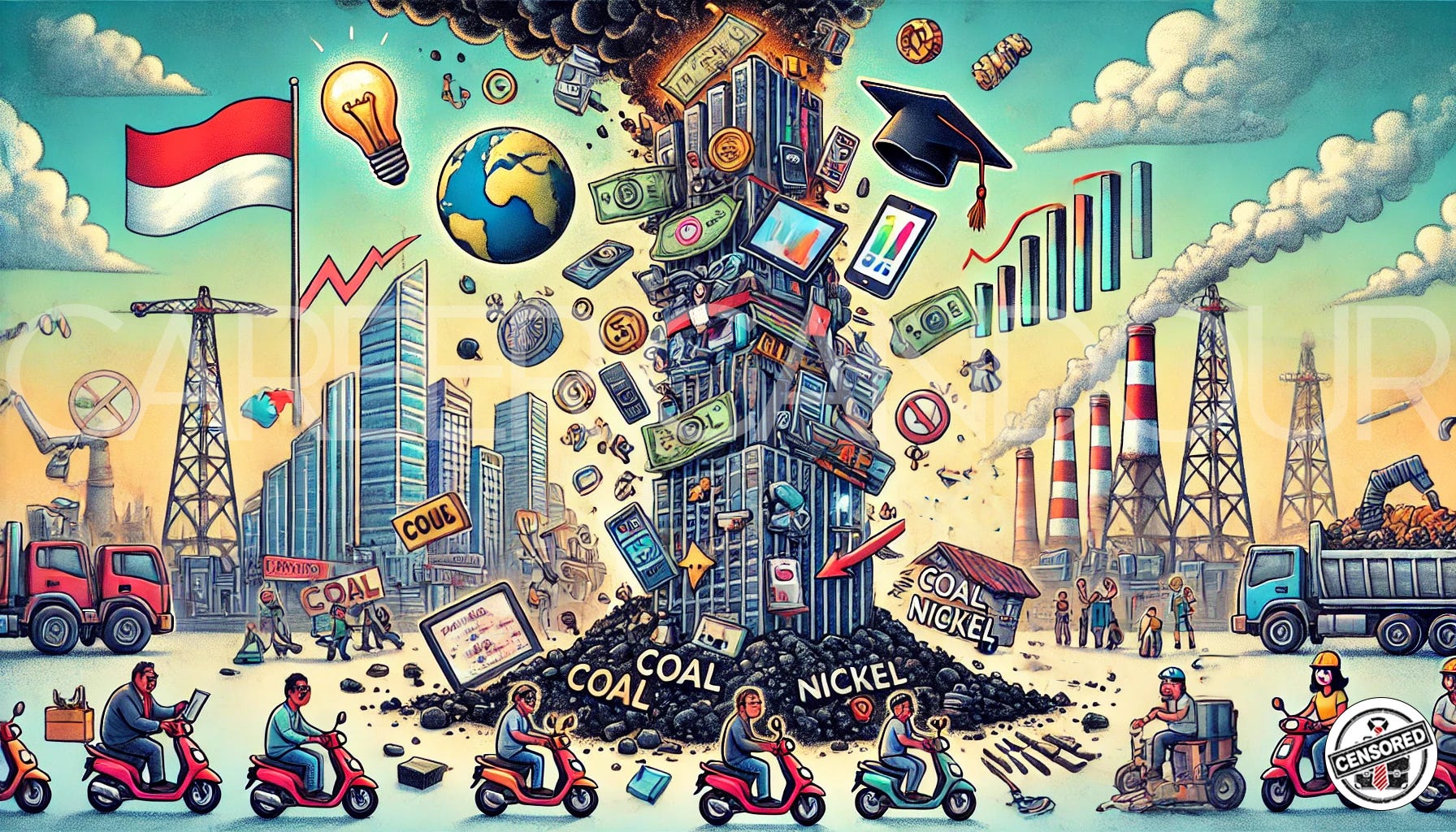
Indonesia, we are told, is confidently moving toward its destiny as the fourth-largest economy on Earth by 2045. This vision is repeated so often that it has taken on the soothing quality of a national lullaby. Presentations glow with optimism, and cinematic renderings of Jakarta. Social media adds its own layer of sparkle, pairing aspirational slogans with electric cars… that were designed and built somewhere else.
Unfortunately, reality is considerably less choreographed. The middle class is thinning, recent graduates are discovering that Gojek is the only employer currently hiring at scale, and the rupiah appears to be locked in a long-term battle with gravity. The digital economy, once promoted as Indonesia’s golden ticket, has deflated. Yet the country continues relying on coal, palm oil and nickel as if global demand were frozen in time.
All of this would be less troubling if an alternative path existed. But as the world shifts toward cleaner energy and synthetic alternatives, Indonesia’s trajectory feels more like a controlled slow slide. Plan A is clear. Plan B, however, remains a mystery.
When Big Numbers Hide Even Bigger Problems
“We’re a trillion-dollar economy!” At first glance, it is a triumphant milestone. It sounds authoritative, it photographs well, and it provides reliable material for speeches about national destiny. Yet behind this celebration sits a natural resource sector that is clearing its throat in the background, hoping someone will notice it is carrying far more weight than advertised.
A closer look at GDP composition reveals an economy that appears balanced.
Agriculture contributes its share,
Manufacturing makes a cameo,
Services look busy,
Construction cranes dot the skyline,
Tourism occasionally reminds the world that Bali exists.
On paper, it resembles a smorgasbord of economic activity. This is the view that earns polite applause from multilateral institutions and reassurances that Indonesia’s fundamentals are sound.
Exports, however, tell a different story. When it comes to earning hard currency and paying for the entire national shopping list, Indonesia relies heavily on goods that come from mines, plantations or both.
Coal dominates,
Nickel rides shotgun,
Palm oil waves from the backseat,
Refined metals squeeze in wherever they can.
The country is not defined solely by these commodities, but they remain the parts of the economy that actually keep the financial engine running.
However, the global marketplace is steadily shifting away from many of these commodities.
Stricter supply chain standards
All the above are narrowing Indonesia’s future lanes. GDP will continue to look fine in the meantime. That is the problem. The headline number remains calm even as the structure beneath it is showing signs of strain.

The Missing Ingredient in Indonesia’s Golden Recipe
“Fourth-largest economy? Absolutely. Right after we produce enough skilled workers to run it.” This remains the unspoken disclaimer behind every grand economic projection. The challenge is not that Indonesians lack talent or ambition. The challenge is that the systems meant to cultivate those qualities have been operating on autopilot for decades.
Countries like Singapore, the United Kingdom and South Korea built their modern success on dense layers of expertise. Indonesia, meanwhile, has constructed a human-capital assembly line that was designed in one era, patched in another, and now struggles to meet the needs of a workforce expected to compete globally. Graduates frequently discover that employers want skills they were never taught, which is why so many of them find themselves navigating the gig economy instead of the corporate world.
The education pipeline makes this predictable.
University seats are limited, and quality varies widely.
Tertiary enrollment remains low by international standards,
R&D investment is almost symbolic.
PISA results continue to place Indonesia far below developed peers,
This is inconvenient for a country hoping to shift into high-value industries.
For a brief moment, the digital economy appeared to be the escape route. Tech startups were supposed to absorb skilled workers, create new industries and prove that Indonesia could innovate rather than import. What happened instead was a spectacular boom and bust. Capital evaporated, unicorns downsized, and the future of work began to look suspiciously similar to the past.
Most Indonesians still operate in an economy where cash is king, informal work is normal, and digital adoption peaks at messaging apps and online shopping. The leap to an innovation-driven workforce requires broad capability, not just pockets of tech enthusiasm. Until that gap closes, Indonesia’s human-capital engine will continue to sputter along, hoping momentum is enough.

The Commodity Hangover: What Happens When Plan A Runs Out
For roughly twenty years, Indonesia’s economic playbook has been easy to memorise.
Extract things from the earth.
Apply a light industrial massage to those things.
Export them vigorously.
Applaud the revenue.
Deliver stirring speeches about national transformation.
Pretend global markets are not slowly rewriting the rules.
The difficulty is that the world is moving on.
Coal is struggling for relevance beyond a handful of energy systems that have yet to modernise.
Nickel, once the prized ingredient of the EV revolution, is trapped in global oversupply and faces technological shifts in battery design
Palm oil is being hemmed in by environmental standards, regulatory walls and increasingly impatient consumers.
Metals, Indonesia’s proud downstream success, face fierce competition from the very countries that helped build the smelters in the first place.
Despite all this, Indonesia continues to expand downstream industries with the confidence of a nation convinced the music will never stop. On paper the strategy sounds good. In practice it delivers relatively few jobs because the facilities are automated. It loads companies and regions with large debts. It anchors future competitiveness to coal power at a moment when coal is becoming a global liability rather than an asset.
Which raises the awkward question of alternative plans.
A diversified industrial base would help.
A skilled workforce would help even more.
Yet neither is materialising fast enough. For now, the conversation tends to trail off into silence.

Plan B: The Part of the Strategy That Appears to Be Missing
Other countries that successfully transitioned into high income status did so by anchoring their growth in human capital, technology, and institutions that steadily improved over time. Their prosperity aged well. Indonesia’s prosperity, by contrast, is tied to commodities that the global economy is actively trying to reduce, regulate or replace. It is a difficult position to modernise from.
The list of what Indonesia would need to fix is long, familiar and politically inconvenient.
Education quality remains uneven.
R&D capacity exists mostly in aspiration.
Manufacturing competitiveness is inconsistent and often undermined by logistics, energy costs and skill gaps.
Infrastructure projects move, but at a pace that keeps consultants employed rather than competitiveness rising.
Governance reforms remain trapped between ambition and patronage.
Labour markets generate work but not enough stable, formal jobs.
The fixation on relocating the capital absorbs political attention that could be directed toward the broader economy.
None of these challenges are insurmountable, but they require sustained commitment that extends beyond electoral cycles. They also require confronting interest groups that prefer predictable rents over long term reforms. In the absence of this, the country continues relying on the same resource heavy model while insisting it is ready for a future that does not resemble its past.
If no significant shift occurs, the next decade will likely bring slower export growth and chronic currency pressure.
Underemployment will remain widespread.
The gig sector will continue absorbing graduates who expected more.
The middle class will struggle to expand.
The national narrative of inevitable ascent will feel increasingly detached from daily experience.
This is not collapse. It is gradual erosion, the quiet kind that becomes obvious only when the ground finally gives way.
Indonesia’s trajectory remains one of the most intriguing in the developing world. It is a nation overflowing with scale, youth and energy, yet equally known for its habit of assuming that sheer size can substitute for strategy. The ambition is admirable. The execution is uneven. And the continued reliance on a set of commodities that the global economy is preparing to move beyond creates an uneasy contrast between national aspiration and structural reality.
If Indonesia maintains its dependence on natural resources while postponing the hard work of upgrading human capital, reforming institutions and nurturing innovative industries, the coming decade will not match the cheerful projections currently circulating in speeches. The shift will be gradual rather than shocking, a slow tightening rather than a sudden break.
Job quality will erode.
Export earnings will soften.
The digital sector will remain smaller than hoped.
The dream of becoming the world’s fourth largest economy will survive mostly as a slogan.
The warning signs are already visible. The world is changing direction, and Indonesia cannot afford to treat this as background noise.
At StratEx - Indonesia Business Advisory we support leaders with grounded insight, workforce strategy and local expertise. Contact us to build resilient teams, future-ready skills and Indonesia-proof organisational structures.