

The air-conditioning inside an upscale Jakarta multiplex hums at a temperature designed to make patrons forget the equatorial humidity outside, but the true chill arrives just before the opening credits roll. Before the Hollywood escapism begins, the screen flares to life: soaring drone shots of brand new expressways, slow-motion footage of combine harvesters cutting through golden rice paddies and smiling schoolchildren lifting identical trays of balanced nutrition. An on-screen advisory warns patrons that recording the trailer is strictly prohibited. You are there to be entertained, certainly, but first, you must be debriefed.
The cognitive dissonance is hard to miss. Yet the biggest sleight of hand in this civic performance is its accounting. That lavish cinematic tribute to administrative competence was not financed by a benevolent patron. You paid for it. And according to the ledger sheets, the state has decided that you have underpaid for the privilege of being persuaded that your complaints are unfounded.
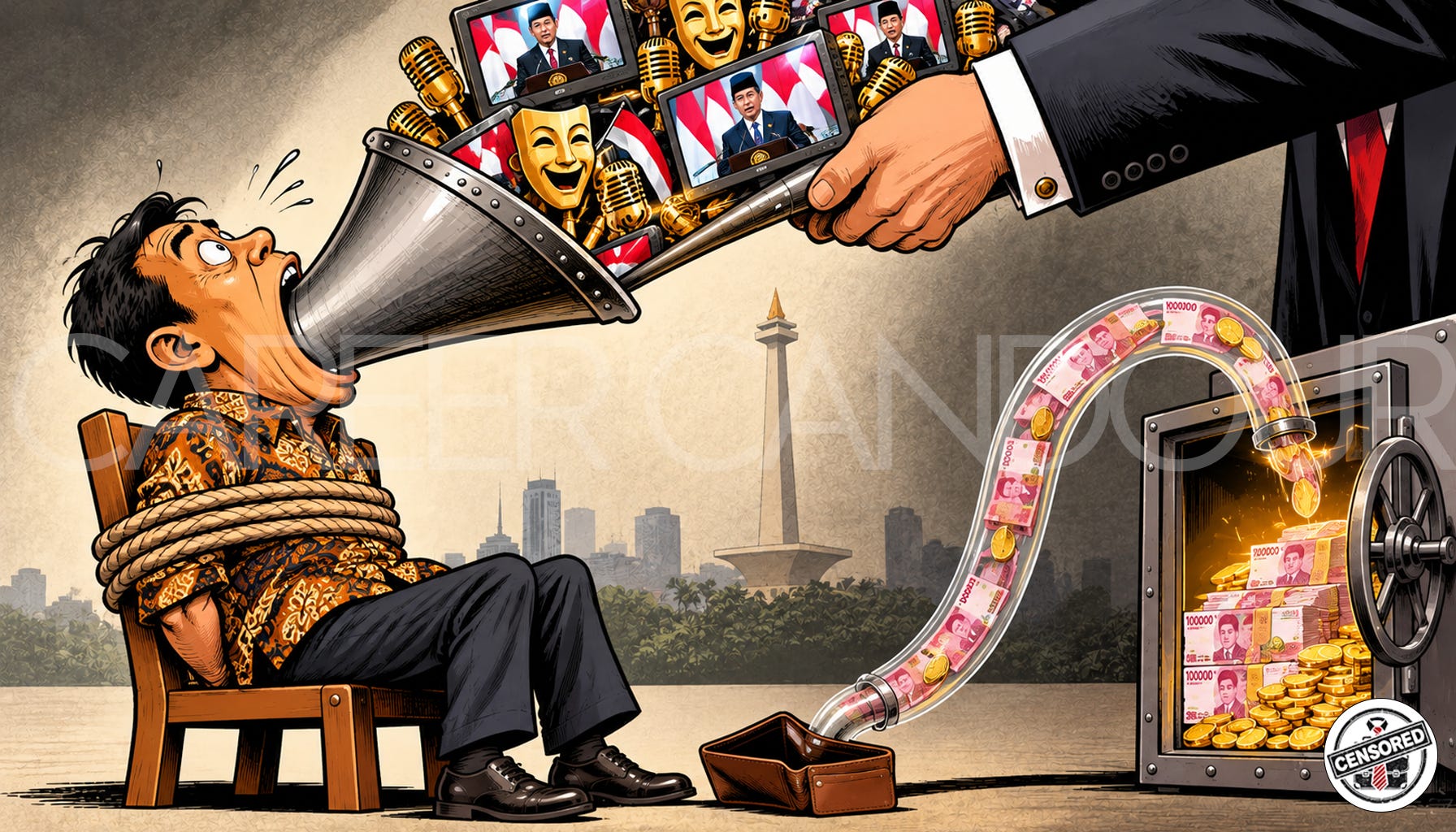
In the budget deliberations for the 2027 fiscal year, the proposed allocation for Badan Komunikasi Pemerintah Republik Indonesia (Bakom) jumped from an embryonic baseline of Rp 25.37 billion to… Rp 1.954 trillion (roughly $125 million). The increase, approved in principle by Commission XIII of the House of Representatives (DPR), represents an expansion of roughly 7,600%. Transitions from a shoestring advisory desk to an imperial agency are rarely so brazen. Jakarta has solved the fundamental friction of democratic accountability by turning statecraft into a subscription service: your taxes are deducted at source, only to be returned to you in the form of digital panegyrics explaining why your skepticism is a statistical misunderstanding.
Harmoko’s Ghost
To appreciate the institutional audacity of this narrative engine, one must examine its plumbing. Indonesia has walked this path before. In the summer of authoritarianism under President Suharto, state narrative was the monopoly of the Departemen Penerangan (Deppen), run for over a decade by the late Harmoko. Harmoko’s apparatus operated on a principle of ritualized submission.
Private television stations were legally compelled to relay TVRI’s evening bulletins,
Farmers were corralled into Kelompencapir (listening, reading, and viewing circles) to applaud state-managed harvests, and
Every ministerial decree was introduced with the sacred liturgical formula: “Menurut petunjuk Bapak Presiden” (According to the guidance of the President).
When the press proved recalcitrant, the state revoked their SIUPP (publishing licenses) and shut down printing presses overnight.
When the New Order collapsed, the reaction was visceral. In 1999, President Abdurrahman Wahid—universally known as Gus Dur—dismantled the architecture of state propaganda by abolishing Deppen altogether. When challenged on why he had dismantled a ministry employing tens of thousands of civil servants, Gus Dur offered a parable: if a barn breeds rats, you do not set mousetraps; you burn the barn to the ground. For nearly two decades, post-Reformasi Indonesia lived in the open air of a deregulated public square. State communications devolved into toothless public relations (Humas) desks scattered across ministries, frequently outpaced and embarrassed by an assertive, investigative commercial press.
The barn, however, has been quietly rebuilt. But where Harmoko’s regime operated through subtraction—shutting down magazines and pulling plugs—the modern administrative state has swapped negative censorship for algorithmic saturation. In an era where outright bans are legally awkward and politically expensive, the state does not need to confiscate the printing press. Instead, an extra two trillion rupiah allows it to flood the digital commons with so much subsidized contentment, so many cheerful lifestyle reels, and such an overwhelming volume of state-curated optimism that critical scrutiny suffocates beneath the sheer tonnage of the timeline.

Rescue or Reputation?
The true measure of any state’s moral imagination is found not in its white papers, but in its comparative budgetary arithmetic. In Senayan, the macroeconomic sermon preached to the public is one of stern, Lutheran discipline.
The middle class has been informed that the nominal VAT rate is 12%, although many non-luxury goods and services continue to face a rate of 11%.
Regional governments have been instructed to tighten their belts as regional transfer funds (TKD) are squeezed to service central commitments.
The fiscal deficit must be defended at all costs; fiscal prudence is the order of the day.
Unless, of course, the expenditure is earmarked for telling the public how well the discipline is working.
Set against the broader budget, Bakom’s Rp 1.954 trillion is highly disproportionate. In the 2027 spending framework, this single communications umbrella will consume nearly double the operational allocation of the National Disaster Management Agency (BNPB), projected at roughly Rp 1.003 trillion.
Consider the physical reality of Indonesia. Thousands of islands straddling the Pacific Ring of Fire, subject to relentless seismic convulsions, volcanic eruptions, tsunamis, and annual monsoon inundations that sweep away entire villages. The state’s financial ledger suggests an actual, mud-and-rubble catastrophe is a misfortune that can be managed with a trillion rupiah, but a sudden drop in the executive’s net favorability rating is a crisis that warrants two trillion.
Should a tectonic fault slip beneath western Java, the state will dispatch a modest, convoy of orange-jacketed rescue workers to dig through the debris. But should the public begin to grumble online about food prices or stagnant real wages, the state is prepared to deploy an armada of narrative consultants, digital listening dashboards, and programmatic media buys capable of carpet-bombing every smartphone screen from Sabang to Merauke. It is the logic of the Cosmetic State: when you cannot afford to reinforce the foundations of the house, you double the budget for the exterior paint.

The Sultan of Spin
The modern citizen, however, has developed a stubborn immunity to bureaucratic prose. An official statement detailing the aggregate export value of processed nickel ore will be universally ignored. To penetrate the consciousness of a nation that spends an average of three hours a day on social media, the state had to abandon the bureaucrat and hire the celebrity.
Enter Raffi Ahmad, the monarch of Indonesian commercial pop culture, widely known as the “Sultan of Andara.” Once a ubiquitous soap opera lead and daytime television host, he constructed an entertainment and digital production empire—RANS Entertainment—that transformed his family’s domestic life into a non-stop, multi-platform reality broadcast. In late 2024, the administration formalized what had long been an informal courtship, and Raffi was sworn in as the Special Presidential Envoy for Youth Generation Development and Arts Workers.
His subsequent State Officials’ Wealth Report (LHKPN) filed with the Corruption Eradication Commission (KPK) read like the asset registry of a commercial bank, with net assets exceeding Rp 1.14 trillion ($70 million), spanning real estate, holding vehicles, and luxury transport. When RANS Entertainment launched its initial public offering on the Indonesia Stock Exchange (IDX), market observers were startled by a valuation that looked less like a traditional domestic media company and more like a Silicon Valley software unicorn, with a projected Price-to-Earnings (P/E) multiple of roughly 38x, despite corporate filings revealing that its annual net profits had contracted by over 40% to roughly Rp 56.7 billion.
The investment thesis behind such a multiple becomes considerably clearer once one examines the procurement paper trails. Public records surfaced showing government ministries awarding contracts for influencer, public relations, and digital socialization packages to RANS-affiliated entities—including a reported Rp 14.7 billion allocation split across two key portfolios.
This is Celebrity Statecraft. It operates by depoliticizing governance. When a cabinet minister in a military-style field uniform insists that an industrial food estate or an ambitious infrastructure project is thriving, the public senses propaganda. But when a beloved television icon takes his millions of followers on a behind-the-scenes tour, jokes with the President, and marvels at the inner workings, the critical faculties of the audience are bypassed entirely. Policy is stripped of its ideological, fiscal, and environmental trade-offs; it becomes an aspirational consumer product.
Yet this corporate-political symbiosis is a Faustian bargain. When RANS was caught up in the blowback of political controversies in late 2026, the market exacted its revenge. A wave of public disillusionment was followed by vendors and musicians witrhdrawing from RANS Carnival, the cancellation of a concert partnership, and the stock tumbling to under Rp 100 per share. When an entertainment empire rents its balance sheet out to the state to serve as a narrative cushion, it discovers that public political cynicism is highly contagious… and devastating to a 38x earnings multiple.

The Eraser
If a Rp 2 trillion communication budget functions as the state’s positive megaphone, it requires an equally formidable defensive weapon to ensure that alternative narratives do not spoil the music.
Under the revised Information and Electronic Transactions Law (UU ITE No. 1/2024), the Ministry of Communication and Digital (Komdigi) issued Ministerial Decrees (Kepmen) No. 127 and 128/2026, operationalized through an automated compliance monitoring architecture known as SAMAN (Sistem Kepatuhan Moderasi Konten).
The regulation introduces an operational benchmark: social media platforms and private electronic systems operators (from Meta and TikTok to X and Google) are legally required to execute access termination or takedowns of content flagged as “urgent disinformation” or “hate speech” within four hours from the receipt of an executive notification. Failure to comply triggers an escalating matrix of financial penalties and potential service suspension.
The four-hour window is a textbook example of digital crowd control. In modern social media dynamics, an unscripted scandal—a video of contaminated meals distributed at an elementary school, an investigative leak documenting corrupt sub-contracts in a national strategic project, or footage of security forces clashing with displaced farmers—requires between four and six hours to go viral. It needs that initial window to jump from local community feeds to activist aggregators, gather algorithmic velocity, and capture the attention of mainstream newsrooms.
By imposing a four-hour execution order, the state creates an algorithmic kill-switch. The primary source material is severed while the rest of the country is still asleep or commuting. By the time an editor in a Jakarta newsroom arrives at their desk to verify the viral outrage, the hyperlink points to a blank page.
The constitutional hazard lies in an administrative takedown process that does not require a prior judicial order. The decree operates via the pasal karet (rubber clauses) of Indonesian administrative law: content can be ordered purged if it is deemed to be “inconsistent with facts,” “disturbing to public order” (meresahkan masyarakat), or “capable of inciting social division.”
The executive branch serves simultaneously as complainant, investigator, fact-checker, and judge. Big Tech platforms—which treat Indonesia as an enormous reservoir of ad impressions but a relatively low-yield territory for Average Revenue Per User (ARPU)—have no economic incentive to defend the constitutional free-speech rights of a provincial whistleblower. When presented with a four-hour ticking clock backed by the threat of administrative fines from SAMAN, a compliance officer in Singapore or Dublin will just press the delete key. It is the privatized outsourcing of state censorship.

The Permanent Campaign
Why has this defensive and offensive apparatus been erected with such urgent, frantic scale? The answer lies in the structural risk of the administration’s policy agenda.
The government has staked its historical legacy on vast, complex, multi-billion-dollar policy gambits:
The universal rollout of Makan Bergizi Gratis (MBG), designed to provide daily meals to tens of millions of students;
The reorganization of state corporate assets under the Danantara sovereign wealth superstructure; and
The aggressive, state-directed expansion of mega-agricultural food estates.
These are programs with razor-thin margins for error. Distributing perishable meals across Indonesia with uneven cold-chain infrastructure is a logistical nightmare; a single systemic wave of food poisonings, supply-chain corruption, or procurement scandals could eviscerate the government’s domestic standing in an afternoon.
Under these conditions, a two-trillion-rupiah communication budget is purchased as political catastrophe insurance.
During parliamentary hearings for the budget in Commission XIII, lawmakers defended the allocation with almost accidental honesty. They did not justify the multi-trillion outlay by pointing to literacy metrics or civic engagement indicators. Instead, they argued that the money was necessary because key economic metrics like growth rates, and investment figures, were failing to register with the public, warning that Bakom’s failure would be measured if the President’s personal approval ratings declined.
This admission strips away the final pretense of statutory public information. Governance has dissolved into The Permanent Campaign. The pollsters, the focus-group consultants, the creative agencies, and the narrative engineers, have been transferred onto the payroll of the state secretariat.
Yet this strategy harbors the Harmoko Trap 2.0.
When a state spends hundreds of billions contracting influencers to smile, deploys cyber-troops to manufacture synthetic consensus in comment sections, and passes ministerial decrees to erase critical friction within four hours, it creates a mirror. The leadership looks into the dashboard and sees only soaring approval ratings, glowing sentiment metrics, and boundless public gratitude.
The downside of the high-end echo chamber is that the state eventually falls victim to its own paid applause. It forgets that algorithms do not eat school meals, bots do not buy cooking oil, and paid influencers do not ride the commuter rail. The leadership convinces itself that its narrative dominance is identical to governance, right up to the moment that reality intrudes from the street.

As the lights in the cinema begin to rise, and the credits for the Hollywood feature finish rolling, the patrons gather their belongings and shuffle out through the heavy doors.
Outside the shopping mall, the real world reasserts itself immediately. A line of ride-hailing drivers sits on the curb, scrolling through phones illuminated by the glare of a massive digital billboard displaying the President’s face against an artistic rendering of a futuristic agricultural hub. The pavement ends fifty meters down the road, giving way to an open drainage ditch that has sat unfinished since the previous municipal budget cycle.
A generation ago, an authoritarian regime had to mobilize the military, station censors at printing presses, and run crude, state-monopolized television relays to maintain its grip on the national imagination.
The modern democratic state does not need to send soldiers to your house. It just charges your credit card for the cinema ticket, taxes your popcorn, bills your tax account for the trailer that plays before the movie, pays an entertainer more than a hospital director to tell you the film was inspiring, and reserves the right to wipe your critical review off the internet before you can finish your drive home.
As you step into the traffic, do not bother looking for the potholes. Somewhere in a operations room in Central Jakarta, a state-funded dashboard has already concluded that your commute was historic, prosperous, and delivered according to the guidance of the President.
StratEx - Indonesia Business Advisory provides Indonesia-focused advisory and leadership intelligence for investors that need to understand what is really moving beneath the surface. Contact us for better visibility before making your next move in Indonesia.