


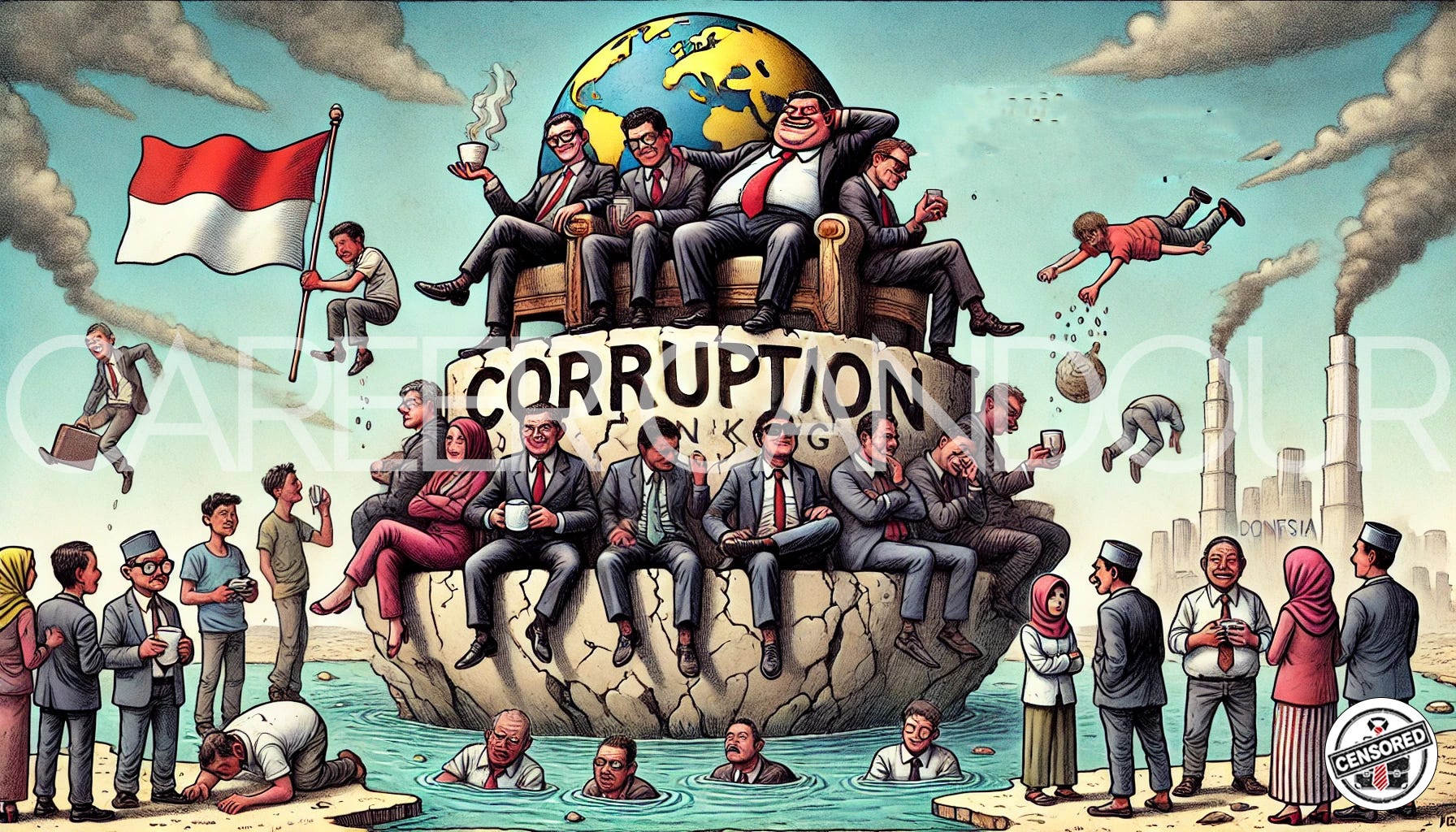
Indonesia has once again slipped down the global corruption rankings. Ten places. Three points.
Again.
The fact that this still gets printed as “news” is quaint. It’s like announcing that Jakarta traffic is bad or that nasi padang is delicious. We know. We’ve known. Our ancestors knew. Paleolithic cave paintings probably included a bupati exchanging goats for permits.
While the fall itself isn’t shocking, the deeper implications should be… and not for the reasons most people think. Because the real casualty of corruption isn’t just FDI, or institutional trust.
It’s human capital. Your human capital. Indonesia’s human capital.
We are talking about the global perception of Indonesian talent:
How international firms view Indonesian professionals,
How Indonesian work experience travels abroad, and
How expats who stay too long start learning a set of rules that are difficult to translate back into places where the rules are actually rules.
So yes, another index, another sigh. But this year, try something different. Look at the score and ask what it is doing to the value of your work.-
When Corruption Stops Being News
Every year when the new Corruption Perceptions Index (CPI) drops, Indonesia reacts with the same energy as someone opening a bank statement they know will be bad:
“Ya ampun… oh well.”
Politicians issue statements about “evaluation” and “commitment.”
NGOs publish statements that could have been written three years ago.
Talk shows briefly rediscover the word “reform.”
The rest of the country responds with weary familiarity.
And to be fair, corruption has become a national constant. You can plan around it. Like Ramadan, Lebaran traffic, and the certainty that any government technology project will somehow cost more than a small moon landing.
The real tragedy is not that corruption exists. Many countries have corruption and still manage to function. The tragedy is that Indonesia’s corruption has become so ordinary that it barely registers as a problem anymore. It no longer shocks, provokes, or mobilises. It is simply background noise.
At this point, corruption is almost localised. It comes in different flavours, different intensities, and different price points, but it is always present. Everyone knows where it lives, how it works, and which doors it quietly opens.
And because the story is so familiar, we stop questioning the shadow it casts. Especially the shadow it casts over something Indonesia desperately wants to boast about:
Its talent. Its workforce. Its human capital.
In global perception terms, Indonesia is increasingly seen as a place where success feels suspect. Where competence is quietly discounted. Where the assumption, fair or not, is that merit alone is rarely the full explanation.

The Human Capital Discount
Here is the part that almost no one talks about.
Corruption does not just hollow out institutions. It tanks salaries. Careers. Reputations. Opportunities.
It turns what should be a discussion about competence into a discussion about risk.
International companies don’t just invest capital; they evaluate human capital. And whether Indonesians like it or not, the CPI score becomes a background variable in that pricing model.
Imagine a CEO in London reviewing a role in Indonesia:
“We need strong talent, high integrity, ability to navigate complexity… wait, CPI 34? Oh boy.”
Suddenly, instead of:
“What can Indonesian professionals bring to the table?”
the internal monologue becomes:
“How many controls do we need? Who signs off on what? How many training modules on bribery reporting must we inflict before onboarding?”
This fog of suspicion, totally unfair to many Indonesians, does the following:
Depresses salary expectations (“We should pay less because risk-adjusted productivity is lower.”)
Narrows roles (“Let’s keep strategic decisions with expats just to be safe.”)
Erects invisible ceilings (“Local staff are great operationally, but global leadership? Hmmm.”)
Foreign firms do not assume that every Indonesian professional is corrupt. That would be too crude. Instead, corruption is treated as ambient. Like humidity.
So even the most ethical, competent Indonesian professional starts from a defensive position.
Their achievements are scrutinized more closely.
Their ceiling is lower until someone at headquarters feels unusually brave.
This is guilt by association at scale. A low-grade haze that dulls how talent is perceived, no matter how hard individuals try to shine through it.

The Perception Penalty
Now let’s talk about Indonesians trying to take their careers abroad.
In a fair universe, Indonesian professionals who have succeeded despite inconsistent regulation, bureaucratic friction, and sudden rule changes would be viewed as unusually capable. They have operated in environments where clarity is rare, processes shift midstream, and outcomes require persistence as much as skill. They should be globally celebrated as elite problem-solvers.
But global labour markets operate on heuristics.
Global recruiters aren’t thinking:
“Wow, you delivered results despite institutional entropy. Hire this genius immediately.”
They’re thinking:
“How much of this achievement was… clean?”
“Will this person understand compliance in a system where we follow laws as… you know… laws?”
“Why do they keep saying ‘bisa diatur’ in interviews and smiling?”
And boom. Your skills get discounted.
This is human capital depreciation in real time. Even individuals who never touched corruption find their experience framed as potentially compromised.
And this is where it becomes dangerous for Indonesia’s global competitiveness:
High corruption → low external trust → undervalued professionals → talent exodus → remaining talent pool weakens further → cycle accelerates.
It is an efficient system. Unfortunately.

The Expatriate Fallout
Expats arrive bright-eyed, convinced that “emerging market experience” is the career accelerant nobody else is smart enough to pursue.
For the first year, they are right. Everything feels thrilling.
The chaos!
The complexity!
The stories you’ll someday tell at a London dinner party!
There is chaos, yes, but also momentum. It feels like growth.
But years 3, 4, and 5?
That’s where the global HR gods begin whispering:
“Ah, so you’ve spent half a decade in a market where half the job is knowing who to WhatsApp to get paperwork unstuck. Interesting.”
CEO in Europe reviewing their CV:
“Impressive resilience… but does this person know how to function in a rules-first environment? Or have they become a black-belt in ‘creative compliance’?”
And that is precisely when the doubts begin. Not locally, but externally.
Suddenly, the once-glorious “Indonesia assignment” transforms into:
A badge of honour only if you’re applying for similar roles in equally chaotic markets, or
A less attractive credential if you’re aiming for Switzerland, Singapore, Denmark, or anywhere that treats compliance as infrastructure.
This is the expat dilemma.
“Did Indonesia improve my adaptability, or did it make me unhirable anywhere that does business properly?”
It's a valid question.. And it should concern Indonesians as much as expats.
If expats struggle to translate Indonesian experience to high-governance markets, imagine the steeper hill Indonesians must climb to prove their excellence wasn’t achieved through “alternative methods.”
The Real Cost of Corruption
While Indonesians have grown numb to corruption, “Ya sudah lah, that’s just how things work…” they’ve underestimated the single most important consequence:
Corruption is destroying the global credibility of Indonesia’s human capital.
When corruption becomes systemic, the message it sends is corrosive.
The world doubts the integrity of institutions →
Which leads to doubting the fairness of promotions →
Which leads to doubting the validity of achievements →
Which results in discounting the competence of people →
Which lowers salary offers, slows career mobility, and raises barriers abroad.
At that point, individuals pay the price.
Indonesian professionals are asked to prove their worth more often and more explicitly than peers from lower corruption environments. None of it appears in policy papers, it happens behind closed doors, one hiring decision at a time.
This is the real cost hidden inside CPI drops. Not the scandals. Not the abstract trillions lost to inefficiency.
It is the markdown of personal market value.
Not because of who someone is, but because of what the system they come from is assumed to represent.
Human capital is the engine of national prosperity. Indonesia has one of the largest and youngest engines in the world. Right now, that engine is being undervalued globally before it’s even allowed to rev.

Most people do not wake up in the morning ready to fight corruption out of civic duty. Or patriotism. Or philosophical commitment to good governance.
But people will change when it threatens something they care about:
Their own careers. Their salary potential. Their children’s futures. The value of their professional reputation.
This is why the conversation around corruption needs to change.
Moralising has not worked.
Public shaming has limited impact.
What might work is reframing corruption as a direct attack on individual opportunity.
“Corruption is robbing you of global respect, higher pay, and better opportunities.”
That’s personal.
Indonesia’s corruption ranking may no longer shock anyone. What should shock people is how efficiently it is shrinking Indonesia’s presence in the global talent market. Every point lost is another layer of doubt added to the country’s professional brand.
If Indonesians understood that corruption isn’t just a governance issue but a human capital catastrophe, maybe the movement toward reform would accelerate.
Corruption doesn’t just hurt the economy.
It hurts you.
Your career.
Your reputation.
Your value.
If that does not trigger urgency, nothing will.
At StratEx - Indonesia Business Advisory we advise organisations in Indonesia on how to structure roles, rewards, and leadership models. Contact us to align your human capital strategies with international expectations of integrity, performance, and accountability.