


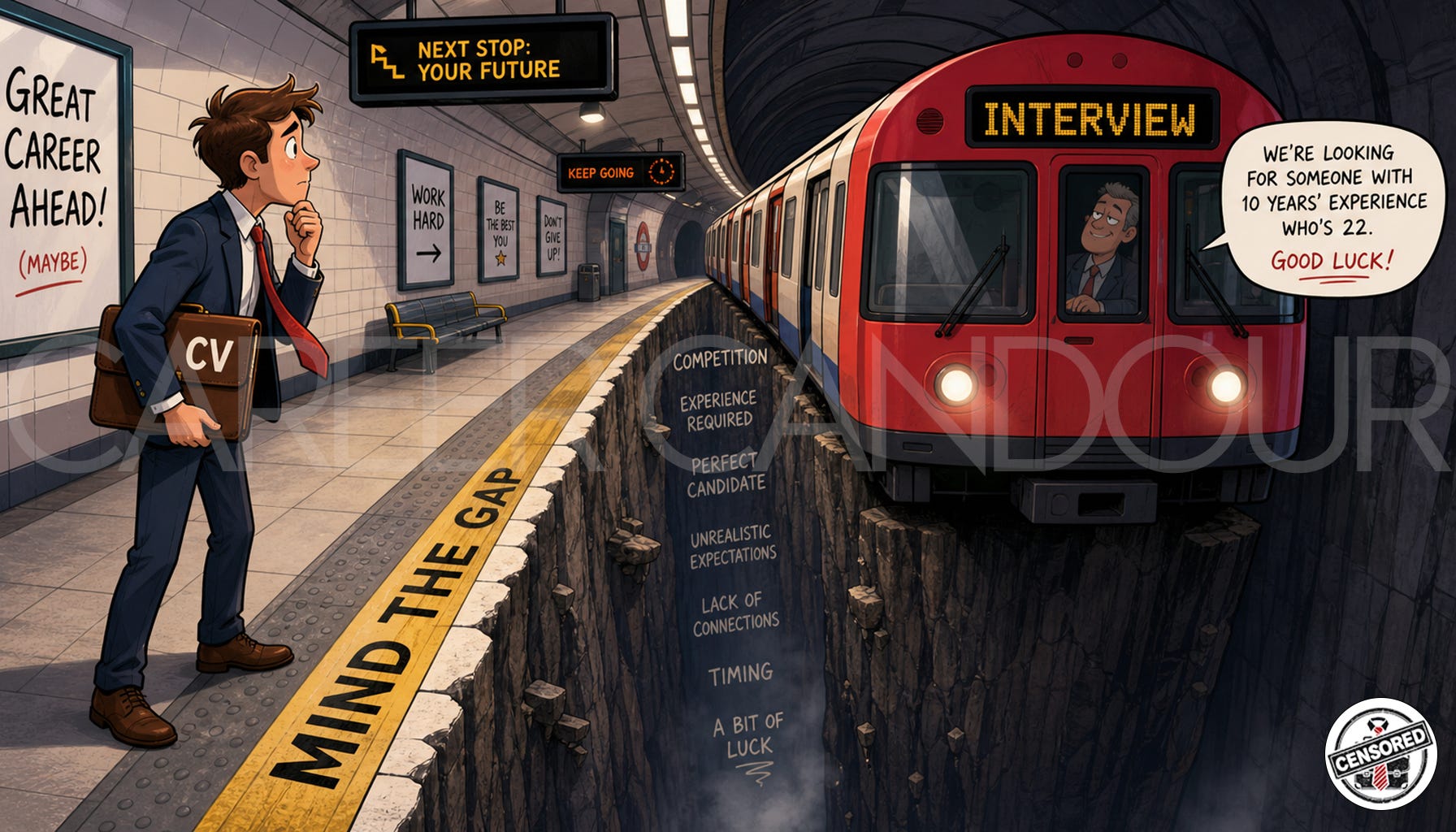
Career gaps make people nervous.
Not always because the gap itself is catastrophic. Quite often, the gap is ordinary. Life happened. A company folded. Or someone needed care.
The trouble usually starts when someone asks about the gap and the candidate suddenly behaves as though they have been stopped at customs with several endangered reptiles in their hand luggage.
“So, I noticed there’s a gap here…”
A simple sentence. Five seconds long. Entirely survivable.
And yet, for many people, this is the moment the interview room becomes a courtroom, the CV becomes evidence, and the candidate’s mouth becomes a badly briefed legal team.
What follows is rarely a clean explanation.
Some people go vague. They “took some time” and “explored a few things” and “reassessed priorities,” which may be true, but also sounds like they joined a mysterious woodland organisation with a charismatic treasurer.
Some people go too detailed. Suddenly the hiring manager knows the emotional temperature of March, the exact moment trust broke down with a former employer.
Others become suspiciously positive. The gap was “a gift,” apparently. A beautiful opportunity to reconnect with purpose. Very moving. Very LinkedIn. Very much the sort of sentence that makes everyone in the room cringe.
Most career gaps do not need this much production value.
They need a clear expectation, in a calm tone, with a quick return to what you bring to the table.
That is the whole job.
Because the gap itself is rarely the most damaging thing. The damaging thing is the strange fog that gathers around it when someone has not decided what it means.
Silence Makes the Gap Look Bigger
There is a particular confidence some candidates place in silence.
They leave the gap sitting there on the CV, unlabelled and unexplained, hoping no one will notice that a year has quietly been removed.
This is ambitious.
Hiring managers may miss many things. They may miss nuance. They may miss achievement.
They will not miss that 2022 has vanished from your CV.
And when people spot an unexplained gap, they do what people always do with missing information: they start decorating it with their own anxieties.
A gap with no explanation becomes a story-shaped hole.
The employer is not necessarily assuming disaster. But they are wondering. That is enough.
The candidate thinks silence makes the gap smaller. Usually, it makes the gap louder.
The better move is to make the gap plain enough to become boring.
Boring is underrated. Boring is your friend. Boring is the blessed state in which an interviewer hears the explanation and feels no desire to pick up a spade.
For example, a simple line such as:
“After my last role ended, I took a short period to reset and focus my next move. I’m now clear that I want to return to work where I can bring structure and commercial judgment to messy operational problems.”
This does enough.
It does not beg. It does not invite the interviewer to sit beside a metaphorical campfire while you explain how the experience changed you.
It just gives the gap a name, puts a fence around it, and moves the conversation back toward value.
That is what people forget. You are not trying to make the gap inspirational. You are trying to stop it becoming suspicious.
There is a world of difference.
Inspirational gap explanations tend to smell fishy.
A useful gap explanation is clear, accounted for, and nobody wants to spend the afternoon discussing it.

Be Clear, Not Confessional
Honesty is good.
Honesty with no editorial control is how interviews go south.
There is a dangerous point in any conversation where a candidate, determined not to seem evasive, begins explaining everything. Not just the relevant thing. Everything. The professional context, the emotional context, the domestic context, and several supporting characters who did not consent to being included.
At first, the hiring manager is listening.
Then they are nodding.
Then they are trapped.
This is the moment the gap has stopped being a gap and become a documentary.
The candidate often believes this level of disclosure proves sincerity. Sometimes it does. More often, it proves that the story has not yet been processed enough to be useful.
You can say:
“I took time out for family reasons. That situation is now stable, and I’m ready to commit properly to the right role.”
That is honest.
It is also merciful.
No one needs the extended cut unless the extended cut is directly relevant to the job, which it usually is not. The interviewer does not require your entire emotional archive. They require enough information to stop worrying.
The same applies to redundancy.
You do not need to narrate the decline of the business.
You do not need to explain that leadership had lost its way,
…although they may well have lost it in spectacular fashion,
You can simply say the role ended as part of a restructure, then move to what you are looking for now.
A gap explanation should create confidence, not intimacy.
This is where many people get it wrong. They confuse vulnerability with usefulness. They think the choice is either sterile corporate nonsense or complete emotional exposure when it’s not.
There is a middle ground. It is called being a grown adult with boundaries.
The best explanations are candid, brief, and slightly dull. Not dull because you are dull. Dull because the gap has been handled.

What They Really Want to Know Is Simple
When a candidate hears, “Can you talk me through this gap?” they often hear something much nastier.
They hear:
“Please explain why society temporarily stopped purchasing your labour.”
A career gap can touch all the tender places: status, usefulness, confidence, money, identity, the fear that everyone else has remained sleek and employable while you have been at home becoming familiar with the ceiling.
So the question feels personal.
But from the employer’s side, the question is usually more practical.
They are trying to work out whether you are ready to work, whether the situation behind the gap is likely to affect the role, and whether your professional edge is still intact.
This is useful, because once you understand the real concern, you can stop answering the wrong question.
You do not need to defend your human worth. Nobody has the budget for that, and frankly the interview slot is only forty-five minutes.
You need to show that the gap has an explanation, that the explanation is under control, and that the next move makes sense.
That is why vague language creates problems.
“I’ve just been seeing what’s out there” sounds harmless, but it can suggest drift.
“I needed time to think” may be true, but if left there, it hangs in the air.
“I’m open to lots of things” seems flexible, but often sounds unfocused.
Employers are not famous for generous interpretation. They are busy, risk-aware, and frequently traumatised by previous hiring mistakes involving someone who interviewed beautifully and then turned out to be a disaster.
So they look for signs.
Calm helps. Specificity helps. A clear reason for the next move helps.
You want the employer to feel that the gap belongs to the past.
Something like this is enough:
“After that role ended, I took time to be deliberate about the next step rather than jumping straight into the wrong thing. The work I want to return to is very clear now: solving operational and commercial problems where things are complex, under-structured, and need better judgment.”
That answer gives the gap a purpose without turning it into a spiritual awakening, and makes the future more interesting than the hiatus.

Answer It, Then Move On
The biggest mistake is letting the gap become the main character.
Once that happens, the conversation becomes strangely difficult to rescue. The interviewer asks one timeline question and suddenly the whole room is inside the gap.
You should not begin telling everyone how hard the last year has been and how much you learned about resilience from a podcast.
You want:
Here is the context.
That period is dealt with.
This is what I am focused on now.
The final part matters most.
A gap explanation that ends with the gap leaves the interviewer staring at the gap.
A gap explanation that ends with value redirects the conversation.
For instance:
“I took time out after redundancy to reset properly. What became clear is that I do my best work where there’s a messy commercial problem, unclear ownership, and a need for someone to bring structure without turning everything into a six-month governance opera.”
This is better than a long explanation because it gives the employer something to buy.
A hiring manager cannot buy your difficult year.
They can buy your judgment. Your experience. Your ability to walk into chaos and make it less annoying.
That is where the conversation needs to go.
This sounds obvious, but under pressure people forget. They become so focused on making the gap acceptable that they forget to make themselves compelling.
They spend the answer trying to prove they are not a risk, which is understandable, but insufficient. At some point, the employer needs to remember why you are useful.
A good gap answer reassures and sells, without appearing to sell. It closes the open loop and then puts your value back on the table like it has been there the whole time.
The tone should be calm enough to suggest you have not been emotionally living inside this answer for six months. Even if you have. Well, especially if you have.

A career gap does not need to ruin the story.
But it does need managing, because unmanaged gaps attract drama. They become bigger in the silence. Stranger in the vagueness. Heavier in the over-explanation.
The answer is not to pretend the gap never happened. Nor is the answer to turn the gap into a personal growth keynote. Most employers can tolerate life happening. Fewer can tolerate being trapped inside your rebirth narrative before they have even discussed salary.
The move is to:.
Name it without flinching.
Frame it without decorating it.
Move back to value before the room starts treating your timeline like a crime scene.
That is enough.
The goal is not to make the gap impressive. The goal is to make it unthreatening.
Handled well, a career gap becomes a small piece of context. A line in the story. A thing that happened.
Handled badly, it puts on a cape, grabs a microphone, and starts introducing itself before you do.
Do not give it that kind of platform.
You have more useful things to be known for.
At Career Candour we work 1:1 with mid-career professionals to build better career narratives and stronger positioning. Career gaps. Redundancy. Time out. Messy transitions. We help you explain the difficult bits clearly, without apology, or oversharing. Want this done properly? DM us.
Thanks. This is useful.