


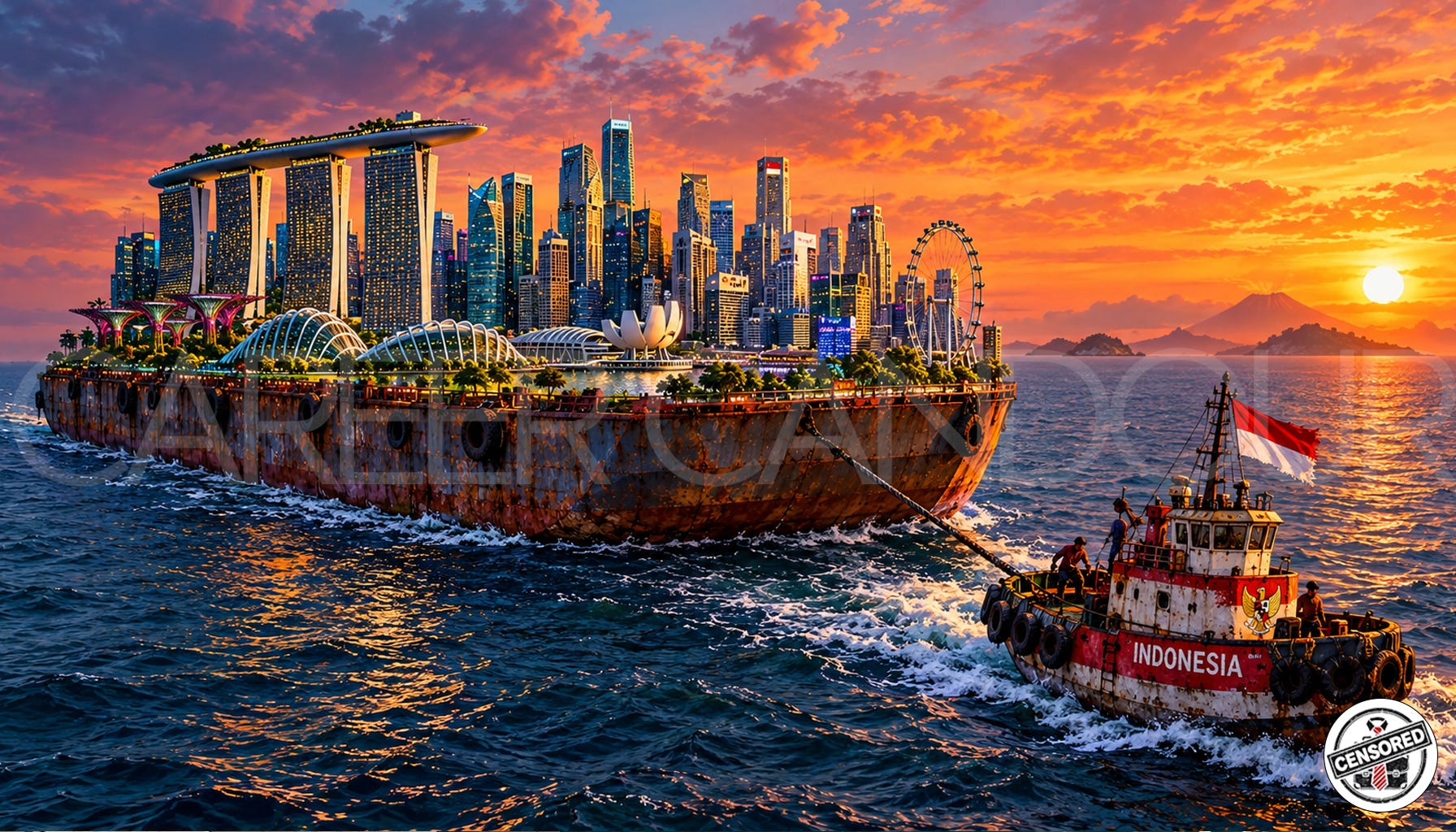
Every religion requires an immaculate conception, and the civic religion of Singapore is no exception.
The gospel has been recited to generations of visiting dignitaries, IMF economists, and impressionable Western journalists: In 1965, a tiny, friendless rock was cast out into the geopolitical wilderness. Possessing limited natural freshwater resources and little room to expand, it dragged itself out of a malaria-ridden swamp through the sheer moral force of Confucian discipline, incorruptible civil servants, and the clean brilliance of foreign-direct-investment-led manufacturing. It is a stirring tale of self-authored redemption. It is also historical revisionism.
There is an unmentionable counter-narrative that causes immediate heartburn in the dining rooms of the Tanglin Club: The Singapore Miracle was heavily subsidized by the chronic, structural dysfunction of the Republic of Indonesia.
Without the resource-rich, institutionally chaotic archipelago next door, Singapore would undoubtedly still be an orderly, prosperous place; perhaps a cleaner version of Penang, or an efficient container transshipment terminal with an impressive botanical garden. But it would not be:
A global capital of private banking.
Asia’s premier commodity-invoicing hub.
Singapore’s celebrated leap from the Third World to the First was accomplished, in indispensable measure, by acting as the offshore billing office, the private banking vault, the physical power consumer, and the ultimate tax shelter for the wealth of a neighbor it routinely treats with condescension.
This long-repressed reality erupted into plain view earlier this month.
When Indonesia’s Minister of Energy and Mineral Resources, Bahlil Lahadalia, dialed down natural gas exports to Singapore by exactly 8%, bringing deliveries precisely to the 92% contractual minimum floor while warning that Jakarta would no longer tolerate partners who “disrespect Indonesia,” Singapore reacted with indignation. When former Singaporean lawmaker Calvin Cheng posted an infographic showing that 90% of Indonesia’s international internet traffic flows through Singapore with the caption, “Cut?”, he was voicing the founding mythology: We are the indispensable brain; you are merely the jungle.
Indonesia’s Minister of Communication and Digital Affairs, Meutya Hafid, answered with simple geography: many of those fiber-optic cable routes lie in Indonesian sovereign territorial waters, powering data flows for 267 million Indonesian consumers who contribute massively to Singapore’s tech HQs revenue.
For sixty years, Singapore has enjoyed the privileges of Indonesian geography, Indonesian resources, and Indonesian capital flight, all while cultivating an attitude of moral elevation.
It is time to settle the score. Singapore does not need to lecture Indonesia on contract law; Singapore needs to send Indonesia a thank-you note.
Capital Flight
The core defense of the Singapore model is that its wealth is self-generated through industrial grit. Singaporeans rightly point to their world-class semiconductor fabs and biomedical parks. Manufacturing accounts for roughly 21.6% of GDP.
Yet an industrial base produces widgets; it does not automatically produce a US$5.2 trillion (S$6.7 trillion) asset management industry.
How did a city-state of six million people acquire the financial gravity to become the undisputed Switzerland of Asia? The modern mythology claims that global capital was naturally attracted by Singapore’s spotless rule of law and triple-A credit rating. That is the marketing brochure. The historical reality is that Singapore’s private banking industry was a major destination for Indonesian wealth and that those flows helped create business for the financial services sector.
When General Suharto established his New Order regime in the late 1960s, he created a state-capitalist machine of historic proportions. Concessions for timber, rubber, oil, and mineral rights were distributed among cronies, military generals, and a favored circle of tycoons.
The primary problem facing these Indonesian elites was not making money; it was hiding it from the very political volatility and predatory state apparatus they operated within.
Singapore stepped forward to provide the solution. Long before Switzerland faced American pressure to dismantle its banking secrecy, Singapore designed its financial regulations to be the premier vault for flight capital from Southeast Asia—and Indonesia in particular. With zero capital gains taxes, strict statutory bank secrecy, and no estate duties, Singapore became the offshore repository for Indonesia’s ruling class.
This dynamic peaked during the 1997–1998 Asian Financial Crisis. As the rupiah collapsed, commercial banks failed, and anti-Chinese riots burned through Jakarta, capital crossed the Singapore Strait. Entire family dynasties, along with their liquid capital, relocated to the residential enclaves of Tanglin and Orchard Road.
The volume of capital involved was extraordinary. The empirical proof finally surfaced during the 2016–2017 Indonesian Tax Amnesty. When the Indonesian Ministry of Finance enticed citizens to declare their hidden wealth, the disclosures revealed the foundation of Singapore’s private banking sector:
Total foreign assets declared globally by Indonesian taxpayers: US$77.8 billion (Rp 1,036 trillion).
The share declared in Singapore alone: US$57.5 billion (Rp 766 trillion).
Singapore accounted for an astonishing 73.9% of all declared offshore wealth held by Indonesian citizens worldwide.
Consider that figure: nearly three-quarters of all documented foreign assets belonging to Southeast Asia’s largest economy were sitting inside a single city-state. And this only represented the capital belonging to those who stepped forward. Indonesian fiscal authorities estimate that the true quantum of Indonesian liquid, corporate, and real-estate wealth sheltered in Singapore sits reliably between US$150 billion and US$200 billion.
Without this flood of Indonesian capital flight, Singapore’s financial district could never have achieved the critical mass required to market itself as a global wealth hub. Indonesian money underwrote the asset-management desks, capitalized the local commercial banks, and inflated the prime real-estate market that established the island’s aura of unstoppable prosperity.

Transfer Pricing
If private banking was seeded by Indonesian political instability, Singapore’s single largest non-manufacturing sector, Wholesale Trade, which accounts for 18.6% of GDP (roughly US$96 billion), was built on monetizing Indonesian dirt, trees, and coal.
Singapore loves to present itself as an ultra-modern knowledge economy floating above the messy extractivism of the developing world. In reality, Singapore is the world’s most lucrative tollbooth on the raw commodities of Indonesia.
Take the apparatus behind Crude Palm Oil (CPO) and thermal coal:
Indonesia is the world’s undisputed king of both resources, producing nearly 50 million tons of palm oil a year and exporting hundreds of millions of tons of coal. These are heavy, dirty, environmentally destructive industries.
The mining of coal leaves moonscapes across Kalimantan;
The cultivation of oil palm has leveled rainforests, drained critical peatlands, and sparked the transboundary smoke that chokes the region every dry season.
Yet the highest-margin slice of this economic value chain does not live in Sumatra or Kalimantan. It lives inside the office towers of Marina Bay.
The mechanism is transfer pricing and trade misinvoicing. An Indonesian resource entity sells its product on paper to its Singaporean trading arm at an artificially suppressed transfer price.
When Indonesia’s Ministry of Finance audited the country’s leading palm oil exporters, it found that CPO was routinely cleared through Indonesian customs at declared export prices between Rp 14,000 and Rp 17,000 per kilogram. Minutes later, that same shipment was re-invoiced by the Singapore trading affiliate to buyers in Rotterdam or Qingdao at Rp 24,000 to Rp 27,000 per kilogram.
The cargo never touched a Singaporean dock. But the spread of US$450 to US$600 per ton was booked in Singapore.
Why? Because in Jakarta, that profit would have been taxed at a statutory corporate rate of 22%, subjected to progressive export levies, and bound by central bank rules requiring the foreign exchange to remain onshore. In Singapore, under the Global Trader Programme (GTP), the trading desk enjoys a negotiated, state-sanctioned tax rate of just 5% to 15% on qualifying income.
The same dynamic applies to coal. The econometric study by Indonesia Corruption Watch (ICW) revealed that between 2006 and 2016, there was a US$27.6 billion gap between the coal exports Indonesia reported and the coal imports reported by destination nations. Singapore, an island that possesses zero coal-fired power plants, routinely clears billions of dollars in paper transactions for Indonesian coal annually, that bypass the Indonesian tax office to pad the wholesale trade statistics of the Lion City.
The hypocrisy is breathtaking. Every year, Singaporean politicians and media outlets treat the seasonal transboundary haze as an unprovoked assault on their sovereignty by an uncivilized neighbor. Lawsuits are threatened under Singapore’s Transboundary Haze Pollution Act.
Yet the very agribusiness and paper conglomerates clearing those peatlands are headquartered, listed, financed, or traded on the Singapore Exchange. Singaporean banks extend their working capital; Singaporean law firms draft their off-take agreements; Singaporean trading desks pocket the concessionary-taxed margins.
Singapore built an entire economic pillar by skimming the profits of Indonesian deforestation, and then complained about the air quality while banking the checks.

Gas and Sand
The mythology of Singapore insists that it overcame its lack of natural endowments through sheer ingenuity. In truth, Singapore outsourced its resource requirements and physical constraints directly across the strait to Indonesia.
A. Powering the Miracle
When Singapore decided to phase out heavy fuel oil in the late 1990s to establish itself as a modern, gas-fired, low-carbon hub for multinational tech firms, where did the fuel come from?
It came from the West Natuna and Grissik (South Sumatra) subsea gas pipelines, commissioned in 2001 and 2003. For more than two decades, Indonesian natural gas kept Singapore’s air-conditionedmalls running, its semiconductor fabs powered, and its desalination plants operational. At its peak, Indonesian pipeline gas supplied a vast share of Singapore’s entire power matrix.
Meanwhile, Batam suffered chronic, rolling power outages. In October 2026, when Batam suffered a 16-hour total grid failure, Indonesian citizens were sitting in the tropical dark while subsea pipes feet away pumped high-pressure gas to keep Singapore cool.
B. The Soil Underfoot
Singapore is literally built on Indonesian geography. Between 1965 and the early 2000s, Singapore expanded its sovereign land area by more than 20% through aggressive coastal reclamation. Where did hundreds of millions of tons of land-fill sand come from?
They were dredged and scooped out of the Riau Islands of Indonesia.
Entire Indonesian islets were eroded, local fishing ecosystems were destroyed, and marine coastlines collapsed so that Singapore could expand Jurong Island, construct Changi Airport, and build the land upon which the financial district sits. The environmental devastation was so severe that in 2003, Indonesia imposed a sweeping ban all exports of sea sand to halt the physical degradation of its borders.
C. The Sweatshop Across the Water
When Singapore needed to climb the value chain away from low-end, dirty manufacturing, it dumped those industries into the Batam-Bintan-Karimun (BBK) Special Economic Zone.
Singapore marketed the “SIJORI Growth Triangle” to Western multinationals: place your high-margin corporate headquarters in Singapore, and place your low-wage, dirty, labor-intensive factories twenty miles across the border in Indonesia, where minimum wages were a fraction of Singapore’s and environmental oversight was toothless.

Trading Insults
This historical reality explains the absurdity of the late October 2026 diplomatic flare-up. It was the perception of an ungrateful beneficiary throwing a tantrum when the provider finally pushed back.
When Minister Bahlil Lahadalia executed the 31 MMBTUD gas reduction, he drew a line in the sand. It was a decisive message, that Indonesia would lean into its contractual flexibility to secure its own borders first.
Singapore’s response was a display of brinksmanship.
The immediate reality proved how hollow the posturing was:
The 31 MMBTUD cut represented less than 2% of Singapore’s daily gas needs. Singapore absorbed it instantly using its Jurong Island LNG terminal.
Yet Singapore reacted as if it had suffered an act of economic warfare.
Why? Because the cut challenged the foundational illusion that Singapore is fully autonomous.
To maintain that illusion, Singapore staged a showcase at the Singapore International Energy Week (SIEW) by announcing a commercial crude storage agreement with Saudi Aramco in the Jurong Rock Caverns.
Yet the irony cut both ways. Indonesia’s nationalist politicians, for all their anti-Singapore rhetoric, were exposed as equally dependent on the very system they condemned.
While Bahlil was chest-thumping about cutting gas, Singapore was supplying nearly 40% of Indonesia’s total oil-product import volume.
Indonesia produces natural gas, but it does not have the domestic refining capacity to fuel the 140 million motorbikes that keep its economy functioning. Had Singapore’s refining desks cut off the fuel supply, the island of Java would have ground to a halt within days. Bahlil was forced to seek supply assurances from countries including India and China, to patch Indonesia’s vulnerability.
The October 2026 crisis was a reminder of a mutual, claustrophobic entanglement. Indonesia remains a critical pillar of Singapore's regional wealth and energy matrix, just as Singapore's financial plumbing and refining capacity remain indispensable to the smooth running of the Indonesian economy.
The difference is that Indonesia is willing to accept messy, protectionist disruptions to forces it way up the value chain. Singapore prefers a sterile narrative of self-made exceptionalism, functioning as a highly polished clearinghouse that constantly extracts and benefits from its neighbor’s raw wealth.

The Counterfactual
Imagine that upon independence in 1965, Indonesia had been replaced not by a sprawling, resource-rich, institutionally chaotic developing nation, but by an impenetrable concrete wall. What would the Singapore Economic Miracle actually look like?
The Financial Hub Collapses in Scale: Without the initial, multi-billion-dollar tsunami of New Order capital flight, Singapore’s private banking sector would likely have remained a modest regional banking outpost. It would never have built the liquidity pools required to attract the wealth of Europe, China, and India.
The Invoicing Empire Evaporates: Without the systematic transfer pricing of Indonesian palm oil, coal, and timber, the Wholesale Trade sector (18.6% of GDP) would likely be cut down to genuine domestic re-exports. The Singapore Exchange (SGX) would lose its flagship agribusiness listings.
The Physical Constraints Bite: Without Indonesian gas pipelines, Singapore would have spent billions of dollars extra on heavy fuel oil and early cryogenic LNG infrastructure throughout the 1990s and 2000s, driving up industrial electricity tariffs and slowing the pace of its manufacturing competitiveness. Without Indonesian sand, its landmass would be significantly smaller. Without Batam, its manufacturing base would have faced severe domestic labor constraints decades earlier.
Take away the Indonesian resource base, the Indonesian capital flight, the Indonesian gas, and the Indonesian consumer market, and Singapore’s real GDP could plausibly shrink by at least a third.
The island would remain clean, safe, and reasonably prosperous—a high-functioning maritime hub akin to a tropical Rotterdam or an orderly Dublin. But the global alpha-city and hyper-wealthy capital of Asian finance, would likely not exist as we know it today.

The myth of the self-made man is a well-known psychological delusion; the myth of the self-made city-state is its geopolitical equivalent.
Singapore did not steal Indonesia’s wealth through military conquest. It built a world-class legal and financial framework specifically designed to monetize the institutional failures, corruption, and resource wealth of its neighbor. It took Indonesia’s capital flight, cleaned it through English common law, taxed it at concessionary rates, and sold it back to Indonesia as “Foreign Direct Investment,” all while looking down on Jakarta for its poor governance.
Indonesia’s elite was complicit in this game. For fifty years, Indonesian oligarchs chose to offshore their profits rather than fix their own country.
Now, through industrial downstreaming (hilirisasi), the creation of Danantara, and the trade chokepoints of PT Danantara Sumberdaya Indonesia (DSI), Jakarta is clumsily attempting to take its capital back. It may fail. Indonesia’s state capacity is fragile, its bureaucracy prone to rent-seeking, and its execution consistently flawed.
Yet the dynamic is visibly tightening, forcing a long-overdue accounting of who bears the weight of this proximity.
The next time a Singaporean diplomat feels the urge to lecture Indonesia on the sanctity of commercial contracts;
The next time a Singaporean politician threatens to unplug the internet; and
The next time the residents of Marina Bay close their luxury windows and complain about the smell of Sumatran smoke drifting across the strait,
…they should take a breath.
That smoke is the consequence of the palm oil trades that capitalized their banks.
That gas pipeline is what kept their semiconductor cleanrooms running.
That offshore wealth is what built their skyline.
Put away the legal writs. Put away the sanctimony.
Pick up a pen, address it to Merdeka Palace in Jakarta, and write the three words that sixty years of economic reality have earned:
“Thank you, Indonesia.”
StratEx - Indonesia Business Advisory provides Indonesia-focused advisory and leadership intelligence for investors that need to understand what is really moving beneath the surface. Contact us for better visibility before making your next move in Indonesia.