


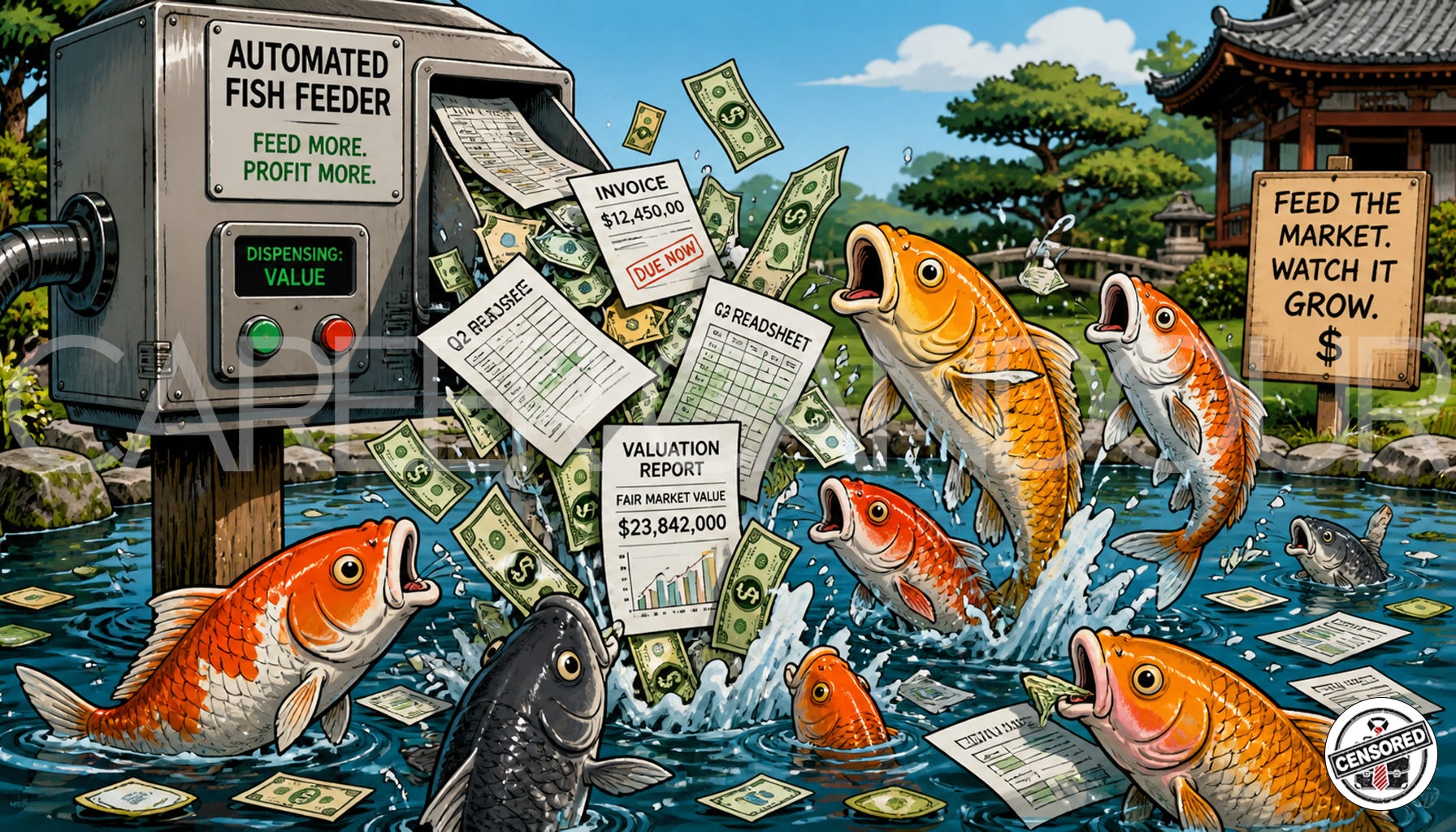
eFishery was supposed to be one of Indonesia’s great technology success stories: agritech, financial inclusion, aquaculture, farmers, data, devices, the whole morally laminated pitch deck. It was valued at more than US$1 billion, backed by names that startup founders usually whisper with the reverence of temple bells: SoftBank, Temasek, Peak XV, others. Then the floor gave way.
The company’s accounts were allegedly inflated on a staggering scale. An internal probe estimated revenue had been inflated by nearly US$600 million in the nine months through September 2024, meaning more than 75% of reported figures may have been fake. The company’s collapse has been described as a roughly US$300 million scandal that wiped out one of Southeast Asia’s brightest startup stories.
And now, former CEO and founder Gibran Huzaifah has been sentenced to nine years in prison by the Bandung District Court. He was found guilty in a case involving embezzlement, manipulation of financial reports, and money laundering, alongside two other former executives. The sentence came with a Rp1 billion fine, and was slightly lighter than the prosecution’s 10-year demand.
Nine years. For a scandal that helped kneecap Indonesian startups, embarrassed global investors, gutted employees, burned credibility, and handed every regional cynic a golden talking point.
Is nine years normal? Legally, maybe it’s not absurd. But morally, politically, and ecosystemically? The jury’s out.
From Unicorn Story to Criminal Case
eFishery began as the kind of company investors love because it sounds both futuristic and socially useful. It made automated fish-feeding devices, then expanded into a broader aquaculture platform: feed, financing, market access, digital tools, the full “we are not just a startup, we are infrastructure” play.
For years, the story worked.
Farmers were being digitised.
Feed efficiency was being improved.
Indonesia had a homegrown unicorn in a sector that was not just another venture capital backed food delivery app.
Then came the familiar sequence:
Whistleblower,
Internal investigation,
Suspension,
Collapse,
Criminal proceedings,
Courtroom,
Sentencing.
The alleged fraud was first reported in December 2024, and later Gibran was removed as CEO following an investor-led financial investigation into alleged misuse of funds.
By January 2025, a draft internal investigation by FTI Consulting estimated eFishery may have inflated revenue by almost US$600 million in the nine months through September 2024.
In April 2025, Bloomberg published the now-infamous account in which Gibran described how he had falsified results. The narrative?
Cash running low,
Spreadsheet open,
Fake numbers inserted,
Investors reassured,
Doom postponed.
By August 2025, Indonesian police had detained Gibran and two other former executives.
Then, on April 29, 2026, the Bandung District Court sentenced Gibran to nine years in prison. Indonesian outlets reported that he was convicted alongside the two other defendants, fined Rp1 billion, and given a sentence one year below the prosecution’s request.
So the public timeline is roughly this:
2018: according to Bloomberg’s account, Gibran began falsifying numbers when eFishery was under severe cash pressure.
2020–2024: some Indonesian reporting says the conduct at issue in court covered this broader period.
December 2024: investor investigation and removal from CEO role.
January 2025: the preliminary internal probe’s finds large-scale revenue inflation.
April 2025: Gibran gives his public account to Bloomberg.
August 2025: police detain Gibran and two other former executives.
April 2026: sentencing: nine years, Rp1 billion fine.
It is the sort of timeline that should be taught in business school.

What We Know About How It Worked
At the centre of the scandal is a simple question: were the numbers real?
Investigators found large-scale inflation of revenue. The alleged structure involved manipulated financial reports, fake or inflated transactions, and the appearance of business activity that did not correspond to the underlying economic reality.
Gibran admitted manipulating financial statements but denied stealing money. He also admitted to manipulating the financial statements, while denying theft.
That distinction matters legally, but from an ecosystem trust perspective it’s about as graceful as a man saying:
“Your Honour, I did burn down the house… but I did not personally keep the smoke.”
Private conversations with former employees point to a darker possibility: that there may have been awareness internally of “two sets of books,” and possibly some degree of knowledge beyond the immediate executives. That is not something one can state as fact without documents, testimony, or public record. But it is exactly the kind of question this case leaves hanging in the air.
Because when a company allegedly inflates revenue at that scale, over that period, with global investors, internal finance teams, auditors, management layers, board reporting, lender relationships, customer data, and operational dashboards, the fairy tale version becomes hard to swallow. The fairy tale version says: one founder, one laptop, one spreadsheet, one moral collapse, many highly educated, innocent adults deceived by Excel.
Possible? Yes.
Comfortable? Very.
Complete? Hmmm.
There are several unanswered questions:
Who inside the company had access to the real operating data?
Who saw discrepancies between cash, revenue, receivables, inventory, device deployment, farmer activity, and financing flows?
Who signed off on investor materials?
Who conducted diligence, and what did they actually verify?
Were red flags missed because they were hidden, or because nobody was incentivised to find them?
Did anyone outside management have enough information to suspect the story was too beautiful to be entirely biological?
The public record gives us convictions of Gibran and two former executives. It does not give us a full map of organisational knowledge. That absence is not proof of a wider conspiracy. But it is also not proof of innocence-by-omission for everyone else.
One of the most absurd modern customs is watching investors describe themselves as visionary “deep diligence” machines when things go well, and as startled woodland animals when things go badly.

The Bloomberg Apology That Made Things Worse
The Bloomberg interview became its own subplot because of how bizarrely confessional it appeared. Public excerpts and summaries describe Gibran explaining how he faked numbers under pressure, after years of trying to build the company. The framing had biography, hardship, ambition, desperation, and spiritual theatre.
The problem with founder apologies is that they often arrive dressed as morality plays.
“I came from nothing.”
“I slept on floors.”
“I wanted to help farmers.”
“I was under pressure.”
“Everyone else was growing fast.”
“I made one mistake.”
“I take responsibility.”
The PR playbook converts fraud into tragedy, tragedy into complexity, complexity into sympathy, and sympathy into reputational salvage.
But the public is not stupid. The public has seen this film. The public has also, in many cases, been under pressure without inventing hundreds of millions of dollars in revenue.
Invoking hardship or religion in proximity to a financial scandal is especially volatile in Indonesia because it can read more like moral laundering. Not money laundering. Moral laundering, where personal piety is placed in the same washing machine as corporate misconduct.
The “I did it because others were doing it” flavour of justification is even worse. That defence has a legal tradition stretching from playgrounds to prison cafeterias. “Other children were also eating glue” is not usually considered a governance framework.
To be fair, human beings are complicated. Founders under severe pressure make catastrophic decisions. Startup ecosystems worship growth, punish honesty, and reward the founders who can make a hockey-stick chart look like scripture. But sympathy for pressure is not the same as a hall pass for deception.
If anything, the apology made things worse, because it seemed to confirm the most cynical reading of startup culture: fake it until you make it, then if you do not make it, explain that faking it was actually a selfless act of wounded idealism conducted for the farmers, the employees, and the nation.

Nine Years: Enough, or Not Nearly Enough?
On one level, the sentence is not obviously outside Indonesia’s legal architecture. Gibran was convicted under provisions including Article 374 of the Criminal Code, in conjunction with participation and continuing-offence provisions, and money-laundering allegations. Article 374, embezzlement in office, carries a maximum sentence of five years under the old KUHP framework, while Indonesia’s money-laundering law can carry much heavier penalties depending on the article applied.
The prosecution reportedly asked for 10 years; the court gave nine. So this was not a wild discount.
But that is the legal answer.
Nine years for a scandal associated with hundreds of millions in investor losses and severe damage to trust in Indonesia’s startup ecosystem feels underwhelming because the harm was not only monetary. It was reputational. It told foreign investors, local founders, employees, farmers, lenders, and regulators that even a flagship company with elite backers could allegedly operate a financial theatre production at industrial scale.
That matters. Capital is cowardly. When a visible company collapses like this, the cost is borne by the next honest Indonesian founder trying to raise money and being asked:
“Yes, but how do we know this is not another eFishery?”
That is the real damage.
So is nine years “paltry”? Compared with the legal charges and the prosecutor’s demand, it may be within the expected zone. Compared with the systemic harm, less so.
The Rp1 billion fine also looks symbolically bizarre next to the scale of reported losses. A billion rupiah is serious money for a normal person. Against a scandal reported in the hundreds of millions of US dollars…
Ultimately, the deeper issue is whether the process has fully exposed the network of knowledge, incentives, negligence, and benefit around the fraud. If the answer is no, then nine years is the curtain.

Was This Really a One-Man Scandal?
The most convenient version of the scandal is that Gibran was the singular architect, beneficiary, villain, and human sacrificial offering.
He falsified the accounts.
He misled investors.
He destroyed the company.
He goes to prison.
Lessons are learned.
Governance committees are formed.
Everyone moves on.
This version gives the public a face. It gives investors closure. It gives regulators a conviction. It gives the startup ecosystem an opportunity to say:
“Bad apple. Very sad. Anyway, our next fund closes in Q3.”
But large scandals rarely happen in moral isolation.
A founder may fake numbers. But:
Boards consume numbers.
Investors reward numbers.
Later-stage investors diligence numbers.
Early investors celebrate markups based on numbers.
Lenders assess numbers.
Employees are hired because of numbers.
PR teams broadcast numbers.
If there really were two sets of books known to multiple people, as some privately claim, then the essential scandal is not just fraud.
Who knew enough to worry?
Who suspected but stayed quiet?
Who benefited from the valuation uplift?
Who had incentives not to ask the ugly question until they had transferred risk to someone else?
Again: without public evidence, names cannot and should not be thrown around. But the point stands. A justice process that stops at the most visible executive may punish the act while preserving the architecture that made the act useful.
Sophisticated investors are not passive widows in Victorian novels, fainting upon discovering that the charming man with the moustache lied about the estate. They are institutions with analysts, lawyers, forensic accountants, data rooms, board seats, and information rights.
If they were deceived, that matters. If they missed obvious signs, that matters too. If anyone knew or suspected more than they later admitted, that matters most of all.
And yet the public accountability appears off. The founder goes to prison. The investors take write-downs, issue sober statements, maybe improve diligence checklists, and continue being invited to panels about “Building Trust in Southeast Asia’s Digital Economy.”

The eFishery scandal is not just about one founder cooking the books. It is about a regional startup ecosystem that spent years rewarding growth stories so aggressively that reality became optional.
Gibran Huzaifah has now been sentenced to nine years in prison. It is not nothing. But for many observers, especially those who believe the scandal involved broader awareness, deeper incentives, and possibly people who will never see the inside of a courtroom, the sentence feels incomplete.
One founder. Two executives. Hundreds of millions in reported damage. Investors embarrassed but apparently not pursued. A public apology that tried to turn a governance disaster into a personal pilgrimage. And now, perhaps, an ending.
But it should not be an ending.
The real test for Indonesia is not whether it can jail one fallen founder. It is whether it can show founders, investors, boards, auditors, and executives that financial fiction will be met with full-spectrum consequence.
If the lesson of eFishery is simply “do not be the person left holding the spreadsheet when the music stops,” then nothing has been fixed. The ecosystem will simply become more careful about optics, more expensive in diligence, more cynical in private, and more fluent in the language of “governance enhancements.”
The scandal set Indonesia back because it made the honest people look naïve and the sceptics look correct. Restoring confidence requires showing that the law can follow the incentives, not just the individual.
Until then, eFishery remains the perfect startup morality tale: a company that promised to feed fish more efficiently, while the adults in the room somehow failed to notice that the biggest thing being fed was the valuation.
At StratEx - Indonesia Business Advisory we support companies, funds, and leadership teams with local insight, market intelligence, and strategic advice. Contact us if you're investing, scaling, or entering, or partnering in Indonesia to understand what’s really happening on the ground.