


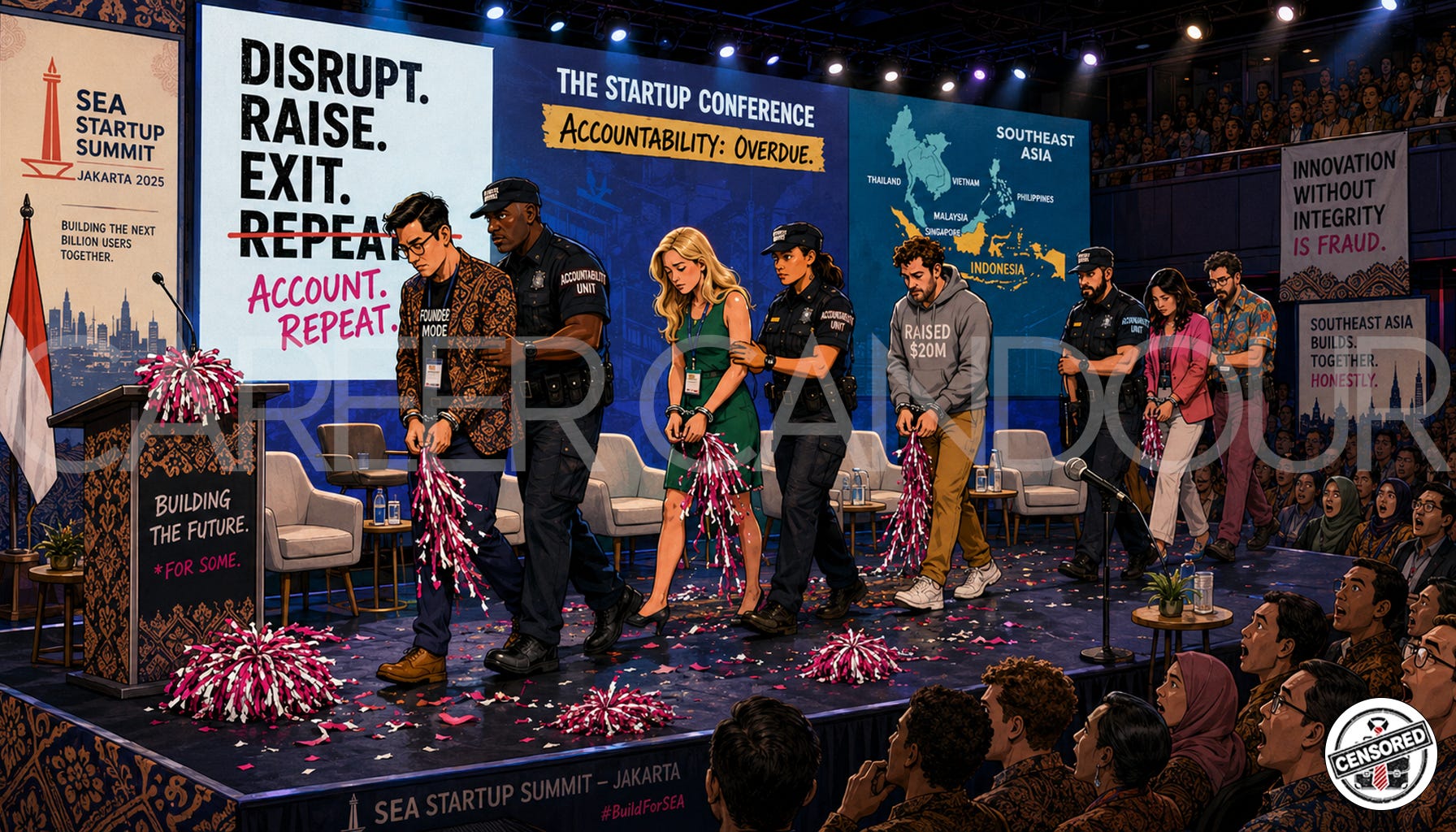
Indonesia’s startup boom is now being given a tidy ending, which should make everyone a little suspicious, because tidy endings are usually written for the comfort of people who were standing closer to the mess than they now care to remember. The story forming around the fallout points toward the most obvious disasters, then exits before the rest of the room has to explain why it spent years treating smoke as a growth strategy.
That is too easy.
The companies that became symbols of the boom were helped along by people beyond the management team, and people who knew how to make a shaky story sound like the future if they said it in front of the right investors. The industry calls this ecosystem building. A less charitable person might call it clapping near money.
Indonesia’s digital opportunity was real, and that is what made the hype so hard to challenge. The country had real problems to solve, and plenty of serious founders were trying to solve them, but the size of the market became a convenient way to avoid looking too closely at individual companies.
When a business looked fragile, someone could always point to Indonesia’s scale.
When the numbers looked uncomfortable, someone could talk about the long game.
When the whole thing started to smell a little smoky, someone would insist that this was just what disruption smells like.
That is where the cheerleaders deserve attention. They helped keep the story warm. They made doubt feel unfashionable. They did not need to sit on the board or touch the accounts to matter, because a startup market runs partly on what people think everyone else believes. If enough connected people behave as though a company has already been blessed, the blessing starts doing work of its own.
Indonesia Was the Perfect Story
Indonesia was an easy country to believe in, which is exactly why the story became so powerful. The market was large enough to make even an average pitch sound important, and the daily frustration of doing business here gave founders a ready-made seriousness before anyone had looked too closely at whether their particular company deserved it.
That matters because a country can have huge potential while individual companies inside it remain weak, badly run, or built around assumptions that collapse the moment capital becomes less generous. During the boom, too many people treated Indonesia’s promise as if it could be transferred wholesale onto whichever startup happened to be raising money that quarter. It was a lovely trick. The founder arrived with a company… and the room evaluated a country.
You could see the habit in the way funding rounds were treated as proof. Once a company raised from the right investors, the money itself began to stand in for evidence. The business did not necessarily become more convincing, but the social pressure around it changed. It is amazing how quickly a valuation can become a personality trait when enough people are staring at it lovingly.
Bukalapak’s later turn away from physical goods showed how much harder the real market was than the boom story had typically suggested. In 2025, Bukalapak stopped selling physical products on its marketplace to focus on virtual products, after tough competition from Shopee and TikTok-backed Tokopedia; they had also posted a loss in the first nine months of 2024, and shares had fallen far from their IPO-era peak. GoTo’s push toward breakeven told a similar story with cost reductions, lower incentives, and layoffs helping the company sharply reduce its adjusted EBITDA loss.
The cheerleaders were especially useful before that shift, because they helped make the boom feel more like a consensus. They spoke about Indonesia’s future in ways that made company-level doubt seem ungenerous. A founder could still be struggling with basic execution, yet the conversation around him would transcend into talk of national transformation, as if the size of the country might eventually come down from the clouds and fix retention.
In many cases it was probably more convenient, than dishonest. A person who sounded excited about Indonesia sounded sophisticated, and pleasingly bullish. A person asking whether customers would still use the product without subsidies sounded like he had wandered into the room with the wrong attitude.

The Cheerleader Class
Every boom produces a person who is hard to place but easy to find.
He is close to founders, or says he is.
He is close to investors, or appears to be.
This person became one of the more irritating fixtures of the boom years. He understood the value of being seen near a company before it became famous, and he understood the even greater value of standing just far enough away once the story went bad. His title usually did a lot of work. “Advisor” could mean deep operational involvement, or it could mean he once had coffee with the founder and has been dining out on it ever since. “Angel investor” sounded pleasant, even when the public record of angelic activity was known only to the angels.
It would be easy to treat this figure as comic decoration, and admittedly he does make that difficult to resist. But he mattered.
If he praised a founder, people noticed.
If he appeared beside a company, the company looked more connected.
If he spoke as though something was already understood by insiders, outsiders became less willing to ask why the insiders had not shown their working.
This is the strange power of proximity. It can look like judgment from a distance. During the boom, plenty of people managed to convert being near the action into a kind of borrowed authority, which is an efficient business model if one is light on achievements.
The cheerleader’s public value came from the impression that he knew something. That is why the later retreat into innocence is so unconvincing. After the crash, the same person who once seemed to have special access often becomes a harmless enthusiast who was simply supporting the ecosystem.
Public credibility should come with memory. If someone built a reputation by amplifying the last cycle, he should not be able to walk into the next one as though he has just arrived from a monastery of sober reflection. He should be asked what he promoted, what he knew, what he missed, and why anyone should treat his next wave of confidence seriously.
This is especially true for people whose careers seem to consist mainly of being early to rooms where other people are doing things. Indonesia needs more supporters of technology, and less people who confuse access with insight.

Blaming One Company Is Too Easy
The easiest way to process the fallout is to point at the most spectacular cases and let them carry the whole moral burden. It gives the public a villain and gives the ecosystem a way to say it has confronted the problem, which is always preferable to actually confronting the problem.
Public summaries of audit-related allegations in the eFishery case describe serious claims, including overstated revenue and inflated operational scale. If those allegations are borne out, they deserve the scrutiny they have received. The danger is that one dramatic scandal becomes a sedative for everyone else.
A few bad names cannot explain the whole mood of the boom.
They cannot explain why so many claims travelled so easily.
They cannot explain why questions about sustainability were delayed until after sustainability became unavoidable.
They cannot explain why people who sounded extremely informed during the rise now claim to have known surprisingly little.
During the rise, the cheerleader was near enough to imply knowledge. During the fall, he was apparently too distant to have any. Indonesian tech may have struggled with profitability, but it produced world-class evasive footwork.
There is a legal line here, and it should be respected. A person who praised a company based on public information has not necessarily done anything unlawful, and a person who believed the wrong founder may simply have been wrong. The law should not prosecute every overconfident man on LinkedIn.
The issue is public accountability. The cheerleaders traded in credibility, so credibility is the place to begin.
If they helped sell a company’s story, they can explain what they knew about it.
If they had a financial interest, they can disclose it.
If they were repeating claims they had never tested, they can admit that their confidence was thinner than advertised.
This should not be a radical standard.
The more truth is that the boom rewarded people for sounding certain. That reward structure did not disappear just because a scandal made everyone briefly serious. If nobody asks hard questions of the people who helped inflate the last story, the next story will inherit much of the same.

The Same Voices Are Already Back
The dust has barely settled, yet parts of the ecosystem are already speaking as though the previous cycle was a difficult but noble seminar, rather than a period in which a lot of people mistook sentiment for proof.
A new wave may well produce better companies. Indonesia still has serious founders building useful things, and that should be encouraged. Nobody sensible wants the country to replace hype with a permanent sulk. The problem is the return of the same public posture: the vague authority, the heavy confidence, the ability to bless whatever comes next without spending too much time explaining what went wrong before.
When someone appears to explain the next great opportunity, people should ask what he was saying during the last one. If he was loudly enthusiastic about companies that later aged badly, that history belongs in the conversation. It may not disqualify him, but a little awkwardness would do the ecosystem good.
The media should also be more careful with its hunger for confident voices. Startup coverage often treats funding as drama. The cheerleader is useful because he can speak fluently, sound connected, and provide the kind of quote that makes a fragile business feel like a national mood.
Investors should not pretend this happened around them by accident. Capital rewards heat, and people appear to manufacture it. If funds chase whatever feels hot, a whole little industry will emerge to warm the room. Complaining later about the smoke is unconvincing when you helped pay for the machine.
The better version of Indonesia’s startup future will require a lower tolerance for borrowed authority. It will require:
People to ask direct questions before the story becomes too expensive to doubt.
Founders to be supported without being turned into mascots.
The word “ecosystem” to do less laundering for people whose main contribution is appearing enthusiastic.
That may sound harsh. Good. The soft version was expensive.

Indonesia’s startup fallout should not be remembered as a neat morality tale about a handful of fallen founders. That version is too small, and it lets too many people leave the room with their reputations oddly untouched. The underlying story is about a market that became too comfortable with confidence, especially when that confidence came from people who had mastered the art of sounding close to the truth without being responsible for it.
The cheerleaders were not the only problem. Many were probably sincere. Some may have been careless rather than cynical. A few may simply have been rich, bored, and unusually available for panels. None of that erases the role they played.
So yes, they should be held accountable. In most cases, that will not mean legal accountability, and it should not. It should mean public memory. It should mean refusing to treat every returning booster as a neutral guide to the future.
Indonesia deserves better than another cycle of smoke, applause, and selective amnesia. It deserves a startup culture where ambition can survive scrutiny, where serious founders are not buried under theatre, and where the next person calling himself an ecosystem builder is asked what exactly he has built.
At StratEx - Indonesia Business Advisory provides Indonesia-focused advisory and leadership intelligence for investors that need to understand what is really moving beneath the surface. Contact us for better visibility before making your next move in Indonesia.