


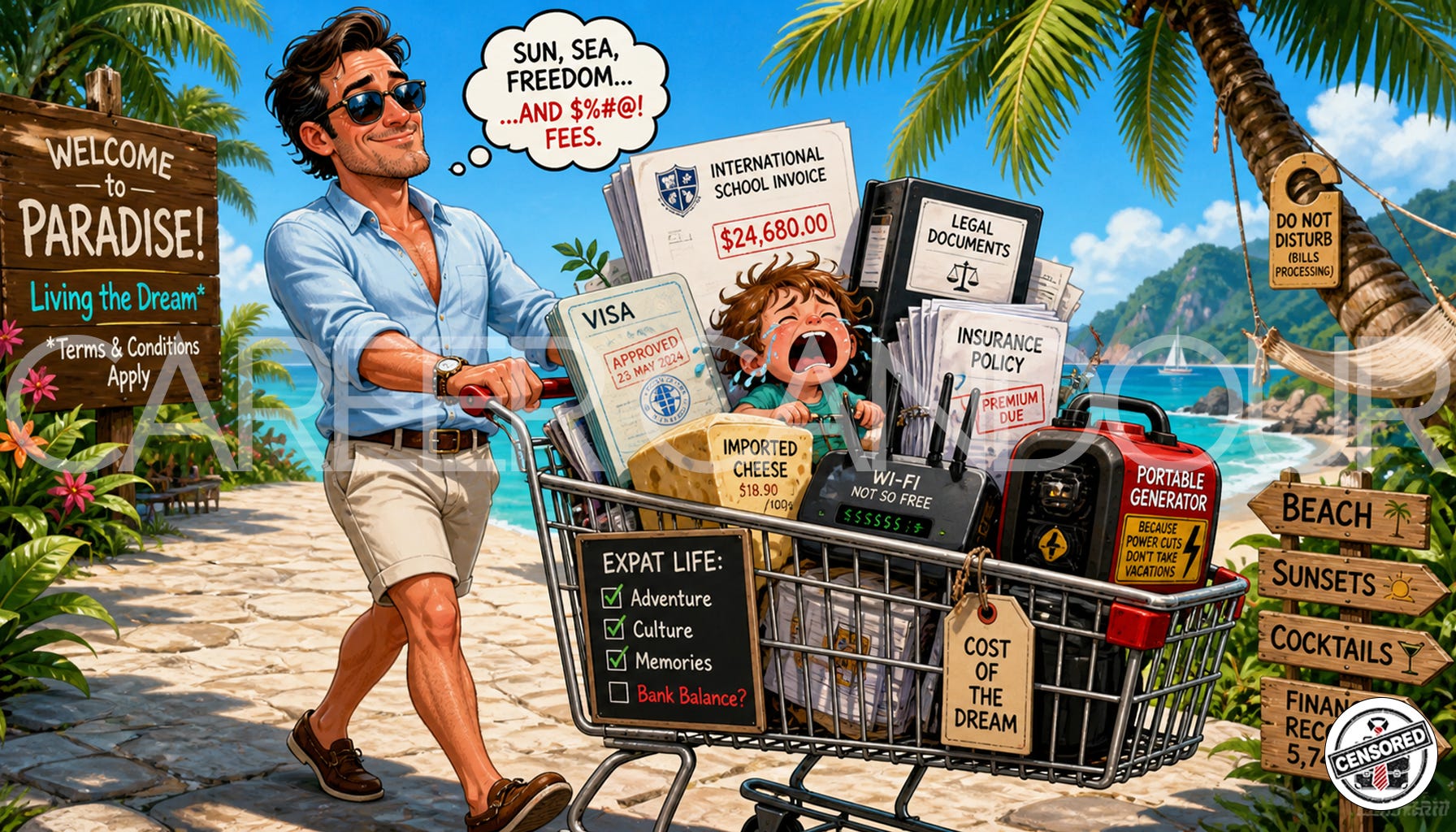
There is a particular expression that appears on the face of the newly arrived expat around month three, usually while standing in a supermarket aisle holding a small, apologetic block of cheddar priced like a controlled substance. It is the expression of a person who has just realised that the country was only cheap before he tried to live in it properly.
Before arrival, the spreadsheet had been seductive in the way all bad ideas are seductive when expressed in neat monthly columns:
Rent down,
Eating out down,
Domestic help down,
Weather up,
Tax possibly down
…and therefore, according to the mathematics of lifestyle arbitrage, happiness was now not only available but fiscally responsible.
And for a while, it works, because the early expat economy is really just the holiday economy; the coffees feel affordable, the taxis feel miraculous, the restaurant bill is reasonable, and the newcomer begins telling friends back home, that people in the West are “doing life wrong.”
Then life, sensing arrogance, enters the chat.
Not vacation life, not hotel life, not the life where a charming local solves everything because you are smiling and carrying cash, but actual life:
The dentist who is either excellent or experimental,
The school that costs more than the mortgage you fled,
The visa consultant who speaks in riddles
The bank that would like seven documents proving you exist but will not accept the six documents proving you exist,
The slow, humiliating discovery that the cheapest country in the world becomes surprisingly expensive the moment you require anything to function predictably.
The myth is not that some countries cost less than others. Of course they do. The myth is that lower prices automatically mean lower living costs, and that a foreign country exists merely as a discount version of the one you left.
Holiday Cheap Is Not Life Cheap
A tourist can declare a country cheap after three dinners, and two taxi rides, because tourism is the only financial model in which nobody has to repair a roof, negotiate a lease clause, find an orthodontist, register a vehicle, renew a residency permit, or learn why the man at the government counter is shaking his head before you have finished your sentence.
The tourist floats above the system, purchasing small pleasures at favourable exchange rates, confusing hospitality with infrastructure, and mistaking the fact that lunch cost six dollars for evidence that the whole country has been successfully audited.
The resident, unfortunately, eventually lands.
The resident learns that cheap restaurants do not make international schooling cheap, that affordable rent does not mean the landlord understands maintenance as a concept, and that a country can offer breathtaking natural beauty while still treating basic administrative continuity as an avant-garde European theory.
This is the first betrayal of the cheap-country fantasy: the prices that seduce you are often the prices attached to optional things, while the prices that discipline you are attached to the non-negotiable parts of adult life, the parts nobody photographs because “Spent Four Hours Proving My Address to a Man Behind Glass” doesn’t performs well on Instagram.
A hotel can make almost anywhere feel easy, because hotels are highly evolved machines built to conceal the country around them, absorbing the chaos so guests can continue believing that the local electricity grid is whimsical rather than unstable, and that the drinking water situation is part of the culture.
But renting a home, hiring staff, choosing insurance, opening accounts, finding doctors, understanding local obligations, and discovering which professionals are competent rather than merely confident all require direct contact with the machinery beneath the postcard..
The tourist asks, “How much is dinner?”
The resident asks, “Why is the internet off again, who is responsible for the leak, does this receipt count for tax purposes, and why has my bank account been frozen because my signature looks slightly more enthusiastic than it did last Thursday?”

The Foreigner Premium Is Real
Every expat pays tax before the tax office even notices them, and it is collected by landlords, agents, fixers, lawyers, schools, drivers, contractors, and consultants.
This is the expat tax on ignorance: the premium paid for not knowing what things should cost, who can be trusted, which rules matter, which rules are theatre, which documents are essential, which promises are ornamental, and which smiling person has just identified you as a temporary economic opportunity.
It is not always malicious, which is part of what makes it so irritating.
Sometimes the surcharge comes from perfectly ordinary market asymmetry, because the newcomer needs something urgently, speaks badly, understands little, wants reassurance, and has already told everyone within a twelve-mile radius that he has moved abroad for a “simpler life,” which is local dialect for “please attach the foreigner margin.”
The expat may:
Pay too much rent because the apartment has the right lighting and he has confused exposed concrete with authenticity;
Hire the wrong adviser because the adviser has a website in English;
Choose the expensive school because other anxious parents are there.
Nobody likes to admit this because it interferes with the self-image of the globally mobile person, who prefers to imagine himself as bold, strategic, and worldly, rather than as a man who just paid double for a sofa because he did not know the delivery guy was also the salesman’s cousin.
The expat tax is not paid only in money either.
It is paid in time, in embarrassment, in avoidable mistakes, in badly translated contracts, and in waiting rooms.
The more sophisticated the expat, the more elaborate the denial can become.
They will say they are:
“Building local relationships” when they are being politely rinsed,
“Moving fast” when they are skipping due diligence, and
“Embracing the culture” when they are accepting operational chaos because challenging it would require admitting they do not yet know how anything works.
That is the real commercial danger of the cheap-country myth: it flatters the outsider into thinking low prices equal easy decisions, when in low-information decisions are often the most expensive purchases available.

Cheap Can Still Be Hard Work
Some countries do not take your money all at once; they take it in mood, momentum, and tiny daily humiliations, which is far more corrosive when you are trying to run a business, raise children, remain married, or simply complete one administrative task before the sun gives up.
This is the part nobody prices correctly: friction.
A low-cost country can still be expensive if every basic process requires a fixer, a follow-up, a stamped copy, a second visit, an introduction, a translation, a mysterious fee, a calmer spouse, and the emotional resilience of a hostage negotiator.
The rent may be lower, but if the power cuts during client calls, the air conditioning develops a moral objection to August, and the internet provider responds to outages with the serenity of an organisation that has already been paid, then the true cost of the place has started billing you through your productivity.
Friction is not dramatic enough to scare people at first.
It arrives as a delay, then a workaround, then a person you must call, then another fee, then an informal process everyone claims is normal, then a dependence on people who understand the system better than you do and may or may not benefit from keeping it that way.
The newly arrived expat, having read three articles about “escaping the rat race,” often fails to notice that he has not escaped the rat race at all; he has merely joined a slower rat race.
And because the visible costs remain lower, he continues to believe he is winning, even as his days become increasingly consumed by solving problems that did not exist in the expensive country he left, which is, admittedly, an awkward detail for the personal brand.
The truly expensive thing about friction is that it forces your life to become more managerial.
You manage the house, the paperwork, the staff, the renewals, the translations, the insurance exclusions, the school communications, the bank moods, the tax questions, and the thousand little gaps between how things are advertised and how they actually behave once you have paid.
A country can be low-cost and still quietly turn you into the unpaid operations director of your own survival.

The Cost Is in Making It Work
The serious expat eventually learns that affordability is not what something costs on the day you buy it, but what it costs to make the entire life around it work without becoming permanently hostage to surprise, improvisation, and people who keep saying “usually no problem” in a tone that suggests there is already a problem.
A cheap apartment is not cheap if it requires a car, a generator, a lawyer, and a school commute long enough to change a child’s personality.
A cheap country is not cheap if every year requires professional intervention to remain legal, every banking relationship feels provisional, and every trip home costs enough to remind you that distance is a recurring charge.
Affordability has to include the boring things, which is why people avoid doing it properly.
It has to include the cost of uncertainty, the cost of replacing convenience, the cost of maintaining standards, the cost of flying out when something goes wrong, the cost of buying imported familiarity because your brave new life apparently still requires the exact cereal your children recognise, and the cost of discovering that “local price” is a phrase most easily accessed by people who are, inconveniently, local.
The commercial question is not whether a country is cheap.
The commercial question is whether the system you need to live, work, protect your family, stay compliant, access healthcare, educate children, manage money, preserve sanity, and leave cleanly if necessary can be built there at a total cost that still makes sense once the romance has been removed.
That is a less sexy calculation, which is why it is useful.
The best expats do not simply compare rent between two cities and declare themselves financially reborn; they examine the full operating environment of a life and ask what must be bought, rented, insured, outsourced, tolerated, translated, duplicated, or forgiven in order for the move to function.
This is the point where the cheap-country conversation becomes more adult, and therefore less popular at dinner.
Because once you price the whole system, the bargain may still be real, but it becomes a more complicated bargain, one that requires discipline, planning, and enough humility to accept that the locals are not extras in your cost-of-living fantasy.

The cheap-country myth survives because it contains just enough truth to be dangerous.
Yes, the rent may be lower.
Yes, the dinner may be cheaper.
Yes, the daily pleasures may feel absurdly accessible compared with the country you left behind.
But life abroad is not purchased one dinner at a time.
It is purchased through systems, through competence, through reliability, through legal standing, through family stability, through the ability to get things done without needing a local priest, a cousin, a stamp, and three separate WhatsApp confirmations from men who all use the same profile photo.
The smart expat does not sneer at cheap places, nor does he worship them.
He respects them enough to stop treating them as discount versions of somewhere else, and he respects his own money enough to calculate the full cost of converting a beautiful place into a workable life.
The expensive mistake is not moving to a cheaper country.
The expensive mistake is believing the country became cheap because you stopped counting.
At StratEx - Indonesia Business Advisory we support employers, founders, and expat professionals with practical HR and Indonesia market advice. Contact us to understand the wider people, compliance, and commercial realities of building a life or workforce in Indonesia.