


If you’ve spent any meaningful time near the recruitment industry in Indonesia, or even just made the mistake of replying to a recruiter’s LinkedIn message, you’ll know the sensation. It’s somewhere between déjà vu and a low-level migraine.
Here, the industry doesn’t evolve. It improvises. Every week (or fortnight), a new half-baked idea, dressed up as a breakthrough, lands. Another agency trying to play at legitimacy while still sending CVs with formatting that would get you fired in Singapore.
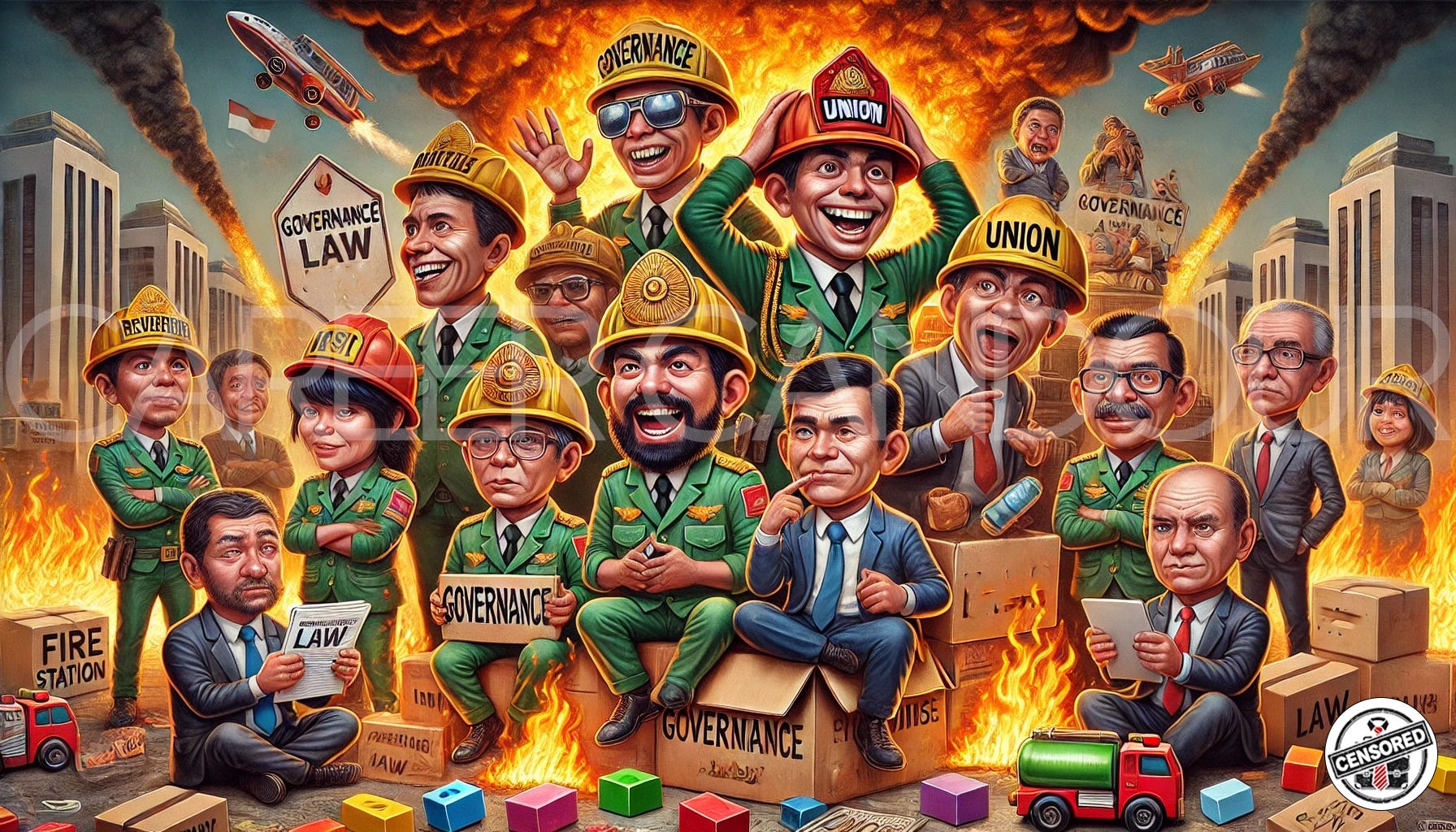
This week’s episode: the formation of a “recruitment union”. A new council of inbox-challenged agencies who believe they’re ready to govern, standardize, and possibly even regulate. Which is charming, in the same way that a drunk guy on a motorbike deciding to direct traffic is charming.
They’re talking price alignment. “Industry unity.” Client protection. It all sounds nice until you remember that price-fixing is a crime, not a community activity.
Why the Recruitment Sector Became a Refuge for the Professionally Homeless
To understand the dysfunction of Indonesia’s recruitment sector, you have to start with the talent pipeline.
In functioning labour markets like London, New York or Hong Kong, agency recruitment is a real job. A competitive craft. It attracts hungry, fast-thinking people with high commercial instincts and enough charm to sell water in a flood. They’re drawn by real commissions, clear accountability, and the thrill of closing complex roles in sectors that keep the economy humming.
Now consider Indonesia. Recruitment here is rarely an intentional career choice. You don’t aim for it. You fall into it. Maybe you didn’t make the cut at Unilever. Maybe your friend’s sister’s boyfriend said his office was hiring. Suddenly, you’re a recruiter.
The qualification bar is subterranean. If you can open a laptop, write a few vague messages, and mispronounce the word “headhunter,” you’re in.
Passion for people? Optional.
Knowledge of industries? Not required.
Proofreading? Let’s not get crazy.
This creates an industry that not only fails to attract great people, but actively selects for mediocrity. The system trains low standards into muscle memory. By the time someone figures out how to actually do the job well, they’re either too burnt out to care or long gone.
So is it any wonder this is the same group now trying to form a national governing body?
An industry that struggles to manage job descriptions wants to manage itself. That’s comedy. But unfortunately, it’s exactly what we’ve come to expect.

Association or Cartel? (And They Don’t Know the Difference Either)
On paper, a professional association can be a good thing. Structure, training, ethics. Accountability, even. That’s how they sell it. It’s very LinkedIn. But look beneath the PR veneer and you’ll find the real agenda hiding just beneath the surface: fee coordination. The kind of thing that gets competition regulators out of bed in the morning.
Forget capability building, or market education, or anything that would require actual work. The first order of business is to “set standard fees.” It’s a group therapy session for agencies afraid of being undercut.
There is, naturally, zero awareness that this is textbook cartel behaviour. Ask them about anti-monopoly laws and they’ll blink slowly, like you’ve just asked them to explain particle physics. Mention the Hays price-fixing case in the UK and watch eyes glaze over. Some of these people still struggle to format a CV. Legal nuance is not their strong suit.
And yet, emboldened by ignorance, they march on, dreaming of governance, authority, and a nice committee photo. They’ve reinvented a cartel without the secrecy or subtlety, swapping boardroom smoke for WhatsApp voice notes.
Meanwhile, back in reality, Indonesia has a long list of high-profile price-fixing cases. Airlines, garlic, beef, motorcycles, SMS… all busted. But don’t worry. Surely the regulators won’t mind if a few mid-tier recruiters dabble in “standardised margins.” You know… just for fun.

When Mediocre People Try to Do Governance, You Get Comedy
A credible industry body needs a few basic things:
Legal competence,
Structural discipline,
An understanding of how markets actually work,
Leaders who know the difference between a best practice and something they just made up five minutes ago.
Unfortunately, none of those qualities appear to be prerequisites for recruitment leadership in Indonesia. Here:
A “senior consultant” is anyone who’s managed to last past their probation.
If they’ve filled two roles and can say “solutioning” with a straight face, they’re qualified to run a webinar. The bar is low enough to trip over.
Meanwhile, “ethics” tends to mean not doing anything that will go viral for the wrong reasons,
“Client advisory” is more about maintaining a fragile relationship than offering any inconvenient truths.
So when this same cohort announces they’re forming an association, complete with governance charters, “national standards,” and possibly some sort of logo, the result isn’t progress.
These are the same firms that
Can’t write a proper job ad,
Can’t find mid-level talent within a three-month timeline,
Still send candidates for roles they haven’t actually been briefed on.
Now they want to define industry ethics and pricing principles?
This isn’t a step toward professionalisation. It’s an organised liability. A collection of half-informed voices trying to regulate an industry they’ve never truly mastered.
And when the legal heat eventually comes, they’ll say they “were just trying to improve the industry.”

A Broken Market Rewards Broken Behaviours
The madness didn’t fall from the sky. It’s a direct consequence of a broken ecosystem; one that consistently rewards the wrong things and punishes competence.
Indonesia’s recruitment sector operates in a market where almost no stakeholder plays their part properly.
Clients often don’t understand how to evaluate recruitment as a service. They treat it like ordering food: fast, cheap, and easily replaceable.
Agencies, in turn, can’t (or won’t) build real differentiation, so they sell speed, volume, and vague promises.
Talent doesn’t know what good looks like.
Most recruiters have never been trained.
Procurement sees fee percentage and stops reading.
In that kind of market, bad behaviour is the business model.
So what do we get?
Spray-and-pray CV sending.
No exclusivity.
“Whoever sends the profile first gets the credit.”
Five agencies working the same role, none of them briefed properly.
Candidates treated like tokens.
Recruiters promoted after three placements and suddenly writing LinkedIn posts about “leadership mindset.”
And in that environment, what do the agencies decide? That the fix is not to improve capability, invest in process, or educate clients. No. The plan is to freeze pricing like it’s 1984 and hope nobody asks questions.
So instead of building value, they try to restrict price. Instead of improving delivery, they try to eliminate competition.
Clients aren’t fooled.
Candidates gain nothing.
Regulators, if they care to notice, could shut it all down by lunchtime.
The only people who benefit are a handful of middle-tier agency heads who love sitting on panels and handing each other imaginary awards.
So here we are. An industry where basic logic routinely takes sick leave, legal awareness is treated as optional reading, and governance is something people play at on LinkedIn.
Indonesia’s recruitment sector continues to astound. Not with excellence, or growth, or even competence, but with its boundless creativity in finding new ways to derail itself. Just when you think they’ve exhausted the catalogue of ridiculousness, a new initiative appears. A union. A task force. A “movement.” Another set of half-written “standards” drafted by people who have never read the regulations they’re planning to violate.
And somehow, every time, it’s framed as “professionalisation.” As if forming committees with no mandate, pricing guidelines with no legality, and titles with no substance is the road to legitimacy. It isn’t.
Still, it’s hard to look away. There’s something hypnotic about watching an industry trip over the same rake, again and again, only to announce it has formed a “Rake Safety Committee.”
Recruitment in Indonesia is less a functioning market and more an ongoing case study in what happens when no one is in charge… but everyone wants to be.
At StratEx - Indonesia Business Advisory we help clients cut through the noise with retained search built on discipline and credibility. Contact us to bring executive-level thinking, assessment, and advisory to every engagement.