


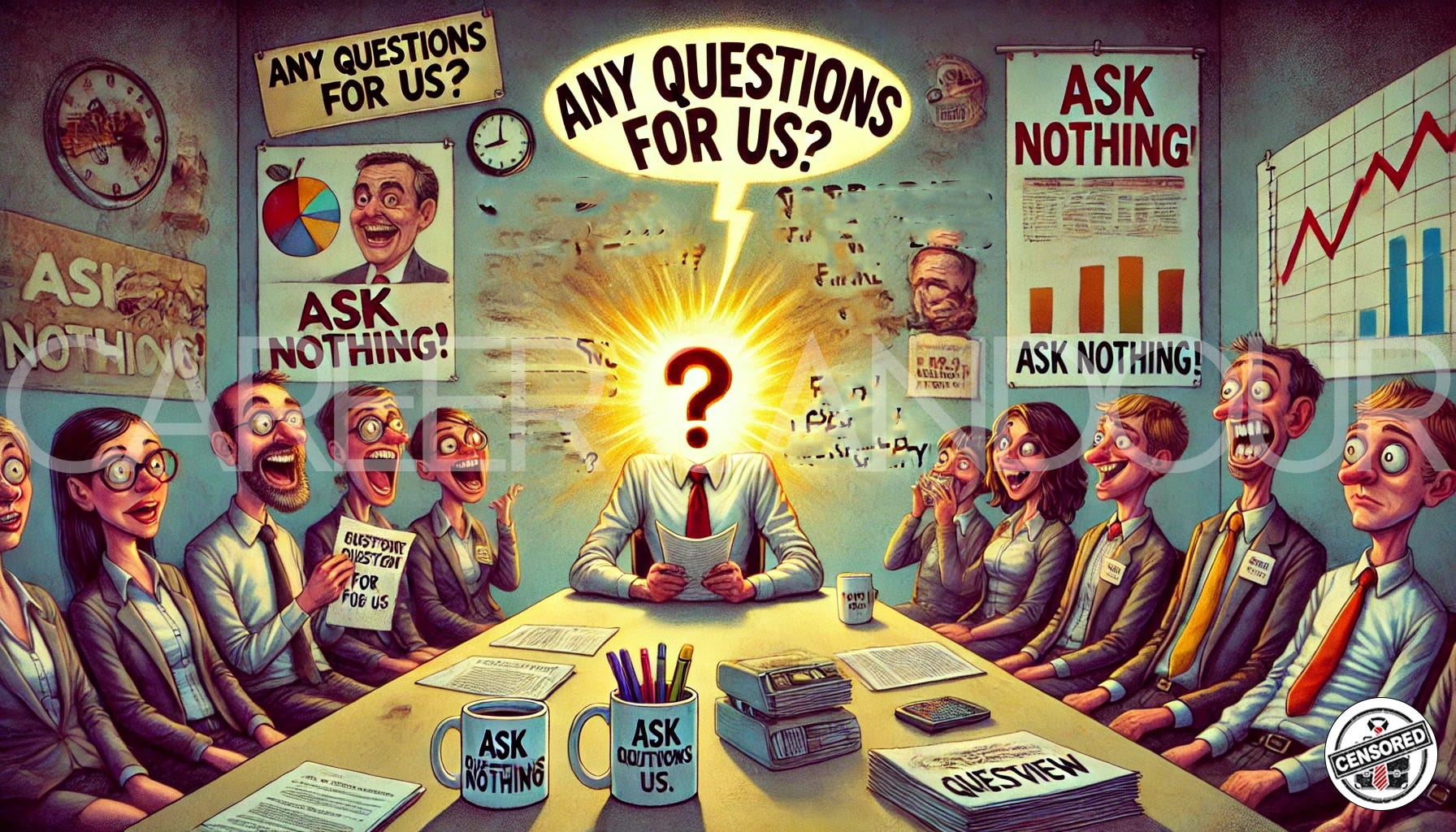
Interviewing is not a skill humans practice regularly, and yet we treat it as though it is.
Most people interview roughly three times per decade, assuming their company does not suddenly implode, restructure, or “embrace rightsizing.” Despite this, candidates are expected to perform flawlessly, narrating their career with confidence, clarity, and emotional restraint.
Across the table sit your interviewers, well-meaning representatives of Corporate Humanity, who often cannot clearly explain what the job actually involves. The job description was written years ago, edited by several people who no longer work there, and approved by Legal after removing anything too specific in case someone sues.
And then, just when you think the ordeal is nearly over, the interviewer smiles warmly and says:
“So… do you have any questions for us?”
At this exact moment, your brain, having spent 45 minutes describing your skills and achievements, suddenly forgets what a question even is.
But there is a way out.
There exists one question, simple and disarmingly reasonable, that cuts through the theater entirely:
“What does success look like in this role in the first 3, 6, or 12 months?”
So today, we’re doing a full, borderline academic breakdown of why this question works, why companies never answer it until you force them to, and what other questions you should keep in your arsenal so you never again end an interview with:
“Uh… no, I think you covered everything.”
The Golden Question and Why It Works
So why is “What does success look like in the first 3, 6, or 12 months?” the undisputed king of post-interview questions?
1. It forces the company to remember that jobs have outcomes.
This is an audacious move. You are asking what the job is actually meant to produce. Most job descriptions prefer to discuss “key responsibilities,” which always include:
“Collaborating with stakeholders,”
“Driving alignment,”
“Managing priorities,” and
“Being passionate about innovation or whatever our CEO just discovered on LinkedIn.”
But ask them what success looks like, and suddenly they must produce an actual deliverable.
A measurable one.
Something resembling reality.
This is not just common sense. Decades of research in organizational psychology show that specific, time-bound goals improve performance far more than vague encouragements to “do your best.”
Which means asking this question makes you appear:
smart,
strategic,
motivated,
and suspiciously well-adjusted.
2. The interviewer probably has not thought about this either.
Their answer will reveal one of three things:
A clear, thoughtful roadmap
→ Great, you’ve found a functional team.An answer that sounds like they’re discovering the role as they speak
→ Proceed with caution.Panic behind the eyes
→ You may be the fourth person they’ve hired into this role in two years.
This question isn’t just for them. You are gathering intelligence.
It’s reconnaissance.
3. It shows confidence without desperation.
Most candidates sound like they are asking for permission to be there. This question does the opposite. It assumes the possibility of success without presuming the outcome. You are not asking if you will get the job. You are asking what winning looks like.
Hiring managers adore this.
It is the polite corporate equivalent of saying:
“If you hire me, I’ll actually do the job instead of warming a chair.”

Asking About What Gets in the Way
After they describe their shiny, idealized vision of success, you ask:
“What tends to get in the way of people achieving that?”
This is where the real data comes out. The stuff they didn’t put in the job description, because apparently honesty lowers applicant volume.
1. It forces the confession of inconvenient truths.
This question has an almost magical ability to surface the things everyone knows but nobody writes down.
Bureaucracy.
Politics.
Chronic under-resourcing.
Competing priorities.
Teams that are technically aligned but emotionally hostile.
Timelines that exist only because someone promised them in a meeting they do not attend anymore.
Sometimes you will hear about systems that cannot be changed, stakeholders who cannot be ignored, or dependencies that are always “almost ready.” Sometimes you will hear nothing explicit, but the hesitation alone tells you what you need to know.
Companies love to advertise their “fast-paced environment,” which is usually code for the absence of process combined with a strong belief in optimism.
But obstacles? That’s the real story.
2. It demonstrates risk literacy, which reads as maturity.
Smart candidates think about obstacles.
Smart hires reduce them.
Interviewers recognize this instantly.
Research on interview validity consistently shows that job-related, situational questions are far better predictors of performance than unstructured, conversational interviews. When you ask about obstacles, you are, in essence, forcing them into a structured interview whether they meant to or not.
3. It creates a natural opening for competence.
Once an obstacle is named, you are invited to respond. You say something like:
“Interesting. I’ve actually worked through something similar in my last role by…”
And suddenly you are not a candidate. You’re
A consultant.
A strategist.
A problem-solver.
A future colleague.
If interviewers could legally hire you on the spot, they probably would.

A Few Other Questions Worth Asking
While the Golden Question does most of the heavy lifting, you should always have a couple more elegant tools in the toolbelt.
Not ten. Not eighteen. Just a couple..
1. “What do your strongest performers here typically do differently?”
Translation:
“What’s the cheat code to being excellent in this environment?”
Listen carefully to the answer. Are top performers described as:
Collaborative or independent.
Fast or meticulous.
Loud or quietly effective.
The words they choose expose cultural norms. You are learning how the organization really works, not how it describes itself.
2. “How does this team define progress when goals are uncertain or changing?”
This is especially powerful in tech, startups, government, or anywhere a meeting could have been an email.
Strong answers reference communication, alignment, and decision-making. Weak answers drift toward effort, responsiveness, or working longer hours.
3. “If I were to join, what would my biggest challenge be in the first 90 days?”
An absolute classic.
It gives the interviewer permission to be honest while giving you insight into the learning curve. If the challenge matches something you’ve handled before, you can say so without forcing it.
4. “What does your team wish leadership understood better?”
This question should be used with care.
If they answer candidly, fantastic.
If they dodge, well… that’s also fantastic, because now you know exactly what you’d be walking into.
These questions reposition you. You are no longer just being assessed. You are assessing. The interviewer will feel that shift, even if they cannot articulate why.

How Interviews Actually Work
To understand why these questions are so effective, you have to zoom out and acknowledge a slightly awkward reality: the modern job interview is a loosely choreographed performance in which everyone is improvising and pretending this is fine.
1. Everyone is bluffing.
Candidates pretend to know everything about the job.
Interviewers pretend to know everything about people.
HR pretends the process is neutral, standardized, and fair.
None of these things are true.. It is simply how the system has evolved. But it does mean that much of what happens in interviews is performative rather than diagnostic.
2. Job descriptions are often fiction.
Research on job–person fit shows that misalignment between expectations and reality causes early turnover.
But do companies fix job descriptions?
Of course not!
They do what they do best:
copy-paste last year’s description and hope nobody notices.
3. Most interviews are unstructured.
Meta-analyses show (and this is real) that:
Structured interviews predict job performance far more reliably
Unstructured interviews largely predict whether the interviewer thinks you’re “cool”
When you ask success-focused questions, you are forcibly injecting structure, accountability, and actual job relevance into a process that is often powered by soft skills, small talk, and the hiring manager’s mood that day.
4. These questions change how you are perceived.
Managers don’t hire candidates.
Managers hire future coworkers they trust not to make their lives harder.
Asking high-caliber, strategic questions immediately slots you into the category of:
“Oh thank God, someone who actually gets it.”
Which is half the battle.
If you take nothing else from this article, nothing about organizational psychology, impression management, or the absurdity of modern hiring, take this one habit with you:
Always, always, ALWAYS ask:
“What does success look like in this role in the first 3 / 6 / 12 months?”
This question is universal, disarming, clarifying, and relentlessly practical. It is almost never answered proactively during the interview process, which is precisely why it matters.
The question strikes the perfect balance:
Confident without arrogance.
Curious without being needy.
Smart without showing off
Strategic without sounding like a LinkedIn influencer
And since interviewing is a skill most people practice infrequently and under stress, you want a question you can rely on even when your cognitive abilities have temporarily left the building.
So use the Golden Question. Use the follow-up. Use a small handful of supporting questions if you have time. But most importantly, use the interview to figure out whether you actually want the job, not just whether they want you.
At Career Candour we work 1:1 with professionals to rehearse high-impact questions, and pressure-test responses. No tricks. No shortcuts. Doesn’t matter how good you are if interviews aren’t converting. Want support that treats this seriously? DM us.