


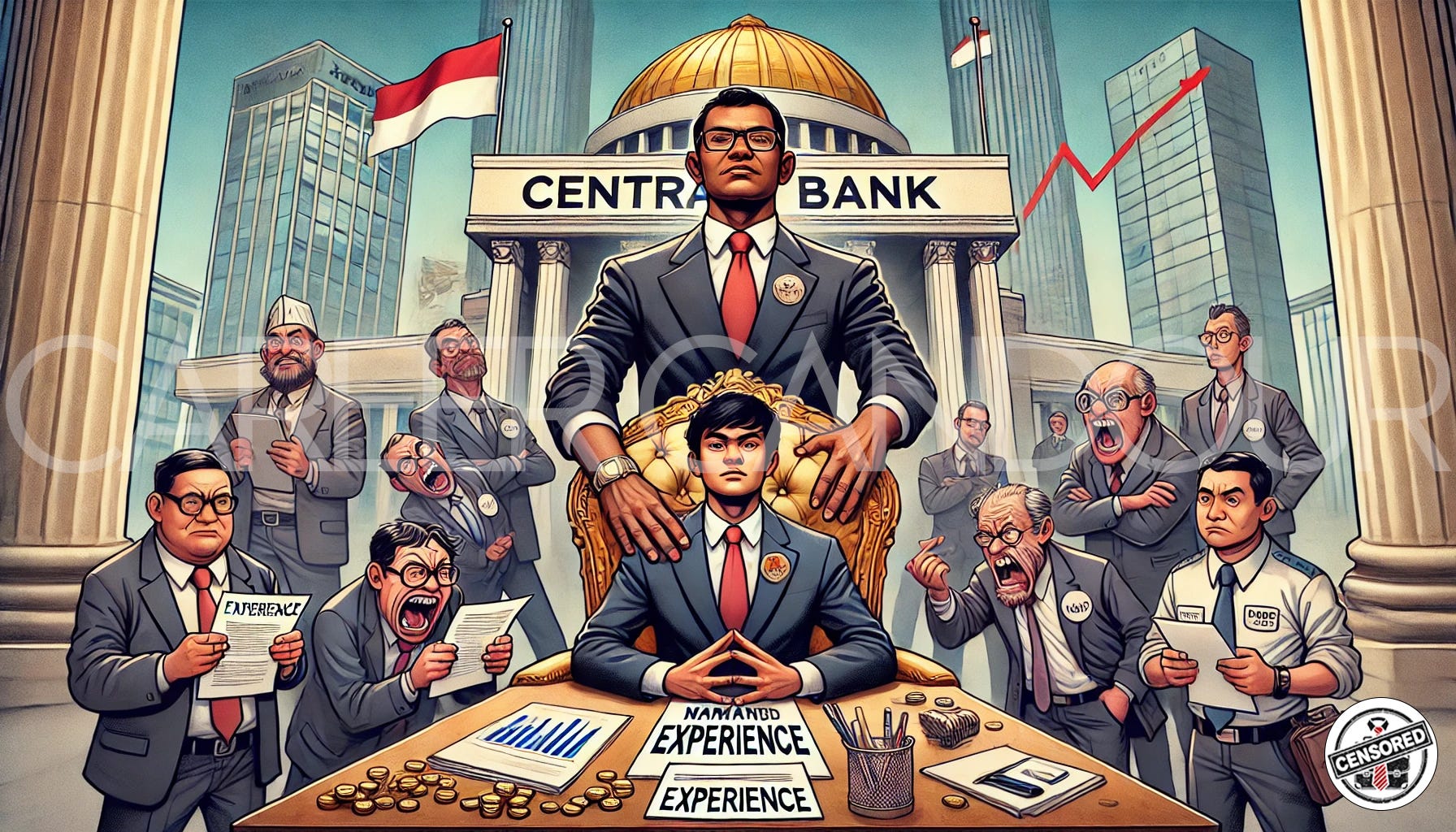
Big news out of Indonesia last week: nepotism has occurred.
Pause for shock.
Let it sink in.
Take a breath.
Yes, the President’s nephew has been appointed Deputy Governor of Bank Indonesia, one of the most sensitive economic institutions in the country. Yes, this role sits right at the intersection of monetary policy, currency stability, inflation expectations, and investor confidence. And yes, the appointee has publicly acknowledged that he does not, in fact, have experience in monetary policy.
But please. Relax.
He says it’s fine.
And really, isn’t that what matters now?
So let’s not overreact.
Nepotism in Indonesia? Shocking.
A politically connected appointee parachuted into a technocratic institution? Unheard of.
A senior official saying, “Yes, I lack experience, but don’t worry, I can do it”? Colour me surprised.
And yet people are upset.
Markets twitched.
Commentators clutched their CVs like security blankets.
LinkedIn philosophers emerged to remind us that experience matters.
Which is fascinating, because last week many of these same people were arguing the exact opposite… for themselves.
No Experience. No Problem
One of the more endearing moments in this whole saga was the honesty.
No awkward deflection.
No tortured word salad.
No consulting-grade paragraph that uses twelve words to avoid saying anything at all.
Just a clean, almost refreshing admission:
“I don’t have experience in monetary policy. But that’s okay.”
And honestly? Points for transparency.
Now, to be fair, nobody is suggesting the Deputy Governor personally sets interest rates while blindfolded.
Central banks are collective institutions.
Committees exist.
Models hum quietly in the background.
There are many clever people in the room who actually know where the levers are.
But that’s not really the point.
The point is that monetary policy is one of those fields where “I’ll figure it out” has never been listed under required qualifications. It’s arcane, technical, path dependent, and brutally sensitive to credibility. One badly phrased sentence can move billions. One misread signal can weaken a currency. This is not an internship.
Which is why, historically, these jobs go to people who have… done monetary policy.
But times change! We are modern now. We disrupt things. We value transferable skills.
And besides, he is not just any generalist. He is a former Deputy Finance Minister. Fiscal policy. Close enough, right? Different discipline, same neighborhood. Like cardiology and plumbing. Both involve pressure. Both use pipes.
So when he says, “Relax,” what he really means is, “Trust the system.”
Which, naturally, is exactly when people stop trusting the system.

Nothing New Here
Let’s dispense with the fake outrage early.
Yes, this is nepotism.
Yes, it looks bad.
Yes, it undermines the optics of institutional independence.
And no, this is not exactly new.
Indonesia did not wake up yesterday and suddenly discover family networks. Patronage, loyalty, proximity to power, these are not scandals in the local political ecosystem. They are infrastructure. They are how things move. Treating this like a shocking aberration is a bit like visiting Rome and being stunned to find pasta on the menu.
Anyone acting genuinely surprised has either just arrived in Southeast Asia or has been misreading history..
What is actually interesting is not that nepotism happened. It is where it happened.
Central banks occupy a strange, semi-sacred space in modern states. They are meant to be boring. Grey. Predictable. Their leaders are supposed to look like they iron their socks. Charisma is suspicious. Drama is disqualifying. If anyone inside the building becomes famous, something has already gone wrong.
Their legitimacy comes from credibility. From the quiet belief that the people inside the room are obsessively competent and faintly allergic to politics.
So when you place the President’s nephew inside that space, you are sending a signal.
The signal is not, “We are about to destroy the currency.”
It is more subtle. It is, “We are comfortable blurring the line between politics and technocracy.”
Markets are exquisitely sensitive to that blur. They price it instantly. They do not need catastrophe. They just need doubt.

When CVs Suddenly Matter
Watching the public reaction to this appointment is like watching a mass outbreak of selective memory. Not amnesia exactly. More like convenient editing.
Suddenly, everyone is very serious about CVs.
Suddenly, people are asking tough questions with the tone of seasoned board members:
Has he done this job before?
Has he operated in a comparable environment?
Does his background actually align with the role?
All excellent questions. Gold standard executive search questions, in fact.
Which is funny.
Because somewhere, right now, one of the people angrily typing those questions is also drafting a message that begins:
“I know my CV doesn’t show a direct fit, but I truly believe I can do this role.”
Ah.
There it is. The duality of man. The philosophical gymnastics routine we all perform without warming up.
So which is it?
Are we a society that believes in stretch opportunities, potential over pedigree, learning on the job, and “just needing someone to give you a chance”?
Or are we a society that believes experience matters, context matters, track record matters, and certain roles are simply too important to experiment with?
You cannot hold both positions at once. At least not honestly.
Yet we try. Constantly.
When I am the candidate, I want grace, imagination, and vision from decision-makers.
When someone else gets the job, especially a politically connected someone else, I suddenly want rigor, conservatism, and strict adherence to the spec.
It is not hypocrisy exactly. It is self-interest with a short memory.

The Part Nobody Wants to Admit
Many people can do jobs they have never done before.
This is not motivational poster nonsense. It is just reality.
Human beings are adaptable.
Intelligence transfers.
People learn fast when rent is due.
Career leaps happen all the time and sometimes they work brilliantly. The first time anyone became a CEO or a minister or a central banker, technically, they had never done it before. At some point, everyone is a stretch.
So the candidates pleading for a chance are not delusional. They might actually succeed.
But systems exist precisely because we cannot afford to run entire institutions on “might.”
In executive search, boards often default to proven patterns because they are accountable. If they miss:
Shareholders ask questions.
Journalists ask questions.
Someone loses their job.
A bad hire costs money, credibility, and sometimes careers.
Now scale that logic up.
In a central bank, the cost of being wrong is not a quarterly earnings miss or an awkward board memo. It is:
Inflation.
Currency weakness.
Capital flight.
Loss of trust.
Pain that spreads quietly and unevenly through millions of households.
It is the kind of mistake that shows up in grocery bills and mortgage rates.
So when people say, “You can’t just hire someone because they say they can do it,” they are right in this context.
And when candidates say, “I haven’t done this exact role but I can grow into it,” they are also right in other contexts.
The problem is not inconsistency. The problem is pretending these contexts are interchangeable.
They are not. One is a career bet. The other is a national one.
So where does that leave us?
With a central bank appointment that many find
unsurprising,
mildly worrying,
symbolically important,
…and defended with a level of casual confidence that does not exactly scream “institutional humility.”
And with a public conversation that is:
loudly principled,
quietly self-interested,
deeply allergic to introspection.
Everyone suddenly becomes a governance purist when it is someone else’s job on the line.
Experience matters.
Track record matters.
Context matters.
We demand evidence, precedent, proof.
We speak like risk committees.
Then Monday morning rolls around and we are back to emailing recruiters saying, “I know I haven’t done this before, but I’m sure I can figure it out.”
Maybe the real lesson here is not about nepotism or monetary policy or even Indonesia.
Maybe it is about the stories we tell ourselves to stay comfortable.
We want potential for ourselves and proof for everyone else. We want a chance when we are stretching and certainty when we are watching. Grace upward. Rigor outward.
So the next time you feel outraged at “Relax, I can do it,” ask yourself one question.
Would you say the same thing in their seat?
If yes, own it.
If no, own that too.
Just stop switching philosophies mid-sentence.
Pick a side, Mr Candidate. What’s it going to be?
At StratEx - Indonesia Business Advisory we work with leaders across Indonesia to design search and succession processes that prioritise credibility. Contact us to reduce risk where it matters most: the top of the house.